

Motivational Marketing
Segment your audience for better marketing results
By Andrea Hill
I learned something in an early management job that I have applied to nearly everything I’ve done since. I was responsible for managing a team of artists and writers at an advertising agency, and it was immediately apparent that their favorite things to do were to criticize everyone else’s ideas and argue with direction. I was tearing my hair out. My manager suggested that I just observe for a week or two, and figure out what motivated each of the team members. That’s how I learned that it’s very difficult to motivate a group as a group, but not so hard to motivate them individually.
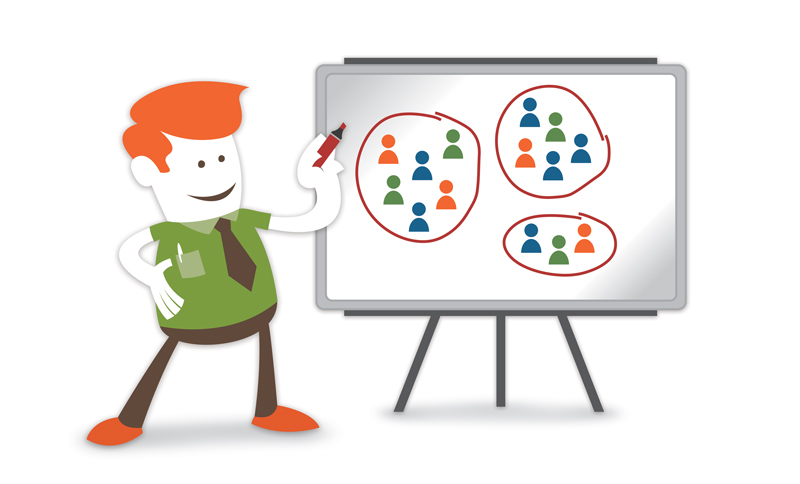
Marketing is just another word for motivation, and, as shown with my challenging team of creatives, it’s difficult to motivate an entire group of customers or prospects in the same way. The same principles apply as with managing: Observe the behavior of the group and find out how to motivate the individuals. If your customer base consists of 50 stores, you can even do this in an almost one-to-one manner. But if your customer base consists of 250 or 1,000 stores or customers, you will need to work with segments.
Customer segmentation is the practice of dividing a group of customers into sub-groups based on similar demographics or behavior. By segmenting your customer list, you gain insight into different ways of marketing to them, and your marketing efforts become more efficient and effective.
Demographic Segmentation
You’ve probably had some experience with demographic segmentation. For example, if you’ve ever broken your list down into regions so you could plan a sales trip to visit several clients on a limited travel budget, that was geographic segmentation. The same goes for segmenting your list to identify stores located in vacation destinations, near universities, or in high- income ZIP codes.
Other types of demographic segmentation include age, income, race, gender, education level, marital status, and number of children. These are only possible if you do a great job capturing relevant information and storing it in your customer relationship management system. If you’re thinking this type of segmentation is only for business-to-consumer marketing, think again. Business-to-business marketers are increasingly using consumer-type demographics to motivate the individuals who make buying decisions.
Generational segmentation can be very useful in the jewelry industry, given the big differences in motivators between Baby Boomers and their Generation X or Millennial next-generation family members and employees. By crafting a different type of message to each generation in a store, you are more likely to hear from at least one of the decision-makers. How could this work? Consider marketing a trendy jewelry item to a Baby Boomer as “perfect for your younger buyers,” while marketing the same thing to a Generation X or Millennial store buyer as “you’re going to love this.”
Behavioral Segmentation
You can also segment your customer lists based on behavior. An RFM (recency, frequency, monetary) analysis can give you insight on nearly a dozen ways to promote to your customers. For example, if you have a small group of customers that buy often, spend a lot, and have purchased in the past few weeks, this is a terrific group to reward. Sending them a small thank-you gift can create a lot of loyalty.
On the other hand, if you have a group of customers who have purchased very recently, but they only purchase once each year, you may want to focus on reaching out to them, finding out how you can support them better, and work on building your relationship.
A group of customers who once bought more frequently and spent an above-aver- age amount, but haven’t purchased recently, needs to be reactivated. Limited- time offers can work with customers such as these. On the other hand, customers who once made many larger-than-aver- age purchases but haven’t purchased in a long time probably deserve a phone call.
You can even do behavioral segmentation with prospects. You probably already have an e-mail sign-up form on your website. But are you using just one form throughout the entire site? If you are, you’re missing an important opportunity. It’s far more effective to put different sign-ups on different types of pages, and assign them to specific prospect lists based on interest. For example, if a potential client is shopping your bridal collection, make sure the sign-up form on that page points to your bridal prospect list. Customers signing up from the form on the color gemstone page or the custom design services page should go on specific lists as well. That way, you can tailor your subsequent marketing activities to those interests. This doesn’t mean you can’t tell them about your other products—you can. But opening marketing communications with things you know they are interested in is more likely to grab and keep their attention.
Customer segmentation is such an important part of marketing that large corporations assign entire teams using sophisticated statistical techniques to study and segment their lists over and over again. But even with some basic tools and a little common sense, you can gain very big benefits on a small business budget.
Once I got the hang of motivating that creative team, we produced some pretty impressive work together. I also had a lot more fun once I started viewing them as highly talented individuals, rather than as members of a difficult group. Your customer list is filled with important assets too. Break out their potential by segmenting them into groups you can motivate and see how much more you can accomplish with your marketing.