

Making the Cut
Putting a bench myth to the test
By Ann Cahoon
Editor’s Note: This article is excerpted from “Bench Myths,” a paper presented at the 2014 Santa Fe Symposium on Jewelry Manufacturing Technology. To download a copy of the paper, click here.
Because sawing is one of the most fundamental things jewelers do at the bench, it’s also probably given the least amount of thought. It tends to be a skill learned early in one’s career, and the approach taught quickly becomes habitual. Jewelers may examine and debate the different brands of saw frames and blades available, but when it comes to technique…it’s just sawing, right?
Not really. Given its importance as one of the key processes in many bench operations, the technique of sawing deserves at least some consideration. Granted, there are really only two variables in technique: Is the saw blade used with or without lubrication? But that’s a good question: Is lubrication essential, or just another myth of bench work?
There are two general schools of thought around this. The first comes from the basic commonsense adage known to all tool-using people: Cutting tools need lubrication to prolong cutting life. The second comes from the standpoint of practicality: Saw blades cost pennies. Many might think it silly to take steps to prolong the life of such an inexpensive tool.
Additionally, many jewelers find applying common wax-type lubricants to be a hindrance, since the shedding of wax off the blade during sawing can obscure layouts and make it more difficult to carefully follow details. But what if lubricant really makes a difference?
The Experiment
To explore this, I devised an experiment. The goal was twofold: (1) to determine what difference, if any, the lubricant made on the life of a saw blade, and (2) to determine what difference, if any, the lubricant made in the quality of the cut. I conducted three tests on both sterling silver and 14k white gold: sawing without lubrication, sawing with a wax-type lubricant applied to the sample, and sawing with a wax-type lubricant applied directly to the blade.
I started each test with a 6-inch by 1-inch, 20-gauge sample of each material. I used Herkules brand saw blades, size 2/0, for all samples. For the tests using a lubricant, I used Boelube 70200 white solid lubricant. I chose these brands because they represented a middle ground: Herkules is neither the most expensive and highest quality blade on the market, nor is it the cheapest and lowest quality. I consider it to be a reliable workhorse at the bench.
I set up the tests based on the following:
- Each test consisted of eight 3-inch cutting passes, for a total of 24 inches of cutting.
- Before cutting, I examined the saw blade with a 10X loupe to establish a baseline reference, and subsequently re-examined it between cuts and at the end of the test.
- In the test where the lubricant was applied to the sheet, I applied it to the back of the material at the beginning of each 3-inch cut, making sure it was in line with the layout line for the cut.
- In the test in which the lubricant was applied directly to the saw blade, I applied it at the beginning of each cut and after every inch of cutting.
- I noted throughout when the performance of the blade changed.
It is color-coded to make comparison easier: smooth and easy cutting is indicated in green, the beginning of dulling is indicated in yellow, difficult cutting is indicated in orange, and extremely dull and difficult cutting is indicated in red.
Click here to download a table with the results of each test.
Conclusions
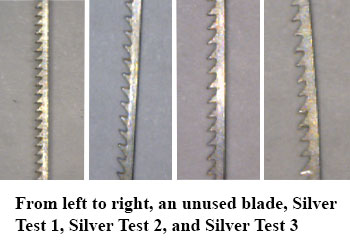
Regardless of the approach, degradation in the quality of cutting was noticeable at virtually the same point in each of the three sterling silver tests, and continuing degradation was fairly linear. Regardless of whether the lubricant was applied to the blade or to the sheet, it did not preserve the tool: All blades show similar dulling, rounding, and hooking (see right). While it is possible to argue that the blades were used to the point of extreme wear, they all performed very similarly in each test. Given that, I am confident in concluding that a lubricant does not significantly alter or improve the performance of a saw blade when cutting this typical “jewelry gauge” of sterling silver.
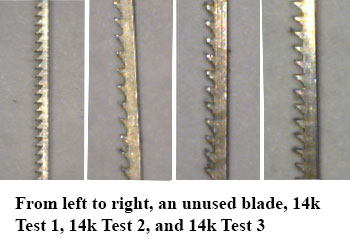
The testing on the 14k white gold samples, however, tells a different story: The lubricant definitely made a difference in preventing the blades’ degradation. While the experience of cutting was fairly similar from sample to sample, the images of the blades (see right) clearly show that the wear on the un-lubricated blade is far more pronounced than the wear on either of the lubricated samples, and that applying lubricant directly on the blade preserved the tool more effectively than lubricating the work piece itself.
But what does this really mean for the working bench jeweler? If the experience of the performance of the tool is largely the same regardless of approach, is there any good reason to change your habits? If one’s work is limited to softer alloys, the introduction of a lubricant seems unnecessary; if you don’t like it, don’t bother. If one works in denser, harder alloys, however, clearly the use of a lubricant will prolong the life of one’s saw blades and possibly deliver better results.