

Mad About Color
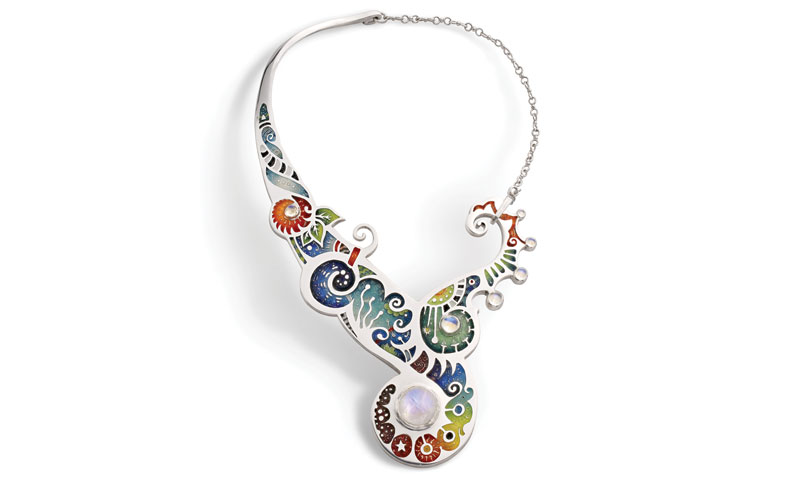
Liz Sabol’s Cheshire Cat necklace
By Tina Snyder
Following the creation of her Mad Hatter Cuff bracelet—a finalist in the PMC category of the 2016 Saul Bell Design Award Competition—Liz Sabol of Liz Sabol Jewelry Art in Pittsburgh set out to create a second Alice in Wonderland-themed piece, this time drawing inspiration from the Cheshire Cat. “I wanted to make a necklace with a lot of movement, so naturally I thought of the Cheshire Cat, who slinks around and turns invisible then reappears,” she says.
The undulating structure of the cold-enameled Champlevé sterling silver PMC necklace, which curves down the neck and then curls in on itself to result in an asymmetrical form, is reflective of the cat turning invisible. To form the neckpiece, Sabol started by refining her sketches in Adobe Illustrator. She then used an etching laser to burn the designs for the front and back of the necklace into plexiglass, making two molds.
Next, Sabol rolled out two large pieces of metal clay and pressed them into the molds. “I have a small window of time to press the clay into the mold, get a good impression that captures all the details, and pull the clay out of the molds before it sticks,” she says.
The necklace halves were dried flat, sanded down from the back to thin and even them out, and joined together with slip and water. “This is a bit tricky, because the clay doesn’t hold its shape well when wet, and the two halves have to match exactly when I put them together after drying,” she says. “Once the pieces are joined, there is some patchwork in-volved, adding clay, filing, and sanding.”
The necklace was then fired at 1,625°F (885°C) in a kiln for four hours. Once cooled, Sabol filed, sanded, and polished the necklace. Then she bent and shaped the piece. After hammer setting the moonstones, the necklace was ready for cold enameling.
Though she most often uses oil paint for enameling, in this piece Sabol opted for a combination of gilder’s paste and colored pencil. The latter is ground down into a fine powder and mixed with mineral spirits to form a paste. Both are paint-ed on with tiny brushes.
When enameling, Sabol roughed out the major blocks of color in the whole piece first, then let it dry a bit so as not to muddy the next color applications. In areas of the necklace where the colors blend into one another, the colors are worked when wet to obtain the blended effect.
When all the painting was done, Sabol used an orange stick and burnisher to clean the paint off all the metal details. She then added the resin, a two-part epoxy, a small section at a time, and cured it in the oven at 130°F (54°C) for three hours before moving on to the next section.
“It takes several applications, working in about eight sections here, because this piece is curved, the resin wants to flow off,” she explains. “So I prop up each section so it’s completely level and the resin stays put during application and curing.”
Once all the resin was cured, Sabol ground it flush with the top of the necklace. “I use a little more than I need, so it domes a bit, and then I grind it down so it’s smooth and even.”
The final touch to the piece was a handmade PMC chain, which Sabol says was enormously time-consuming to construct. “I made a bunch of metal clay jump rings and gently spread them apart just enough to snap into the next one and close it up with paste,” she explains. “They would often break or pop back open, so it took a long time to get the perfect number of usable jump rings.”
That said, all the time, careful work, and attention to detail in this piece paid off, earning Sabol second place in the PMC category of the 2017 Saul Bell Design Awards.