

Love Beads
Three artists share their passion for crafting beaded jewelry
By Shannon L. Brown
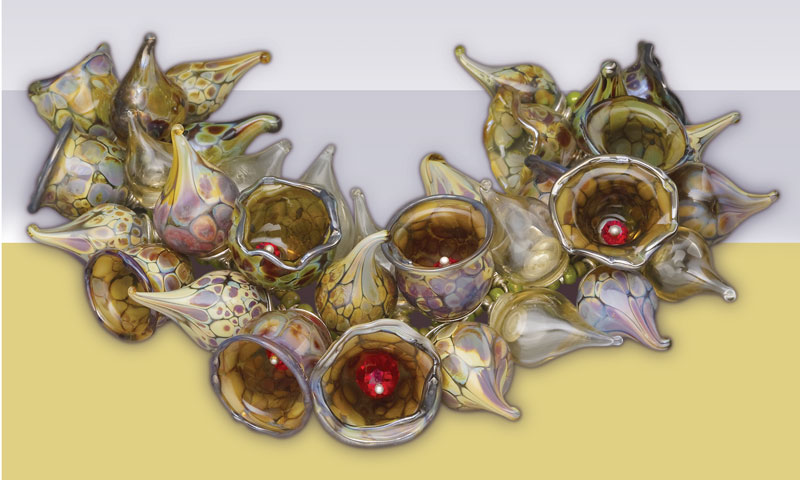
Although they work with very different materials, the three artists profiled here share one common bond—a love of crafting jewelry with beads. From handmade glass to high karat gold to sparkling crystals, the media through which these talented artists express themselves vary widely. Uniting them all is the common thread of elevating handcrafted bead jewelry to a new level. Their stories may inspire you. Their jewelry surely will.
Burning Brightly: Mary V. Smith
A mesmerizing flame melting spectacularly colored glass into a perfect bead. The possibilities of infinite shapes and sizes. The beautiful jewelry those beads can become.
All of these factors pulled Mary V. Smith of St. Peters, Missouri, into lampwork—the art of using a torch to melt glass rods into beads. A corporate graphic designer for 20 years, he saw her industry changing in the ’90s and felt her creativity being stifled by new technology, so she began exploring her options. She had dabbled in making jewelry and loved going to the St. Louis Art Fair. “I went to school for fine art and graphic design,” she says. “I had to do something with my hands. I tried to transfer some of my knowledge and color theory into jewelry.”
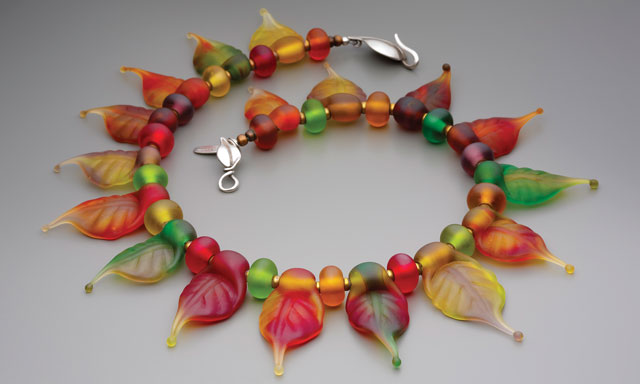
Lampworking is all about amazing combinations of color. The process begins with a steel mandrel, a torch, and a glass rod. Smith coats the end of the rod with bead release, a material that allows the glass to adhere but come off later. Holding the glass in the flame, she spins the mandrel in a slow circle, wrapping the glass around it, pulling it in and out of the flame until the bead is the shape she wants. When the glass begins to cool, she adds other colors. The completed bead then goes into a kiln for annealing to strengthen it.
“In lampworking, there’s a relationship between the flame and you as you slowly go in and out of it,” says Smith. “You cannot rush the process. It’s almost like a slow dance.”
Soon after her first glass bead making lesson in 2000, Smith rented workspace in her instructor’s home studio and developed her skills. She began building a clientele, but lacked confidence in her abilities. Her Fall Leaves necklace (below), a six-month project, transformed her into a professional in her mind due to its complex nature and successful result. When molten, the red, orange, amber, and olive green glass look the same. On top of that, the red and orange are “striking” colors—the most difficult glass to work with, says Smith. “When using striking transparent red and orange, you must re-introduce the finished bead back in the flame at just the right time to bring but the true color of the glass,” she explains. If the moment is missed, a brown bead results after annealing.
“I remember getting the necklace done and putting it on,” she recalls. “I had a big mirror for customers to try on jewelry, and I finally felt like I was more than just playing around.”
From that point forward it has been game on for Smith, who describes her jewelry style as “fun and feminine, with a contemporary twist.” She now works in a home studio, sells her jewelry online and at major regional art fairs, and is on the faculty where she had her first lesson. And she’s still making new discoveries every day.
“There’s not a day that I sit down at my torch that I don’t learn something new,” she says. “I think that’s probably some of the addiction for me. I always want to keep learning.”
Caramelized Necklace
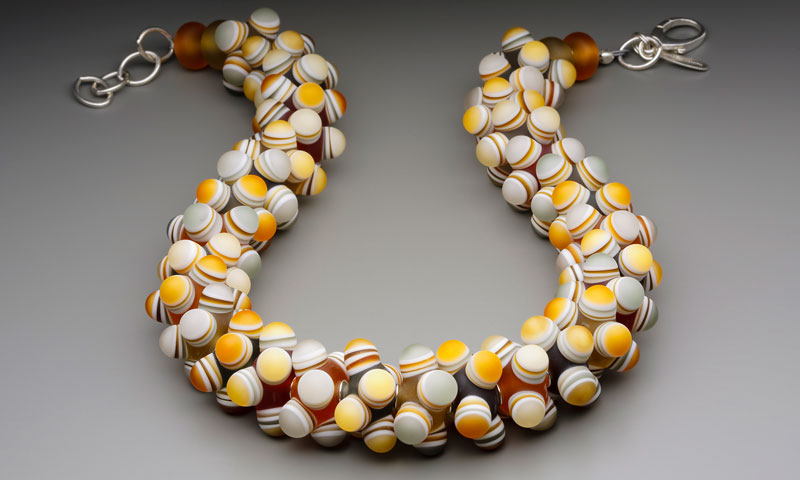
Mary V. Smith uses soft, sodalime glass from Murano, Italy, to construct her beads because she says it’s “consistent and stable in the flame.” After first crafting the design of her Caramelized necklace in opaque black,white, and gray glass, she thought, “Wow, if it looks like this in opaque, what if I can get it to work in transparent?” (Because opaque glass is stiffer, it can be easier to work with.)
Caramelized took approximately 80 to 120 hours to make, and it won second place in the beads category of the 2009 Saul Bell Design Award competition. Smith wanted the necklace to appear as though it comprises many individual beads, but it actually has 31 interlocking beads with six nodules on each. “I had to play around with it to get the nodules not to melt into each other as I was laying down the colors,” she says. With six nodules on each bead, they’re in the flame for about 8 to 12 minutes.
All lampwork beads have to be annealed in a kiln to strengthen them, but knowing when to anneal is vital. The glass has to cool slightly but not too much, and the success—or failure—of the bead often isn’t visible until after annealing. Hot glass is usually dark so it masks the delineation of colors.
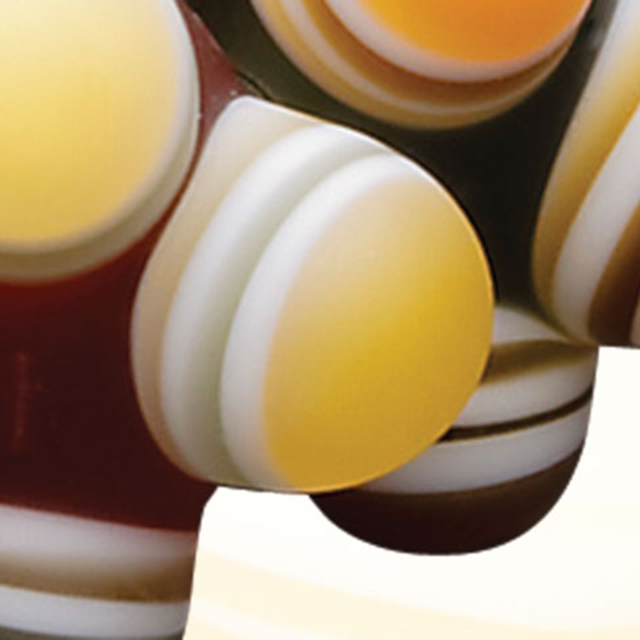
To create the 31 beads in Caramelized, Smith used a lampworking torch and a 13 inch long by 3/32 inch diameter steel mandrel. (The diameter is the final size of the holes in the beads.) Holding the glass in the flame, she spins the mandrel in a slow circle, wrapping the glass around it, pulling it in and out of the flame until the bead is the shape she wants. When it begins to cool, she adds other colors, varying the order of layers from bead to bead.
It’s a very delicate craft. “I’ve cracked the center beads before when I’m making them because I’m so focused on the heat on the nodules that the base bead can cool off enough to crack,” says Smith. “When that happens, you’ve lost your work.”
After annealing, Smith secures the mandrel in a vise grip and twists off the beads. Under running water, she cleans out the chalky bead release residue in the holes with a diamond bit reamer. She etches the beads by immersing them in Etch Bath for 4 to 5 minutes, which takes a bit of the surface off the glass, giving it depth and softness. “I get such a great response to the etched glass,” says Smith. “It’s by far what I sell most.”
Strung on a double thickness of woven stainless steel Soft Touch Wire, Caramelized has 5.6 mm sterling silver bicone beads between each glass bead, adding to the illusion that the beads are interlocking.
Updated Ancient: Jonathan Rutledge
Jonathan Rutledge of Evanston, Illinois, served in the U.S. Air Force, winning the Air Force Achievement Award for metal work on airplanes. After being discharged, he didn’t immediately pursue a career in jewelry. He went to college to earn a degree in political science, but an elective class in metals and jewelry design hooked him. He continued taking jewelry classes but graduated with his mind set on working in law enforcement. While testing for a job at the local police department, something clicked. “I just decided, I really don’t want to do this. I want to make things,” he recalls, noting the striking realization he had while flipping through one of his mother’s books filled with pictures of ancient granulated jewelry. “I thought to myself, this is what I want to do for the rest of my life.”

Since then he has been perfecting his line of precious metal jewelry, which often includes beads. “My bigger pieces have just happened to be bead pieces, more to come up with my own sense of style,” he says. “When I started to work in gold, I tried to do something a little more technically difficult in each new piece that I made. The first bead that I made fell right into this progression—I had to try time and time again to figure out how to make the perfect gold bead.”
And the shape of the beads posed another interesting challenge. “[I had to find a way] to make the design flow freely and evenly across a round surface that doesn’t really have a proper beginning or end,” he says. “With a bead, it has to look like the face of the piece no matter the angle.”
Dozens of beads later, Rutledge still loves the challenge of fabricating precious metal beads for his jewelry pieces. And even today his style is true to the lifechanging book he paged through years ago, but with a contemporary spin. He sees a constant evolution in his work but still loves the intricate process of granulation—which is no surprise, considering his fascination with beads. “It makes me happy to sit down and [granulate],” he says. “I can do it all day long and wonderwhere the time went.”
22k and Tahitian Pearl Necklace

Since beading is an ancient art, it would seem a perfect match for the granulation technique, a process used by the Sumerians and Etruscans. Jonathan Rutledge incorporates granulated beads into his jewelry designs, updating the old technique with modern twists, such as his version of the Greek key pattern on the round beads and clasp in this necklace—the second place winner in the bead category of the 2008 Saul Bell Design Award competition.
“I love the way light plays off of granulation—how evening light makes the background darker, how light in a room bounces off of it, deepening the contrast between the two surfaces,” says Rutledge.
Beginning with a sketch and 30 Tahitian pearls graduating from 12.5 mm to 9.5 mm, Rutledge designed beads in 22k yellow gold—five round ones graduating from 18 mm to 12 mm, and eight spacer beads graduating from 10 mm to 8 mm.

Rutledge fabricates the round beads from 28 gauge sheet metal. He uses a dap and die set to create the two halves of the bead, fuses them together, and then granulates using copperplate granules. He attaches eight bezel settings to the central bead after granulation, and then sets the 2 carats of diamonds.
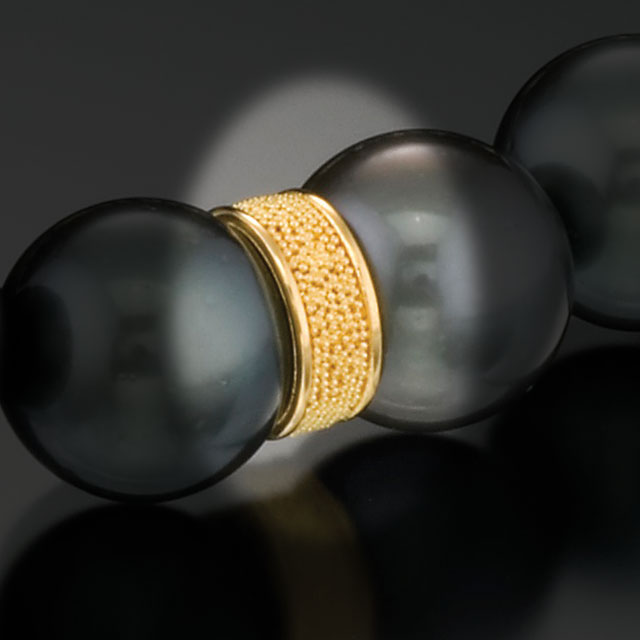
Starting with a strip of sheet metal, Rutledge fabricates the spacer beads, granulates them, and trims them with polished wire—a contrast to the brassbrushed finish on the other gold components in the piece.
Colorful Creations: Katie Hacker
Beading industry powerhouse Katie Hacker of Keystone, Indiana, hosts a national TV show, has authored or co-authored almost two dozen books, and has her own line of findings. Her love of beading began when she was a teenager and couldn’t find clip earrings, so she made her own. Raised in a family that loved crafting—her parents owned miniatures and dollhouse distributorship—Hacker landed back in the same industry after earning a degree in literature and journalism, becoming the editor for a craft book publisher.
She began writing books and articles on beading, all leading her to build relationships with manufacturers. Soon she was creating jewelry for their ads and websites.
Then eight years ago when the public television show Beads, Baubles and Jewels began, Hacker was chosen to do a three-minute segment in each episode. When the host left three seasons ago, she stepped into the position, taking on more of an editorial role, developing future seasons, and becoming involved with lining up guests and content.
One of the first 30 worldwide to be honored with the title Create Your Style with Swarovski Elements Ambassador by the Austrian crystal company, Hacker says, “I use a lot of crystal in my work. My new book is all wire and crystal—and the last book, too.” She enjoys mixing crystal and natural materials such as semi-precious stones, wood, and nuts, using metal components to highlight and accent the designs. Her favorite gemstones include jet and turquoise because they work well with the sparkle of crystal.
And she’s also an inventor. Always having beads on her mind, Hacker saw a necklace she liked with channel-set diamonds one Christmas and thought, “There must be a way to make it for beady people.” The result is components with customizable channels for pendants and earrings called Katiedids (her childhood nickname), which are manufactured by Beadalon.
Hacker enjoys using her own findings and is expanding the line to have more finishes and additional shapes. “I’m mostly inspired by the materials themselves and really have to play with the components [in a piece],” she says. “Sometimes I just have a vision for how it’s going to end and I have to figure out how to get there.”
While Hacker has been a dominant force in the world of DIY jewelry for some time now, she says that the line between the craft and fine jewelry worlds is beginning to blur. At a recent Bead and Button Show in Milwaukee, Hacker says, “I was shocked by the number of booths demonstrating metalworking techniques. Just a few years ago that was not part of this market at all. They’re now taking traditional bench methods into the craft/DIY side.”
For makers of beaded jewelry, Hacker adds, the bar is being raised.
Twisted Treasure Necklace
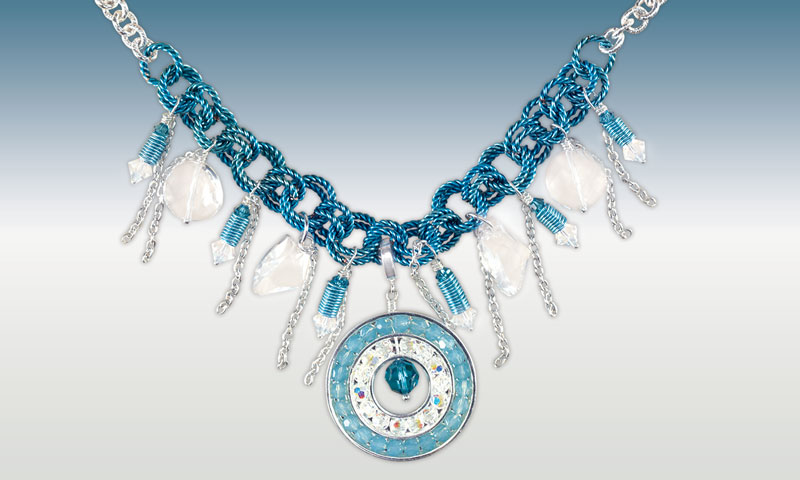
On the cover of Katie Hacker’s upcoming book, Live Wire Jewelry, this necklace with a color palette inspired by the ocean features Swarovski Elements crystals and a pendant from her Katiedids line of findings. Always keeping in mind the wearability of the final piece, Hacker often designs jewelry in shades of one color to make coordinating with fashions easier. She also likes to open up options for DIYers who opt to make the design. “I like providing a design that allows people to explore their own creativity,” she says. “They could keep it simple by creating the pendant and chain, or they could take it to the next level by adding multiple drops and dangles.”
To create this chain, Hacker cuts ice blue enamel-coated Artistic Wire by Beadalon into three 2-yard lengths and wraps the three wires around a twisting tool to twist them together. She then wraps the twisted wire around an 8 mm mandrel to make a coil and cuts it into 40 rings.
To make the coiled dangles for the necklace, Hacker winds ice blue wire around a 4 mm mandrel and cuts the coil into 1.25 inch lengths. She pairs the coils with beads on headpins and various lengths of delicate silver plated chain. Each is attached to two rings on the blue chain.
The inner channel of the pendant features 4 mm round crystals and the outer channel showcases 4 mm round Pacific opal crystals, all threaded on flexible beading wire. To keep the beads in place, a head pin is inserted through the middle of the pendant and passes up through the top to wrap around the bail.
A silver plated chain with a simple toggle clasp completes the necklace.