

Letting Go
Establishing expectations to help release control
By Andrea Hill
Last month we started our exploration of how to get out of our own way by examining a logical, effective method for addressing fear of the unknown. But what if you like change, you embrace learning new things, and you’re still stuck? Then it’s possible you’re suffering from one or both of the other two reasons we get in our own way: a need to control everything, or sacrificing the good for the perfect.
I know a business owner who is quite the Renaissance man. His ability to come up with new ideas, to imagine how things could be made, and to create innovative manufacturing techniques to make them is inspiring. Unfortunately, his need to control everything stands in the way of his success. The business is too big to be run by one person, yet he won’t let his employees contribute in meaningful ways. He manages their activities to such a degree that the entire company is stuck—unable to move until the owner puts his stamp of approval on the tiniest of details.
I can tell stories of dozens of business owners who are one-person shops long past the point when they should have expanded, simply because they don’t want to let go of the control they enjoy when they do everything themselves.
If you’re a one-person shop and you’re making the amount of money you want to make and getting the amount of free time you need to be a balanced human, you’re just fine the way you are. But if you’re feeling stuck, needing to grow but afraid to trust anyone else with your details, here are a few tips for letting go.
Assess Yourself
Start by making a brutally honest list of your skills. This list must be based entirely on the here-and-now. No “If I took a day and really worked on it I could be great at it” thinking. Just cold, hard facts. Take a piece of paper and make three columns. At the top of the columns write the headings “Fantastic Skills,” “Average Skills,” and “I Stink at This.” It should look something like this:
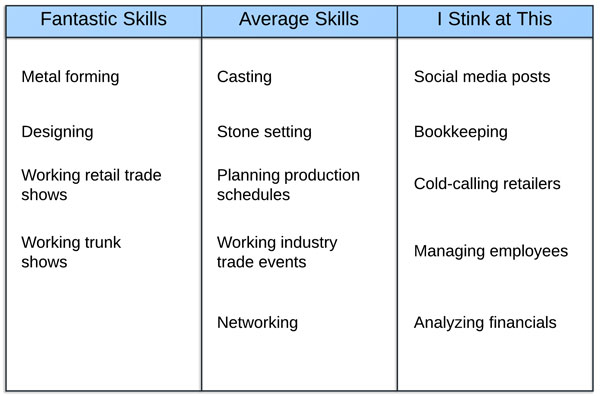
A genuine control freak will look at this list and immediately make plans for perfecting everything in the “Average Skills” and “I Stink at This” columns, but that’s not rational. Here’s a business fact that you must accept:
No business has unlimited resources. Your resources will always fall short of being sufficient to accomplish everything your business needs and wants to do.
This is true whether you are a one-person operation or General Electric. Attempts to become the master of every possible business skill will only steal time and attention from doing the things that are already your strengths.
Which Skills Are Strategic?
Once you have completed your personal skills list, take out a red pen. Circle the elements that are the most important to your business’s strategic success. Everything on our example list is important for a business to do well, but which are the most strategic, the most tied with your special value to your customers, your secret sauce of strategic differentiation? Imagine for a moment that the example business is a design firm that:
• Offers jewelry with a very unique metal finish.
• Uses unique and difficult-to-set gemstones.
• Works closely with retailers to attract customers and sell through event-based marketing.
The essential strategic skills for that company might look like this:
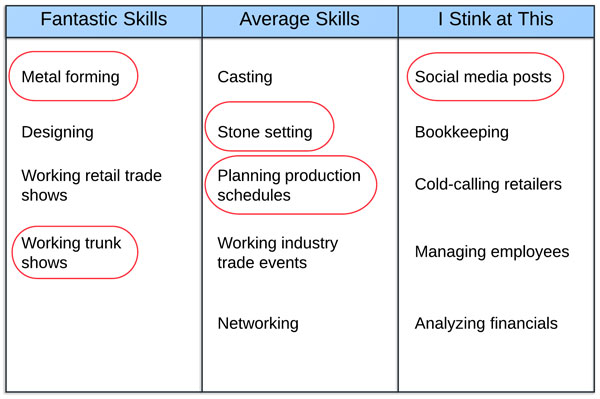
Unless you happen to have a lot of free time on your hands, you could probably choose to perfect one of the three things you aren’t fantastic at. But what about the other two?
Here’s an interesting little paradox. Many times, the tasks and responsibilities we won’t let go of are the ones that we don’t do well ourselves. I think the reason why is that it’s hard to delegate—and even harder to manage—something that we are not good at ourselves. We’d rather muddle through in an attempt to control the mistakes.
But controlling for mistakes is a zero-sum game. You can’t soar when you’re spending all your time trying not to fall. So here is a method you can use to get control—and then let go of it.
Step 1: If you feel the need to move one of your strategic skills into your “Fantastic” column, choose it and commit to it. You only get one, so choose wisely based on your innate capabilities and talents and your level of interest.
Step 2: For each of the remaining strategic skills, make a list of the required outcomes, the things that absolutely must be accomplished to satisfy the business need from that element. Let’s use “planning production” for our example.
What must be accomplished in the area of planning production?
- All initial orders from retailers must be completed in four weeks.
- All reorders from retailers must be completed in one week.
- We must know the status of every order at all times.
- We must maintain a quality approval rate (final quality) of 99 percent or higher.
This simple act of defining outcomes for an aspect of your business places the control where it should be—at the beginning. Once you have established these expectations, you will feel freer to trust someone else to do the work, whether it is an employee or an outsource partner. It will also free you to focus on the things you are really, really good at, which are most likely the things you love to do.