Let It Roar
Jonathan Rutledge’s homage to the Ishtar Gate
By Irina Hawkins
As a member of the U.S. Air Force, Jonathan Rutledge lived in Germany for four years. There, he not only acquired his initial experience with metals while repairing F-16 jets at Ramstein Air Force Base, but also fed his love of art and history, visiting numerous European museums. The fascination with the past is evident in his work; many of Rutledge’s techniques are based on those used to create ancient classical jewelry.
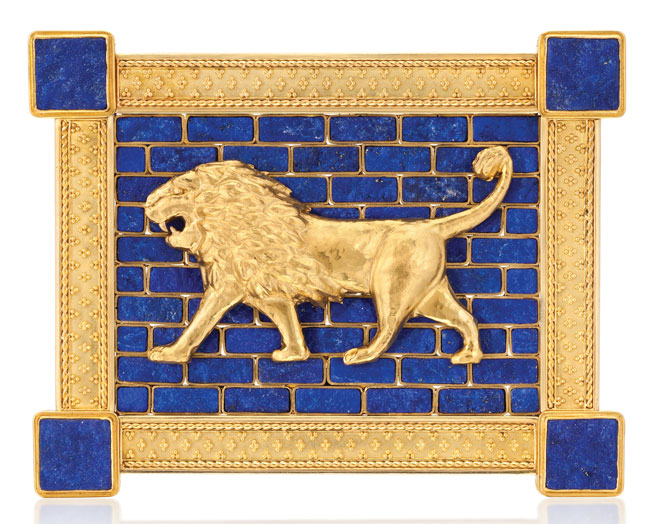
His A Lion at the Gate brooch reflects this interest in ancient techniques, most notably the Etruscan process of granulation as well as chasing and repoussé. Featuring 69 3 mm by 8 mm by 2 mm and 10 3 mm by 4 mm by 2 mm lapis “bricks” and a 22k lion, the brooch was influenced by the Ishtar Gate, the eighth gate to the inner city of Babylon erected around 575 BCE. Rutledge recalls being moved by photos of the gate he stumbled on in a book on Assyria. He loved the effervescent blue of the glazed brick and chose to replicate it with lapis lazuli.
The first step to making the brooch was creating the wall’s lapis bricks. Rutledge says that getting the bricks to their precise dimensions was a challenge, since even a half a millimeter difference in size posed a problem. Fortunately, the German cutter he found did an amazing job cutting the exact dimensions he required, thus easing the placement process for him. The bezels for the bricks were made with 22k gold sheet, each piece bent to size and soldered closed. Rutledge says he spent a long time fitting the bricks—measuring each one, moving them around, ensuring that they all lined up perfectly. Once he had the placement right, he used his laser to weld the bricks together to build the wall.
Next, it was time to construct the frame. He created an inner wall using 18k for strength. He then added an outer frame in 22k, as its higher gold content would allow for easier fusion of the many granules with which he planned to accent it.
Each of the granules measures half a millimeter in diameter. He created them by cutting snippets of gold wire and then heating them with a torch until they balled up. Once he made a batch, he poured the granules through sieves of various sizes to separate them by size. Using a paintbrush, he painstakingly placed each granule. When he was happy with their placement, he used an acetylene torch to fuse the granules to the surface. Because it’s easy to melt the granules, Rutledge watched the color of the heated gold to find the perfect fusing temperature.
Next, it came time to create the lion. He began by pouring a 22k ingot and running it through a rolling mill to make a gold sheet. He drew the lion on the sheet, which he secured in a pitch bowl. He then used a tracing punch to outline the drawing as well as a series of steel punches and a chasing hammer to shape the tip of the sheet to reflect the lion’s mane. During the process, he continually turned over the piece to work from both sides, using a variety of punches for the chasing and repoussé work.
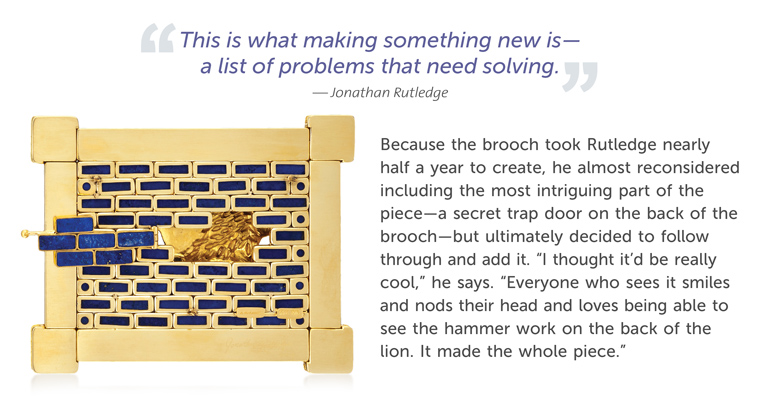
Once he was happy with the lion, it was time to attach it to the brick wall. Since Rutledge had never done something like this before, he had to figure out how to make it happen. “This is what making something new is—a list of problems that need solving,” he explains. He ultimately soldered five posts to the backside of the lion that he fit between bricks and then welded in place to the backside of the wall.
Because the brooch measures 3.25 inches by 2.5 inches, Rutledge felt that it might be too large to wear as a pin so he had a frame built to display it as artwork. Some pieces are meant to be worn daily; others are meant for special occasions. And then there are those, such as A Lion at the Gate, that deserve to be framed.