

Layered Looks
Considering the steady high price of gold over the past few years, more jewelers are turning to gold-filled — a layer of karat gold bonded to a core metal — as a budget-friendly option. Here’s what you need to know about working with gold-filled materials.
By Shannon L. Brown
Judith Bright’s retail store makes its home in a high-end mall in Nashville that services a diverse clientele. To meet the needs of her customers, Bright has built her business around gold-filled jewelry. “If we worked in solid gold, I’d maybe have six designs,” she says. “Gold-filled has given me the ability to design and go in many different directions in the niche market of affordable jewelry.”
And she’s not alone. Considering the steady high price of gold over the past few years, more jewelers are turning to gold-filled—a layer of karat gold bonded to a core metal—as a budget-friendly option. “There is a perceived value in gold-filled because of the gold content,” says Rick Greinke, plant manager for Award Concepts Inc. in St. Charles, Illinois. “It’s an affordable alternative to karat gold with some of the same prestige.”
Choosing Material
Gold-filled can be produced by different methods, but generally a layer of gold is braze bonded to a core metal with solder used to form the bond. It is also sometimes hot bonded with high pressure and heat. Some manufacturers use an interlining layer of nickel between the gold layer and the metal core for specific applications.
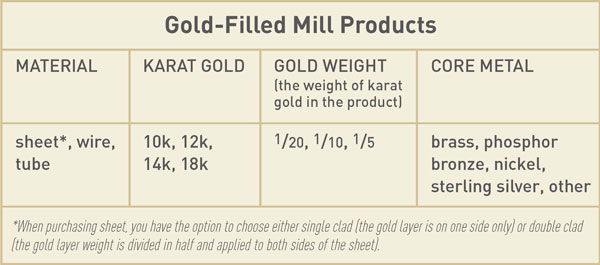
To review the variety of options available for gold-filled mill products, see the chart below.
Working
For the most part, you can work gold-filled materials using the same techniques suitable for karat golds. You can bend, roll, solder, braze, set, tumble, epoxy, antique, etc. “There’s really not a whole lot that you can’t do to it,” says Grienke. But for certain applications, special care is needed to ensure the best results:
Cutting. Because of the nature of these materials, when you cut them you will likely expose the core metal. When working with wire or tubing, the effect is negligible; however, every edge of sheet metal—even double-clad sheet—exposes the core metal. The solution is to plate it. This works well for low-wear pieces such as pins or earrings, but doesn’t last long on pieces with high wear, such as rings. If you use gold-filled sheet to fabricate rings, be prepared to educate your customer that the plating will wear off, exposing the core metal on the edges of the piece and requiring re-plating.
Brian Clapprood, vice president of engineering for LeachGarner in Attleboro, Massachusetts, says that diamond cutting is one of the bigger issues when working with gold-filled, as cutting too deeply will expose the core metal. “We have customers who buy 1/10 to 1/5—the thicker varieties of gold-filled—for diamond cutting,” he says. “This is a process that demands precision.”
Soldering. Using an easy or medium solder when working with gold-filled is a safe choice, but hard solder can be used if the heat is controlled properly, says Clapprood. To prevent firescale, which requires additional polishing of the gold layer, always use flux.
Stamping. The stamping process leaves more of the gold on top of the piece and less on the sides or bottoms of indentations where it has spread more thinly. In this case, even more care must be taken when polishing to avoid removing too much gold. When stamping, always verify that the stamping tool is very clean so no imperfections will be left behind that will require more gold to be removed than with a standard polish.
Finishing. Careful finishing is the key to using gold-filled. A layer of precious metal is just that, a layer. Polishing requires extreme care to avoid removing too much of the gold layer for two reasons: It will expose the underlying metal and could drop the gold amount below the stamped quality.
A tumbler is a good first step for finishing because it’s a non-abrasive process. Standard wheels and buffs can be used to give the piece a final polish, but avoid any highly abrasive products.
It’s important to remember that as a manufacturer or designer using gold-filled it’s your responsibility to educate the customer about the product. “It’s not a substitute for gold, it’s an alternative,” says Clapprood. Explain to your customer how it’s made and what the benefits are in terms of perceived value, and you might find yourself in the same place as Judith Bright. “Figuring in the bottom line and using this material has opened up creative options for my business,” she says. “We have found our niche.”
Silver-filled Solutions
Silver may have become the go-to metal for designers and manufacturers when gold prices went through the roof, but silver-filled takes affordability one step further. Silver-filled is a layer of sterling or fine silver bonded by heat to copper, resulting in a silver layer that is 1/10 or 1/20 the total weight of the product. To determine the cost-effectiveness of moving from silver to silver-filled, consider market prices.
“If silver is $40, an ounce of sterling round wire will run $44.30 and an ounce of 1/10 silver-filled wire will run $16.18 for orders that are not high-volume,” says Kevin Whitmore, gemstones and metals divisions product manager at Rio Grande in Albuquerque, New Mexico. “If silver is $25, an ounce of sterling round wire will be $28.93 and an ounce of 1/10 silver-filled wire will be $14.61. [Higher silver prices] make the financial case for silver-filled more compelling.”
Even so, silver-filled is an attractive option for those who work extensively in silver or gold-filled. Helen Wang of Helen Wang Jewelry in Minneapolis recently introduced silver-filled into her line of earrings and larger pieces that have a lot of components, for which she’d have to charge more in gold-filled. “There are more and more products now available in silver-filled,” says Wang. “I’m trying everything I can get my hands on.”
As silver prices fluctuate, demand for silver-filled continues to grow, with suppliers adding new mill products and findings regularly. This is a niche market to watch.