

John Easley: Composed in Composites
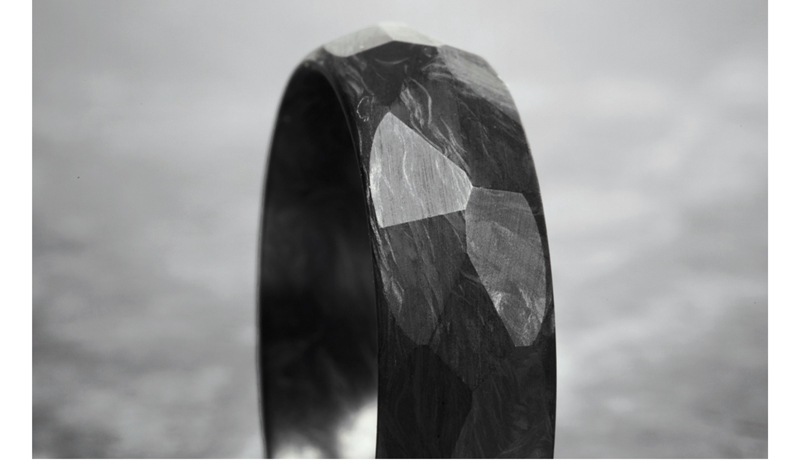
John Easley
Composed in Composites
If you give an engineer a material, they will want to examine it. And figure it out. And maybe take it apart. And, in some cases, if you give an engineer a material, they will want to make a ring out of it. Particularly if they lost their wedding ring, like jeweler John Easley did about three years ago.
“I lost my wedding band, and wanted to make a replacement band that was meaningful,” he says. “I was studying to be a composites engineer at the time and learned about carbon fiber and a process called forged carbon, which was developed by Lamborghini around 2010. I liked the way it was made, with two materials that had strengths in different ways coming together under heat and pressure to become something stronger than they were separately. I thought that was a good symbol of my marriage—that we were better together.”
Setting out to understand carbon fiber and how it could be formed into a ring revealed that it wasn’t going to be simple. But even Easley was surprised at the path this decision would eventually take, and the work it would involve.
In its normal state, carbon fiber exists in either a woven form or in straight lines. While this makes it perfect for creating strong and light shells, such as car chassis, the fiber’s strength only exists in the directions in which the fibers run. It does not provide the same strength in all directions, as would be needed for a solid item such as a ring. In the forged carbon process, the fibers are basically torn apart, then brought back together under heat and pressure. As it cures, Easley says, it gains that omnidirectional strength.
And while it’s great to understand the process and the material, you have to have the techniques and tools for doing what you want with it. As Easley discovered, that was a challenge all its own.
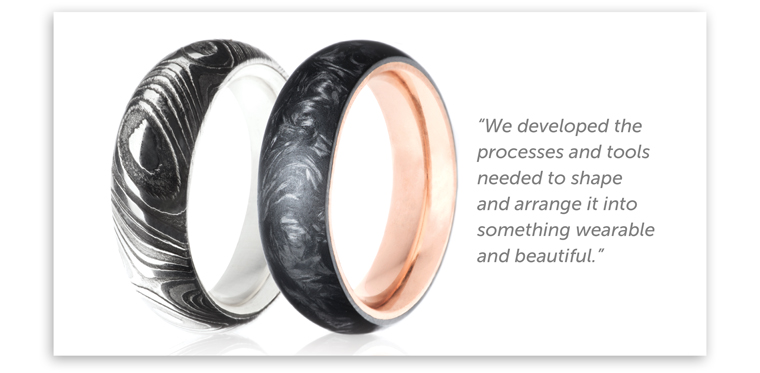
“It’s a new material, so you can’t just look up how to machine it or press it or how to finish it,” he says. “There aren’t many companies doing this. There are a few others but they don’t share their processes. We developed the processes and tools needed to shape and arrange it into something wearable and beautiful.”
Even something as apparently simple as a mold had to be rethought, and then created. “Carbon fiber actually shrinks as it heats up,” he says, noting that the resin requires a temperature of only about 310°F to cure. In the curing process, the carbon fiber is placed in a scientific oven that ramps up the heat in 5°F increments, holds it at temperature for two hours, then drops at 5°F per minute until it’s cool enough to release. In that time, though, the mold needs to follow the fiber. “We had to develop molds that decrease in volume as the carbon fiber heats. The mold continues to press the carbon fiber to make sure it becomes strong without voids—small pockets of air that can lower integrity.” The molds they use were designed and machined in-house while Easley was still in school, studying mechanical engineering. “My professors helped,” he says.
For cutting, Easley turned to the aerospace industry. Lockheed Martin and other such companies had developed diamond bits and cutting tools used in the creation of forged carbon fiber elements in the planes. The special tools are required due to carbon fiber’s abrasive nature. Because of the need to create or improvise tools, Easley took a look at many industries.
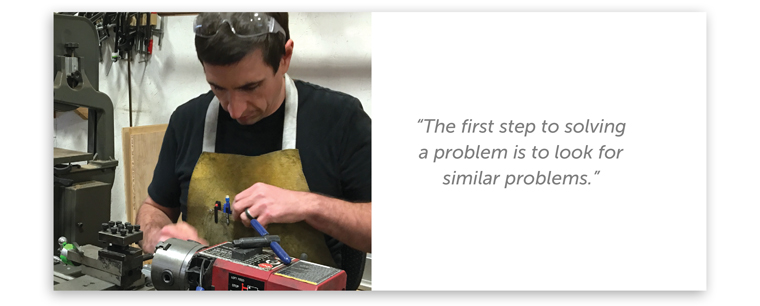
“The first step to solving a problem is to look for similar problems,” he says. “We looked to the aerospace industry, and the research Lockheed Martin had done on how to machine it, what tools and what speeds to use to cut it. We also used other industries. Some of the [mold] releasing mechanisms we use come from the cooking industry. For a lot of our molds and polishing processes, we use industrial-grade cooking equipment and materials. One of the things about the food service industry is that the mold releases and tools they use are food-safe. Using them helps us make sure our product is safe to wear.”
Having figured out his process, built the tools, and started making rings, Easley and his wife needed a way to get the business off the ground. What better way to go for a product with a high-tech look than to head to the internet? “We decided to do a Kickstarter,” he says. “It was one of the highest-funded Kickstarters to that point.” The Kickstarter crowdfunding campaign was so successful, in fact, they hit their $400,000 goal in just three days. With their idea completely funded, they went into the business full swing. Their line now offers more than 800 SKUs.
While carbon fiber still needs some explaining as a jewelry material, Easley has found that there is an existing awareness of it in the higher-end market, due in large part to certain luxury items. “We had to find a way to establish the material’s value,” he says. “It helped that Lamborghini developed it and uses it in its cars. It’s also in Bell & Ross and Tag Heuer watches. Those are of a much higher value than similar watches not made of carbon fiber. Because this is a new process, we still need to educate people, which we do through our social media.”
For him, though, the real appeal of carbon fiber, and its intrinsic value, goes right back to that metaphor about his marriage. “I think people understand the symbolism behind two things coming together to be stronger than they are separately. It helps them to remember why they’re wearing the ring.”
Up to the Challenge • String Theory • Fabric & Fabrication • To the Point