

In the Clear
Transparent protective coatings offer jewelers tarnish and wear resistance
By Shawna Kulpa
There are few things more frustrating: After spending hours crafting a piece of jewelry, polishing it to a high shine, and proudly placing it on display for your customers to admire (and hopefully buy), you walk by the display days later and notice that the piece is already looking a little dingy thanks to a bit of tarnish. What if there were a way for you to trust that the pieces you place in your display cases would stay as pristine as the day that they were born?
The solution may just be one of the different types of transparent protective coatings available to the jewelry industry. There are two types currently being used by jewelers: basic coatings designed to temporarily protect against tarnish, and e-coatings that are designed to provide tarnish and wear resistance over the long term. Could one be right for you and your designs? Read on to learn more about these coatings—what they’re designed to do, how they must be applied, and how long they can be expected to hold up.
Basic Coatings
When it comes to basic transparent coatings, there are two types: waxes and lacquers. Designed to temporarily prevent tarnishing, both types are easy to apply and neither requires any expensive equipment.
Waxes are the simplest type of coating. They can be applied to dry jewelry items and then buffed off, leaving behind a thin, protective layer. “The benefit of wax is that it’s very delicate on the surface of the jewelry—it won’t change the color of a patina,” explains Thomas Flores, a member of the technical support team at Rio Grande in Albuquerque, New Mexico. “But because it’s a wax, it’s not very durable, especially for rings.”
The second type of basic coating is a lacquer, which can be made with a variety of materials, including acrylic or polyurethane. More durable than wax, lacquers are frequently referred to as anti-tarnish dips because they are usually applied by dipping the item into a room-temperature solution. There are also spray coatings available, but Michael Akkaoui, president and CEO of metal finishing firm Tanury Industries in Lincoln, Rhode Island, notes that the sprays can sometimes apply a heavy and non-uniform coating.
Both types are suitable for preventing tarnish on an item while it’s being stored or on display, and both are safe to use on any of the common jewelry metals. “They’re widely used in the industry because the setup is inexpensive and the degree of training and technical knowledge is low—almost anyone can apply them,” says Akkaoui.
But as easy as these coatings are to apply, there are some downsides to them, the biggest of which is that both types are temporary.
“They’ll slow the tarnishing while the item is on display, but as soon as someone handles it, the coating will wear off,” says Rusty Heath, director of Legor Group USA in Albuquerque, New Mexico.
“It’s not the kind of protection you want on higher-end goods,” Akkaoui agrees. “It could peel with wear, and in some cases, the lacquers can turn milky white before they fail.”
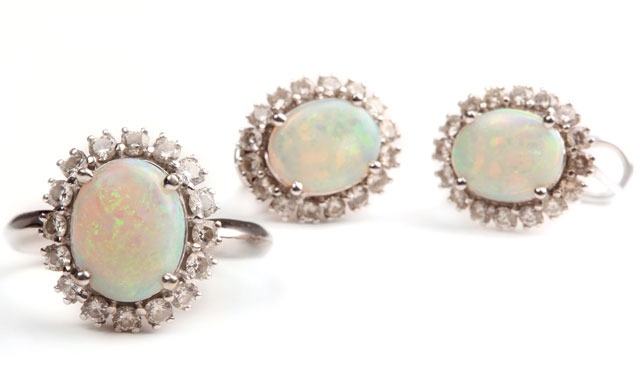
Neither wax nor lacquer coatings offer any scratch or wear resistance, and some of the lacquers could cause trouble if applied near sensitive gemstones.
In addition, neither wax nor lacquer offers any scratch or wear resistance, and some of the lacquers could cause trouble if applied near sensitive gemstones. “Understand what the stones are and their reactions to chemicals,” Heath warns. “There may be some stones you don’t want subjected to the solutions.” When dealing with gem-set pieces, it’s best to apply the lacquer or wax (which could coat the stones) before the setting occurs.
Akkaoui also points out that glues don’t adhere well to these coatings, which is worth noting if you’re making fashion jewelry items and intend to glue gemstones or crystals onto them.
Another drawback to these types of coatings is that they can visibly chip and flake off with wear. And some of the lacquers can also turn yellow over time. That’s something jewelers should consider if they’re planning on applying one to their items for long-term storage or display.
One upside that these materials offer is the ease in which they can be removed from an item in need of repair or if the coating is showing signs of wear and needs to be replaced. Most of these coatings can be easily removed by simple friction, such as by rubbing the item with a polishing cloth, or with the application of a little heat.
E-Coatings
The next level of transparent protective coatings are e-coatings. These are generally resin-based coatings that are electrically applied to the surface of jewelry parts, creating an impermeable layer that will protect against tarnish as well as provide wear resistance to the piece. These coatings are usually clear, although there are some e-coatings that contain color pigments to achieve specific colors.
“With these coatings, we’re not just trying to prevent tarnish, we’re also trying to prevent wear on the coated surface,” says Heath. However, he notes that the protection does not include scratch resistance. “No e-coating offers scratch resistance. You could take a knife and cut into the surface. But in everyday wear of the jewelry part, e-coatings increase the life of the piece.”
Because these coatings resist wear, they offer manufacturers the option of reducing plating thicknesses on jewelry pieces. Heath points out that this is the biggest advantage for jewelers—particularly those who might plate their pieces. “They don’t have to worry about that piece coming back in two weeks because the plating is wearing off,” he says. “You can guarantee the part for a longer period of time.”
With all these benefits, a jeweler may wonder why everyone isn’t e-coating their designs. After all, who doesn’t want to protect their creations from tarnish and wear?
The reason why could be because of the process needed to apply them, which is substantially more involved than buffing on a wax or dipping a piece into lacquer.
“They’re generally applied through an electrolysis process,” says Heath, noting that the process works only with conductive surfaces. “You take a resin-based material and electrically charge the bath, just like plating.”
“The setup is quite substantial,” adds Akkaoui. “If you’re doing volume production, a typical e-coat setup could be well over $100,000 for a true manufacturing environment. On a smaller scale, a jeweler may be able to use their in-house plating equipment.”
According to Heath, jewelers will need a power supply, a tank, and an oven. He also notes that there are tabletop kits with one-liter beakers and small convection ovens that jewelers can use to e-coat in their small studio or workshop. “Things that only used to be done in large plating houses can now be done on the tabletop.”
Jewelers should follow the same cleaning steps as with plating to ensure the surface of the piece is fully clean prior to applying the coating. “You want to start with the best surface possible,” says Flores.
And just as with plating, the longer the item remains in the bath, the thicker the coating will become. Most e-coatings should ideally measure between 5 and 35 microns thick, says Heath. And thicker isn’t necessarily better.
“Reflectivity is what drives the brightness of a part,” explains Heath. “The more reflective the surface, the brighter and shinier the piece. The thicker you go with the coating, the reflectivity starts to go down.”
Flores highlights another reason to keep the bath on the shorter side: “You can go too thick and it will give the piece a plastic feel, degrading the feeling of the metal.” But he notes that the ideal thickness of the coating can also depend on the size of the piece. “On something with a heavier weight, you can get away with a thicker layer because it won’t be as noticeable.”
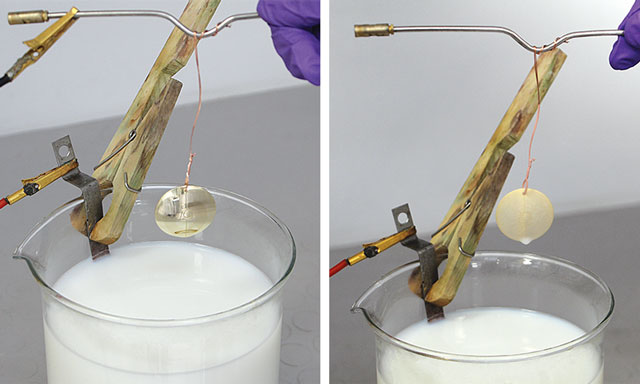
Applying e-coatings is similar to the plating process: Jewelry items are dipped into an electrically charged bath and resin-based material molecules move through the bath and attach to the piece. When pieces are removed from the bath they’ll appear milky white (right) but will turn clear after the coating has been cured.
After pieces have been coated, they need to be placed in an oven to cure. Fresh from the bath, they’ll appear milky white, but don’t be alarmed—it’s normal. Avoid handling the pieces with your hands until the piece has been fully cured, as fingerprints can become embedded in the coating.
Now is also the perfect time to make sure the coating has been evenly applied. “The benefit of e-coatings is that you can inspect the part before you bake it,” says Flores. If you see uneven areas or if the coating has spread onto gemstones, he adds, it can be removed with alcohol.
The piece should be placed in an oven for around 35 minutes at 300°F to cure. Once it’s fully cured, you can touch the piece with your bare hands. The coating should also be invisible to the naked eye.
“After rinsing and going through the curing process, the coating turns crystal clear,” says Akkaoui. “You’d be hard pressed to tell that there’s a coating on the product, if done right.”
Ideally, e-coatings should be applied to jewelry pieces before any stones are set. That’s particularly true when working with certain stones, Heath says. “There’s a risk with stones that carry some conductivity, such as black diamonds,” he cautions. “They would need to be polished off. Also, consider stones that would be at risk from the curing process temperatures.”
If you do apply the coating onto a gem-set piece, plan to rinse the stones off before curing—especially pavé, Flores says.
“The coating will get into the fine, little crevices of a [pavé] piece,” he explains. “While it’s not bonding or sticking, it’s still there. It could leave a film on the stone surface. It’s easier to rinse it off than it is to go back in to remove it later.”
It’s also important to note that e-coatings are not suitable for all types of jewelry. According to Heath, the coatings are best suited for rings, brooches, and other types of jewelry that don’t have moving parts. He does not recommend it for items such as linked chains. (“Because you’re putting on a resin, the contact points of the piece will stick together,” he warns.)
How long e-coatings last depends on various factors: the thickness of the coating, the types of materials it comes into contact with, and even the wearer’s body chemistry. “People don’t understand that we all have very different acidic natures to our bodies,” says Heath. “All of those things directly affect the life of any type of coating we put on the surface.”
Akkaoui says that how long coatings last depends on the item and how often it’s worn. “If it’s a piece of jewelry that’s worn twice a month, you’re probably looking at three to five years of wear before you see any sign of degradation,” he says. “For a ring that’s worn daily, it depends. With care, it could probably last a year.”
When the coating does begin to wear away, it won’t be very noticeable. Unlike some of the basic coatings, e-coatings won’t chip or flake off. “They do wear away and will get thinner, especially on the bottom of ring shanks,” says Flores. “In some instances, you can even feel the elevation change, but you won’t see anything.”
One downside to e-coatings is the removal process. If a coated piece ever needs to be repaired, the coating will first need to be removed.
“With any sizing or repair work, you want to remove it from the whole piece because you want an even coating on the repaired piece,” says Heath.
Akkaoui adds that in order to reapply the coating, “any prior coats need to be removed before a new coat can be applied because it’s nonconductive.”
But sometimes that is easier said than done. Stripping an e-coating from a piece requires a special setup and the use of caustic materials.
“E-coatings are designed to not be removed, so you’ll need a chemical to remove them, and it’s not a totally safe process,” says Heath. “Work with caution.”
This can be especially challenging for jewelers getting in a piece for repair who may be unsure of the type of original coating on the piece and how to remove it. “You have to figure out what the coating is because you’ll have to put it back after the repair,” Flores says. If jewelers are unsure about what type of coating is on a piece, they shouldn’t hesitate to “send the piece back to the person who put the coating on and ask them to remove it.”
While there’s no solution that will ward off tarnish or prevent wear resistance on a jewelry piece permanently, transparent coating solutions offer jewelers the option of protecting their pieces long after they’ve left the shop.