

Hit the Reset
Realign your marketing strategy with the new consumer reality
By Andrea Hill
Have you ever noticed that once in a while, your life gets out of whack? Despite your best intentions, you suddenly realize that you’re not exercising, you’re eating poorly, or you’re not making enough family time. The reason you’re able to recognize it and make appropriate adjustment is your ability to have a mental picture of your priorities and to see when your choices aren’t lining up with your values.
Such misalignments occur in business too. Spending time and money on the wrong things can distract you from achieving your goals. If you have a clear business strategy, you’ll realize that you’re off track and course-correct. Without a strategy, you may not even see that you’re heading in the wrong direction.

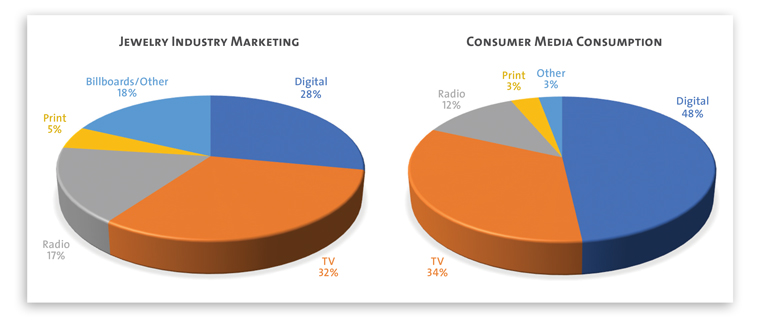
There’s a significant misalignment right now in jewelry industry marketing. As shown in the charts below, the way the jewelry industry spends its marketing dollars does not line up with the way consumers spend their time. As a result, a tremendous amount of those dollars are wasted. Are you thinking, “But this doesn’t apply to me, because I’m a B2B company, not B2C”? That doesn’t matter, because successful B2B marketing today looks almost exactly like successful B2C.
Here’s another interesting statistic from a recent Google blog post: “Holiday store visits dropped 55 percent from 38 billion in 2010 to 17 billion in 2013, according to Shoppertrak. Yet during that same period, same store sales rose, according to MasterCard’s SpendPulse report, which means that the value of each store visit actually doubled.”
What has happened is that consumers aren’t browsing in stores any more. They’re spending more than 15 hours per week online doing product research, then going directly to one store to purchase.
So, what does this mean for you? If you’re a retailer, it means you must create a more rewarding online experience for your potential customers and distribute your advertising dollars more consistently with the way consumers spend their time. If you’re a producer selling through retail, the implications are even greater, because you must build brand capital with consumers while building your relationship with retail partners. How will you do that? Here are a few suggestions:
The New Try-Before-You-Buy
Make sure your website is filled with well-written product descriptions, using both images and video. Why video? Because it’s the new try before you buy. Instead of going into a store to try on jewelry, accessories, and apparel, consumers want to start with a virtual experience. A static image can show the details of a pair of earrings, but a video of a woman putting on and wearing the earrings will show how the earrings hang. The model can share if the earrings feel light or heavy, and what she imagines wearing them with. Video production today is as close as the nearest smartphone. As long as the video is well lit, the model is well groomed, and the phone is steadily held, your video will be perfectly sufficient.
How does this help the producer who is not selling directly to consumers? First, it gives your retailers linkable content. Should the retailer itself be doing this level of marketing? Probably. But do you want to wait around for that to happen? Providing your retailer with rich content is one way to convince consumers that their store is the one to visit. Also, make sure you have a prominent find-a-retailer page on your site to direct consumers who discover your jewelry and want to buy.
Retail/Wholesale Dynamics are Changing
Every producer can segment its retail clients into categories based on how often and how much they reorder. For many, those reorders are getting smaller and less frequent. Most producers are accustomed to vetting retailers based on reputation and credit history. Now it’s time to add another level of discernment.
If you’re spending time, money, and energy pitching your jewelry to retailers who are not marketing according to the new rules, you’re going to be disappointed. Retailers that are on top of their online marketing are far more likely to sell through their inventory and reorder. But how do you know?
When you consider a retailer, take a close look at its website. Is it full of products for sale? Are the descriptions rich and interesting to read? Does it offer product videos? Do you find yourself compelled to check out other pages? After you visit the site, do ads from that store pop up in your social media or news feeds? Does the retailer show up as a paid advertiser on Google searches? Does it have great Google and Yelp reviews, and does it regularly respond to reviewers? You probably can’t ask how it invests its advertising dollars, but all these things are clues to a retailer’s marketing strategy.
There are many statistics available regarding the way shopping has changed, but the two I shared here are the most compelling. Together, they tell an important story about how to find consumers, and what consumers expect once we capture their attention. Fixing the misalignments in marketing and online experience will mean the difference between a business that grows and a business that fails. Luckily, it’s not much more difficult than starting (or restarting) an exercise regimen. Once you get in the groove, you’ll learn new skills and improve every day.