

High Strung
Using beads to create high-fashion designs at lower price points
By Shannon L. Brown
Put down your torch and step away from the bench. We’re about to give you a glimpse into the world of beads, where countless colors, sizes, and shapes await your creative interpretations. The possibilities are exciting. But wait, there’s more. Why else might you consider working with beads?
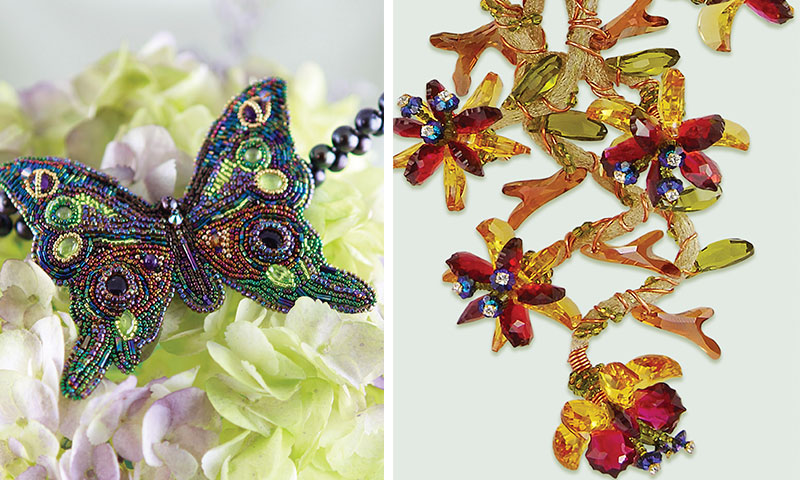
They’re cheap (relatively speaking). Crystal, glass, and semi-precious beads are generally inexpensive. If you’d like, you can mix in your metal of choice, precious or otherwise.
They’re experiment-friendly. One of the beautiful things about beads is the ability to play. Sure you can try new things in gold or silver, but it can get costly if you don’t like the results. With beads, you simply cut apart the design and start over. You’ve usually lost little, other than time.
They’re easy to work with. The learning curve for basic stringing and other beading methods can be short.
Sound like fun? Be warned: Beads can be highly addictive. Order a box of beads and open it slowly. The colors and textures will spark your imagination and may change your life. Not possible? Read on. One experience with beading changed the course of many of these designers’ paths.
Handcrafted Couture
While some artists are dedicated to a particular type of bead, designer Michelle Van Dykhuizen of Van Dykhuizen Designs in Raleigh, North Carolina, uses whatever works to complete her vision for a piece. Venetian glass, seed beads, gemstone beads, freshwater pearls, vintage Swarovski and other crystal beads, 14k gold, and 14k gold-filled beads all find their way into her work.
Van Dykhuizen’s bead journey began in the early 1990s when a neighbor taught her to make earrings. After one evening at her dining room table with the resulting “biker chic earrings” she still owns, she’d fallen in love with beading. She continued with her own designs over the years, many of which focused on pearls, which is not surprising given her degree in marine biology.
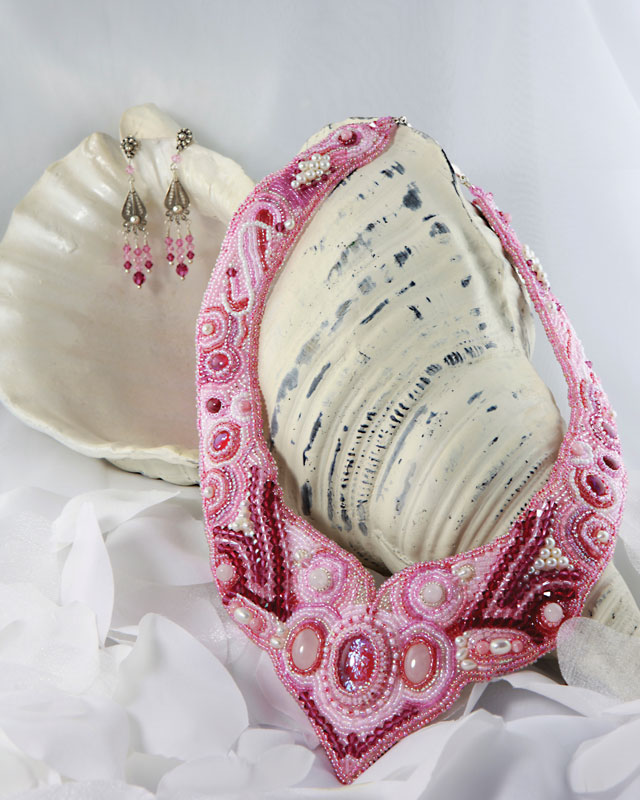
In 2009 she opened her own fine jewelry store, where her beadwork shares square footage with the diamond and precious gemstone jewelry that she also custom designs. She displays some of her beaded designs in shadow-box frames that hang on the wall. “People gravitate to my designs because they’re looking for the unusual, and these don’t look handcrafted like your aunt made them,” she says. In fact, some of her signature bib-style Couture Collars take up to 70 hours to create and feature a mix of precious and non-precious materials. “You have the feel of something unique with a price tag you can afford,” she says. “It’s much less expensive than diamonds and 14k.”
The one area Van Dykhuizen spares no expense is on the clasps for her beaded pieces, which are almost always 14k gold. “One of the best components you should have is a clasp, so I always put really good quality clasps on my pieces.” To ensure durability, she generally strings her beadwork on 49 strand beading wire. “It’s fluid, supple, strong, and sturdy for metal or heavy beads.”
And just because beads may be inexpensive compared to precious gems, they don’t have to appear so. Venetian glass beads, for example, “have a gem-like quality,” says Van Dykhuizen. “They give sparkle and richness that you don’t see with other beads and have a nice weight. When you’ve used Venetian glass in your piece, it feels like a substantial piece of jewelry.”
When making custom wedding day jewelry for bridal parties, a category that sells well in her store, Van Dykhuizen often combines Venetian glass with Swarovski crystals for bridesmaids to coordinate with wedding colors. For Gen Y brides, she often pairs baroque or larger size rice pearls with unique Swarovski crystal shapes for an elegant look.
To ensure she doesn’t miss out on add-on sales, Van Dykhuizen always makes earrings to match necklaces. “I don’t always sell the two together as a set, but I do make sure there are earrings to go with the necklaces I make,” she says. “I started doing this because so many clients would ask, ‘Do you have any earrings to match?’ Now I can say, ‘yes, I do,’ and the client doesn’t have to wait for me to build them.”
Couture Collar By Van Dykhuizen Designs
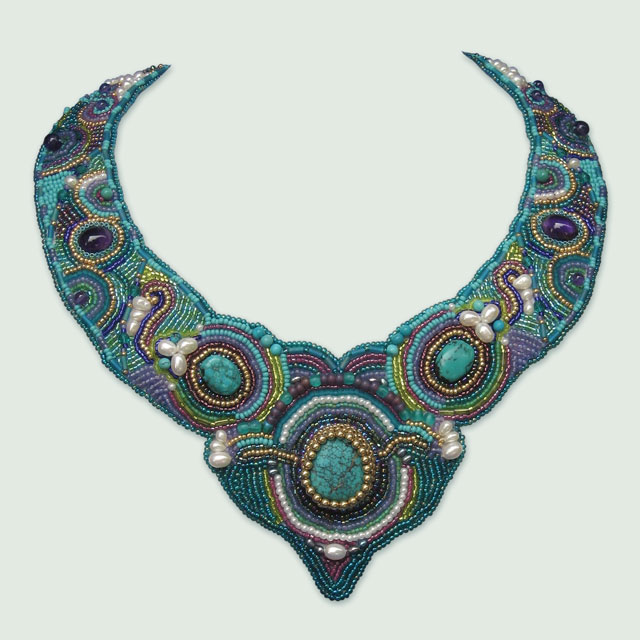
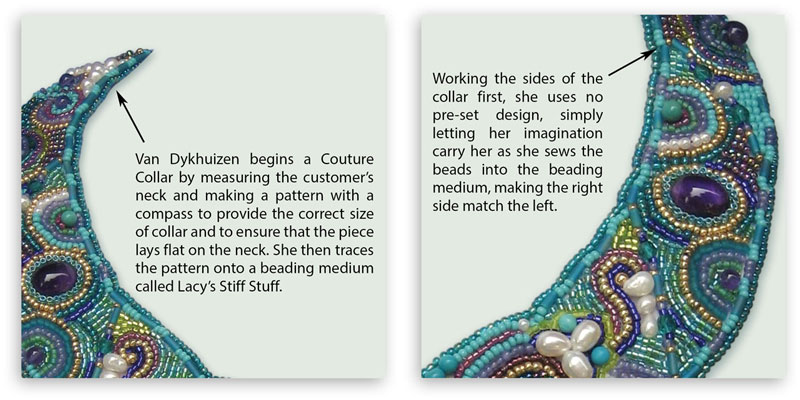
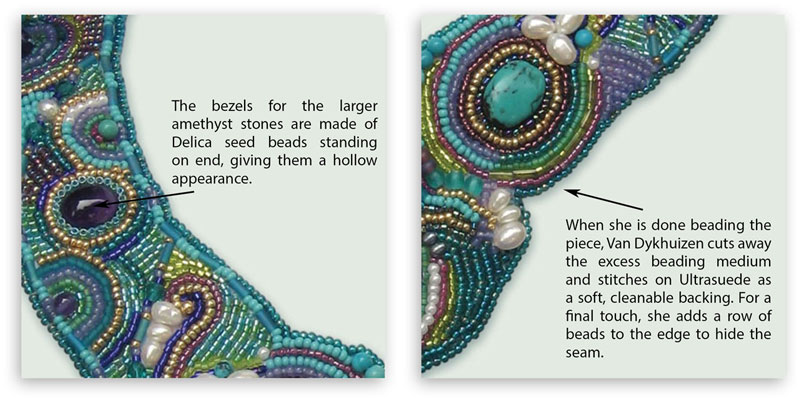
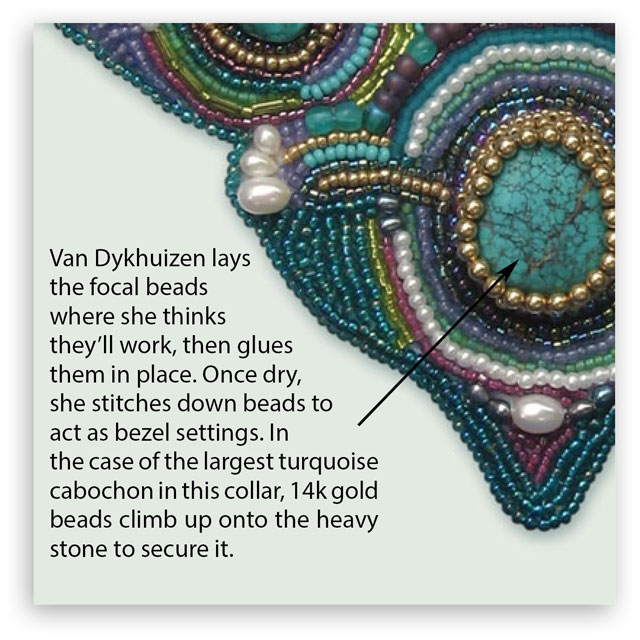
A signature piece by Michelle Van Dykhuizen of Van Dykhuizen Designs in Raleigh, North Carolina, is the Couture Collar, a necklace in line with the currently fashionable beaded bib. In addition to the three large natural turquoise in front, the bead array in this collar includes smaller round turquoise, white and dyed freshwater pearls, vintage turquoise glass beads, amethyst, charorite, frosted and clear glass, and 14k gold beads. Most collars take about 70 hours to create and retail for between $1,000 and $1,800.
High-End Costume
“Heirloom-quality costume jewelry” is how Linda A. Hartung of Alacarte Jewelry in Forestville, California, would describe her work. Living near California’s redwoods, she often takes inspiration from nature when crafting her beaded pieces, which are mainly executed in Swarovski crystals. Many of her customers travel frequently and need jewelry that fits their jet-setting lifestyles. “High-end costume jewelry really meets their needs,” says Hartung.
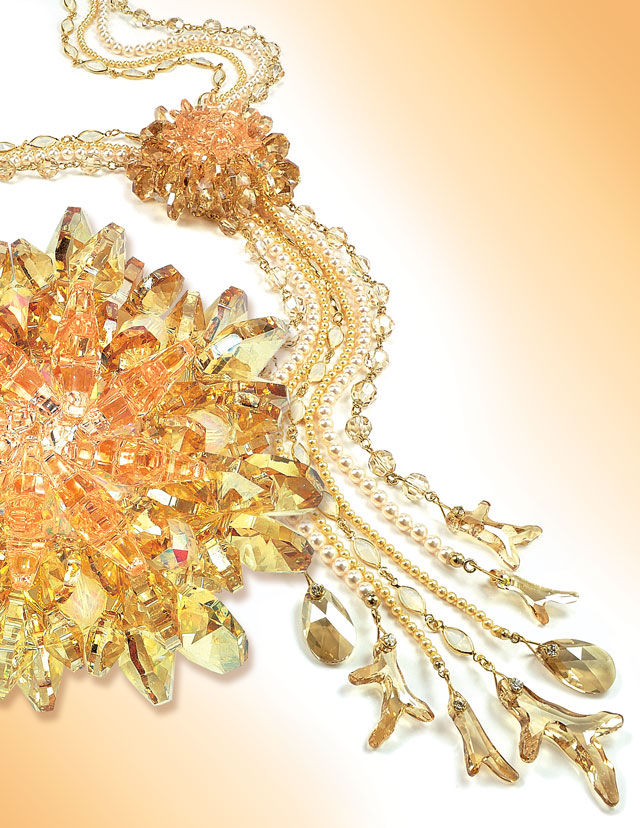
For the past three years, one of her designs has been displayed in Swarovski’s booth at the Accessories Show in New York City, showcasing a high-end, trendsetting look achieved using the company’s newest products. In 2009, Swarovski chose Hartung’s Bloom Necklace (below) to showcase. The bloom itself is a removable enhancer with a magnetic back—a piece that may appear simple but is time-consuming to create. The process involves “doodling” with beads on string, working with the facets of the crystals until they shift into the perfect shape. Hartung calls it “crystal origami.”
Working with crystals is a gentle art, she explains. If there is a “pop” or any colorful shards appear on her white work table, Hartung unstrings the beads and starts over. The beading process itself can be incredibly time-consuming. For example, the Bloom Necklace takes 10 to 12 hours to create, with the bloom portion taking about eight hours itself. And that time is reflected in the price tag: While most of Alacarte’s jewelry sells for less than $200, the Bloom Necklace sells for just under $1,000.
If creating complex beaded pieces weren’t enough, Alacarte’s business evolved as one problem led to a custom solution. Believing clasps should be “a beautiful beginning and a beautiful ending to your jewelry,” Hartung and her husband and business partner Tim searched for and couldn’t find clasps they could bejewel and coordinate with a bracelet or necklace. In the end, they worked with a few companies in Europe to design nickel-free clasps with indentations for gluing Swarovski crystals, giving them a bezel-set appearance. The companies now custom-manufacture these clasps exclusively for Alacarte.
They then came across a wire mesh material made of hair-fine wires with an enamel coating, which is also now being manufactured for them under the trademark WireLace.
When beaders from around the world contacted Alacarte asking where they could get the clasps and WireLace used in the company’s work, Alacarte started selling the products, opening up new business opportunities.
“If you’re innovating, you don’t have anything to follow,” says Hartung. “The designers who are leading the way don’t let what they don’t know—or what they can’t get—stop them.”
Wood Nymph By Alacarte Jewelry
“If you were a wood nymph, this would be the necklace you would want to wear,” says designer Linda A. Hartung of Alacarte Jewelry in Forestville, California. The three branches intertwine, giving it the appearance of no beginning and no ending. “It’s actually very comfortable to wear,” she adds. “You can bend it to fit your shape.” Comprising all Swarovski crystal components, the necklace took approximately 70 hours to create and sells for $3,000.
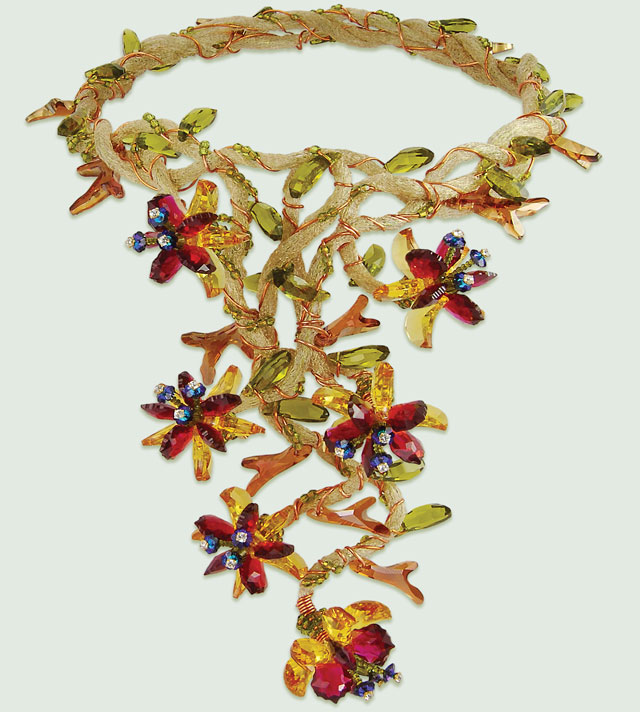
Crystal pressing against a hard surface can fracture at the facet edges, so the necklace’s frame had to be soft. Hartung covered 18-gauge wire with 1/8 inch diameter RNT clear flexible tubing to create a soft, bendable structure for the necklace. Two layers of Alacarte’s trademarked WireLace enamel-coated hair-thin wire in pale gold slide over the tubing, covering it completely.
Enamel-coated 20-gauge copper wire winds around the tubing with a variety of Swarovski Elements added for a natural, woodsy look.
Each of the six flowers is made of moon and baroque Swarovski Elements pendant crystals and takes about three hours to create. The crystals are strung on wire and manipulated until the facets move into a pleasing shape, with no two flowers looking exactly alike. The bottom is then crimped to secure. After crystal head pins with crystal beads are added as stamens, the finished flower is inserted into an open end of tubing, then wrapped with copper wire threaded with 3 mm green crystal beads to both secure the flower to the piece and finish the underside with a natural look.