

Handle with Care
Tips for designing with and setting delicate gemstones
By Shannon L. Brown
The modern consumer is all about unique. Studies have shown that Generation Y jewelry shoppers dare to be different, option for custom designs and designer pieces over run-of-the-mill product.
When it comes to gemstones, the same philosophy holds true. Consumers today are more open to wearing unusual gems, and there is a trend among designers to incorporate less familiar stones into their work. No longer wedded to the classic trio of ruby, sapphire, and emerald, jewelry makers today are drawn to lapis, moonstone, opal, and turquoise, to name a few. But while these gemstones offer the uniqueness consumers are asking for, they can also pose stressful challenges to the jewelers who work with them.
Most of these gems are relatively fragile, and therefore must be handled with care. Design, fabrication, and finishing techniques all play into keeping the stones safe. Technologies such as CAD/CAM and laser welding can help, making possible setting and fabrication techniques that were not an option in the past.
Below, six designers share examples of pieces that showcase delicate gemstones. They explain what they did in the design and fabrication process to ensure those gemstones not only look their best, but also stay safe during both the creation of the piece and subsequent wear.

Robert Pelliccia
JR Dunn
Lighthouse Point, Florida
To make perfect settings in 18k white gold for these irregularly shaped, hand-carved jade teardrops without subjecting them to stress, Robert Pelliccia relied on the precision of CAD/CAM. He imported a digital photo of the jade into the outline. He cast the 18k frame to fit the jades exactly and attached tiny 21 gauge prongs in the four corners on each side. After tacking the prongs in place with a laser welder, he soldered them permanently. He prong-set the frames with sapphires and diamonds, and polished the prongs before setting the jades to prevent damaging them.
Pamela Froman
Pamela Froman Fine Jewelry
Los Angeles
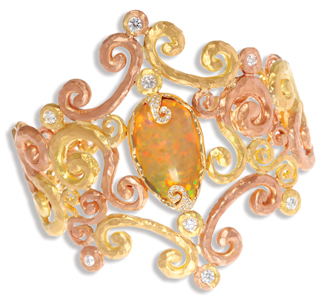
To keep the edges of this teardrop-shaped Ethiopian opal safe, Pamela Froman bezel-set it in her own alloy of 18k pink and yellow gold. She added a diamond-studded swirl over the bottom of the bezel to form an extra layer of protection for the opal’s delicate tip, mirroring the element at the top. Set from the back, the opal is covered with a filigree cutout sheet of gold, then laser welded at the edges, taking advantage of the laser’s ability to weld next to heat-sensitive gemstones.
Leon Megé
Leon Megé Inc.
New York City
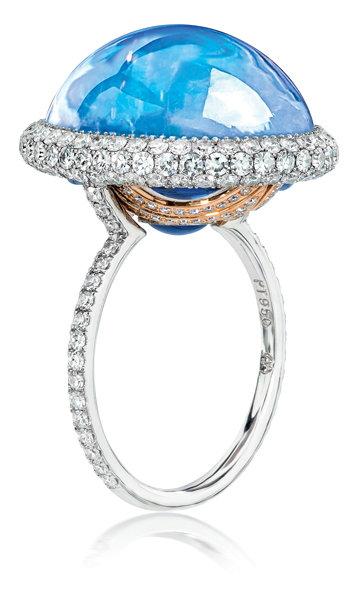
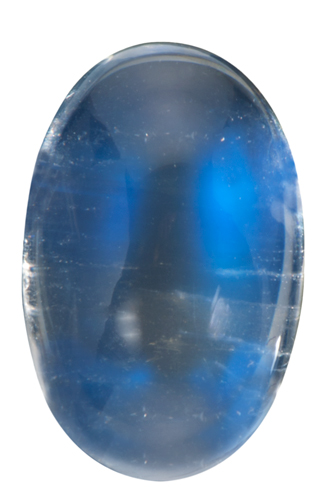
The intoxicating blue milkiness of this African moonstone begged for the most unobtrusive setting—definitely not traditional prongs, which would hide the stone and could scratch the surface of the gorgeous gem when the metal was pushed onto it. Leon Megé’s solution was to create a low bezel-type setting for the moonstone and raise tiny beads on the inner edge of it while pavé setting the diamonds.
Four marquise-shaped buff-top cabochon sapphires are burnished onto a palladium cup that sits beneath the moonstone, reflecting blue into the stone to enhance its color. Diamond-set 18k rose gold stripes are soldered to the bottom of the cup. To assemble the setting, the cup is soldered to the platinum shank, the diamond-set halo of platinum is soldered in place, the moonstone is set, and the tiny beads are gently pushed toward it as prongs.
Mark Schneider
Mark Schneider Design
Long Beach, California
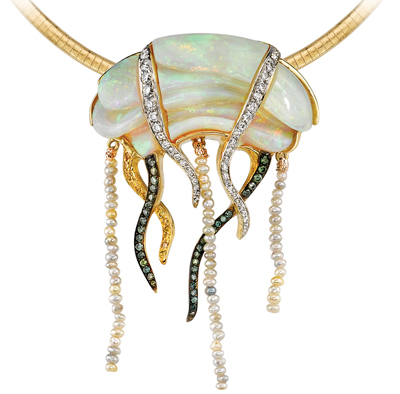
A large, irregularly shaped opal in Mark Schneider’s shop was destined for reincarnation in the form of a 14k yellow gold jellyfish. But while he was working on the initial design, the opal cracked in two pieces. A crisis for some, Schneider just went with the flow, having a lapidary intentionally crack the opal at the opposite end to create three separate pieces, then modifying his design to suit.
Schneider had the lapidary clean up the edges and carve the opals a bit to give the jellyfish a more realistic appearance. Since the opals have unevenly shaped backs, setting them required special care. Trying to simply press them into a flat-backed bezel-type setting would likely end in disaster, as the combination of open space and pressure could cause the gems to break again. To avoid this, Schneider pressed the opals side-by-side into wax, and carved and cast the setting in one piece to fit them precisely. He first set the tentacles with white, black, and yellow diamonds, attached the pearl tentacles to jump rings, then set the three opals in place and snugged the metal up around them.
Alishan Halebian
Alishan Jewelry
Irvine, California
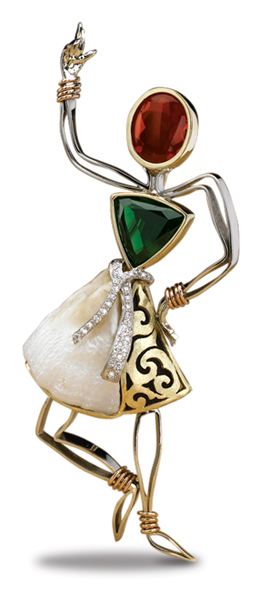
A montage of delicate stones comes together in Alishan Halebian’s 18k yellow, rose, and white gold Ballerina pin. After fabricating the metal frame for the piece, Halebian set the fire opal head and chrome diopside body from the back. He used a laser welder to attach a piece of gold in a corresponding shape with an open center to hold each of the stones in place. The skirt portion of the frame was designed to hold a piece of ebony wood on the right and a natural Tennessee River pearl on the left. Halebian placed the ebony into the setting and laser welded a scrollwork 18k cage over it. He then pinned the pearl in place with a pin that sticks up from the leg component beneath it. In the final step, the diamond-set white gold scarf, which acts as a kind of extended prong over the pearl, was laser welded on as a decorative means of holding the piece together and protecting the pearl.
Dawn Muscio
D. Muscio Fine Jewelry Studio
Atlanta
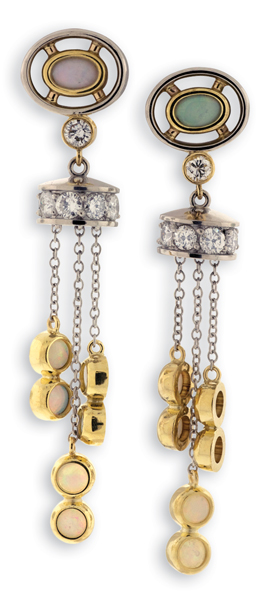
When repurposing delicate gemstones from an heirloom piece, the challenges of keeping those gems intact intensify. Such was the case in this pendant and earring set by Dawn Muscio. The client wanted to use opals from a piece she had inherited in a new design, some of which were chipped. Muscio’s solution was to create heavy bezel settings cast in 18k gold for the opals. These heavy settings not only serve to hide any pre-existing damage, but also provide a durable barrier to prevent any further damage during wear.
To set the 3 mm diameter round opals, Muscio placed each inside a cast 18k yellow bezel, then inserted a slice of 3 mm diameter tube behind the opal and secured it in place with a laser welder. The oval opals are secured in a similar manner but with a cast piece that matches their shape.
Five Tips for Setting Delicate Gems
1. When setting delicate gemstones, use a softer metal to lessen your chances of damaging the gem during fabrication and setting. “For yellow, opt for 18 karat gold, and for white, choose platinum or palladium,” says Dawn Muscio of Atlanta.
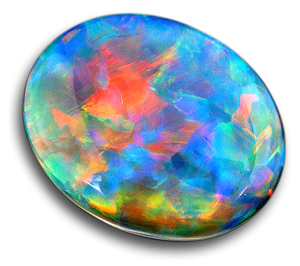
2. Porous gems, such as opal, require extra-special care, as they soak up just about anything. “We learned this the hard way when we went to rhodium plate a two-tone 18k piece set with an opal,” recalls Pamela Froman of Los Angeles. “We masked the non-white parts with Dykem Steel Blue Layout Fluid, but that mixed with the rhodium solution and the opal soaked it up and turned purple…permanently.”
3. Always suggest low-wear pieces such as pendants or earrings when working with a client who wants to use delicate gemstones in a custom design, recommends Muscio. “If it’s a sensitive stone, I don’t usually recommend a ring unless it’s special-occasion,” she says. “If the stone is going in a ring, I’ll be very conscious of the setting style, taking into account the girdle of the stone. If inclusions come to the edge or it has a thin girdle, I’ll bezel-set it because it lessens pressure. When you hammer something all around, it’s a gradual and more even pressure than pushing on one point with a prong.”
4. “Keep in mind that some delicate gems still have the potential for breakage, no matter how well-planned the design or protective the setting,” adds Froman. “Make sure the end consumer is aware of the fragility of their new gem, so they will give it the proper care. I like to include personalized opal care instructions with the sale of any of my opal jewelry.”
5. When it comes to applying heat near a sensitive stone, the laser welder is your best friend. “With delicate gemstones, the laser as a tool becomes very, very handy,” says Halebian.
But even when using a laser, take all the necessary precautions to protect the gemstone prior to welding near it. “Use a barrier to prevent drafts from hitting the stone,” suggests Leon Megé of New York City. “If it cools too quickly, it may crack.”