

Group Effort
The inspiring story behind the Matilija Poppy Project
By Tina Snyder
It was during a visit to the Newark Museum when metalsmith Tom Herman and enamelist Patsy Croft first held a piece of jewelry that would change their lives forever: The Ada Brooch, a plique-à-jour masterpiece crafted by Marcus and Co. in 1904.
“As makers, Tom and I became obsessed with the construction of this piece,” says Croft. “We were captivated by all the details—from how languidly it moved to its unbelievable integrity and apparently stress-free structure, for going on a century.”
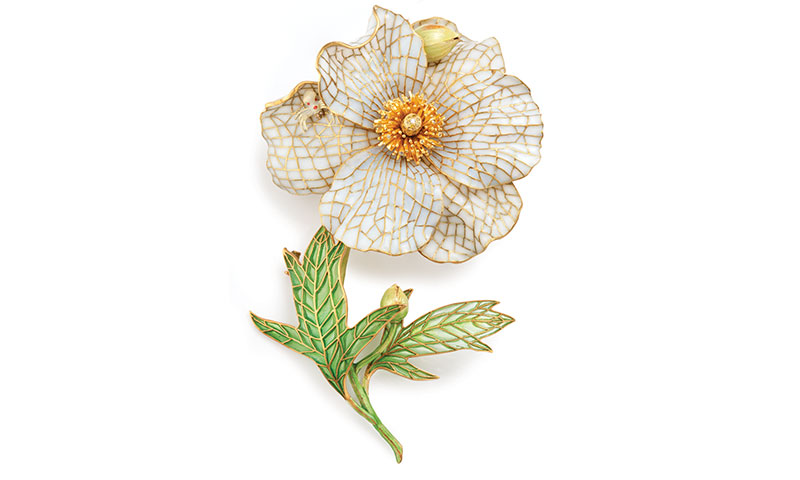
The pair researched the Ada Brooch and estimate that it took between five and seven craftspeople to bring it to life. It would take a collaborative process to devise something so complicated, and yet so elegant—and they were up for the challenge.
And the timing couldn’t have been more perfect, as Herman was scheduled to teach a hands-on jewelry workshop at the Mendocino Arts Center (MAC). He suggested to the MAC jewelry/metals coordinator that Croft teach a workshop on enameling concurrently, with students visiting both classrooms and learning from both artists. Participants would collaborate on a three-dimensional plique-à-jour piece inspired by the Ada Brooch that would be auctioned to benefit the MAC’s jewelry/metal arts program.
For the MAC brooch, the muse was found in the matilija poppy. Native to California, this crepe papery white flower with a sunny center blooms as large as your palm. In late spring and early summer, the MAC features a stunning display of the poppies—making them the perfect subject of the collaborative project.
A dozen metalsmiths and eight enamelists convened for the workshops in January of 2017, perfecting their fabricating, chasing, saw piercing, and plique-à-jour skills while making important contributions to the early design and fabrication of the poppy. Through conversations and brainstorming, the sketch took shape. The biggest hurdle was translating the delicacy of the flower into a structurally sound brooch made of metal and glass.
During the workshops, the group fabricated the main components that comprise the poppy in 18k gold, including alloying the metal, rolling sheet, forming the pieces, chasing, and fusing the components together. Enamels do not work well with solder, so fusing is required.
Then there was the feat of making the poppy’s stamens look realistic. “It was no easy trick to get those little spikes to stand just right, but one of Tom’s students, Dawn Nakanishi, had the perfect approach,” says Croft. “Initially we had planned to make a dome then add wires with balled ends, but Dawn showed us how to take a tapered strip of metal, cut slits a few millimeters apart, roll it up, and then pull the strips of metal open like a paper flower.”
Armed with the main components of the poppy at the culmination of the two-week workshops, Herman and Croft had their work cut out for them in completing the brooch—and a few unexpected setbacks along the way.
Herman returned home to find that what he thought was a sinus infection was actually non-Hodgkin lymphoma. He immediately began aggressive chemotherapy treatments.
“My passion for the poppy project was my saving grace through those dire days,” he says. “Even when I felt lousy, it was better to feel like crap at my bench, working on the project, than laying in bed.”
With the help of his son, Ethan, Herman painstakingly pierced and chased each of the elements. He then fused them in segments that could be disassembled for the enameling process and easily reassembled. Herman estimates he spent 1,200 hours on the final metalworking of the piece, then shipped it to Croft for enameling. In the video below, you can see Herman piercing one of the brooch’s petals.
Shortly after receiving the poppy framework, Croft had an old back issue flare up and went in for surgery. “Like Tom, I found that when I’m determined and have something other—and greater—than pain to think about, it makes all the difference,” she says.
On the road to recovery, Croft began the approximately 800 hours of enameling. “The poppy pushed me to a new level in my practice of plique-à-jour enameling,” she says. “I could hear the voices of the old masters behind the Ada brooch whispering in my ear, helping me figure out how to get just the right color combination to make the flower’s buds, leaves, and petals come alive in all dimensions.” In the video below, Crotch enamels a poppy leaf.
Herman, Croft, and the helping hands of the MAC workshop group saw the fruits of their labor in the spring of 2019, when the Matilija Poppy Brooch was auctioned at Sotheby’s, fetching $47,500. All proceeds benefit MAC’s jewelry/metal arts program—where Croft and Herman hope their passion for this project will inspire other artists to collaborate and push the boundaries of jewelry design and fabrication to achieve extraordinary results.