

Great Beginnings: Getting to Know Alishan Halebian
Getting to know Alishan Halebian
By Irina Hawkins
When did you know you wanted to be a jewelry designer?
Growing up, I had no idea about the industry; I stumbled into it. In Armenia, I studied ceramic arts in college. I loved it, but it was short-lived because we emigrated. When I arrived in the U.S. in 1970, I was 18. I took drawing and design classes at Los Angeles City College, but I had to find a way to support my family, so I started working as a stone setter for a family friend, and later—for Edward Zakarian, an Armenian jeweler from Romania. I worked in his shop in downtown Los Angeles for two years.
What drew you to the field?
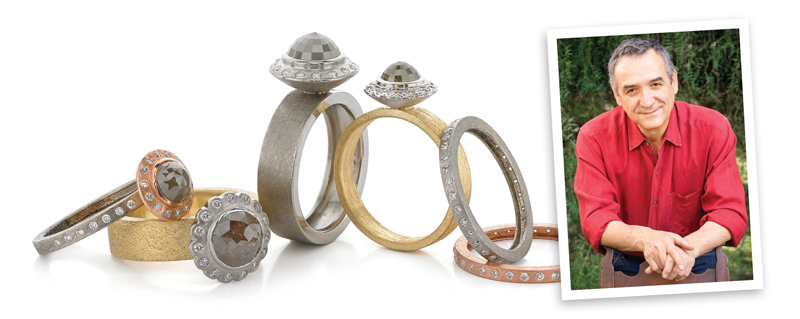
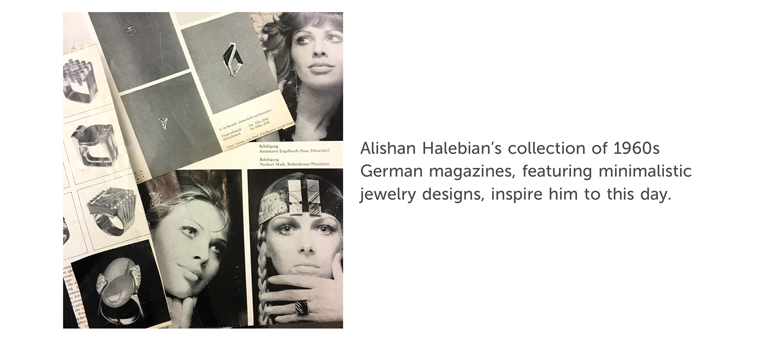
I was considering studying architecture, but changed my mind after being moved by some remarkable jewelry I saw in the pages of old magazines I have to this day. Because Zakarian had trained in Austria, he had German Gold and Silver magazines from the 1960s. The jeweler was going to throw them away, so I took them. I really liked the minimal approach—the artistic and sculptural shapes pulled me in. Even after 50 years, those designs still look fresh and inspire me. It’s very hard to do something so simple and yet so striking. When I design, I try to combine that aesthetic with my love for ornamentation. The contrast appeals to me.
How did you get your start as a designer?
After Zakarian’s business went down, I opened up my own company. Making a living stone setting, I earned to create. While I could draw the designs, I didn’t know how to produce them since I never had any training. I began teaching myself. Once I saw how impeccable other designers’ work was, I’d get self-conscious about mine. Every time I finished a piece, I’d put it in a safe. Working on custom orders allowed me to sharpen my techniques, but I still didn’t feel ready to show the pieces to anyone, accumulating them for nine years.
What is a memorable challenge you had to overcome?
The most challenging part was learning to focus. I’m impatient. When I start a piece, I lose interest in it even before I finish it. Yet, a focused collection is stronger. I learned this the hard way. When I tried selling the contents of the safe to local stores, I received many compliments but no sales. I found out that my line was all over the place. Even though the pieces were beautiful, the collection lacked cohesion. I’d hear, “We don’t have a customer for this,” over and over. When you’re not connected to the market, you’re just acting on a whim. You do anything you want—contemporary, eclectic, and everything in between. They couldn’t see Alishan when they looked at my line. Now, to prevent getting bored, I work on 10-15 pieces simultaneously.
Who were your mentors?
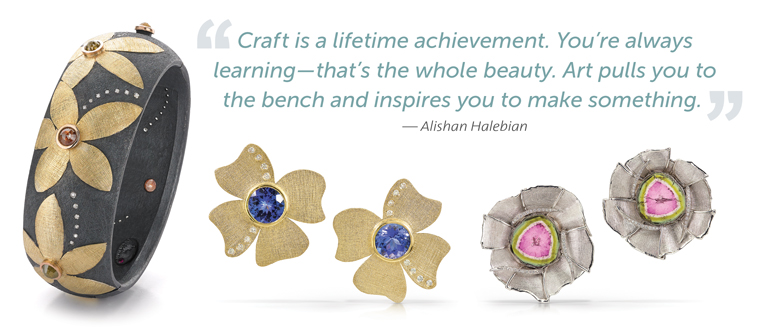
I bought a wonderful technical book called Jewelry: Concepts and Technology by Oppi Untracht. That’s how I learned how to make jewelry. It took me years to master some techniques, but the studying part is still not finished. Craft is a lifetime achievement. You’re always learning—that’s the whole beauty. Art pulls you to the bench and inspires you to make something. Because I’m self-taught, I’ve never had anyone tell me what to do and always enjoyed my independence. I learned from my own mistakes, stumbling onto wonderful surprises once in a while. Because of the trial and error process, it took longer. But I wouldn’t trade the freedom of the mind for anything. There’s no substitute for it. Especially in the creative process, it’s a must. Also, when I look at my friends’ designs, I get inspired. I consider them my mentors. Anything that moves me, including music, art, and architecture, is a mentor.
Did you change your mind about anything along the way?
For a long time, I avoided CAD. I just had a mental barrier that prevented me from using the technology, even though it allowed for perfect lines and a quick turnaround. I felt that a CAD-produced design was easy to distinguish, soulless, one of a bunch. I liked the imperfections of bench designs, but ultimately decided to get with the times and learned the software on my own. It took a long time to become proficient. When I could have done something in five minutes on a bench, it would take me two to three hours via CAD, but I persisted. Now I understand that every technology has a good and a bad side. I combine hand fabrication and CAD in my work.
What advice would you give to new jewelers?
When starting out, drop all labels. Forget about becoming a designer. Begin from step one and move up. You can’t jump. Be connected to the trade—its publications, shows, and contests. Feel the heart of the industry and the designers.