

Go with the Flow
Effective spruing strategies
By Shawna Kulpa
(Originally Published by MJSA August 2019)
Casting jewelry isn’t for the faint of heart. Aside from the high temperatures needed to melt precious metal alloys, you’ll need to rush that molten metal into a hot flask as fast as possible. There’s also a tremendous amount of science involved: Casting is equal parts physics and metallurgy, with maybe a dash of mad scientist mixed in.
Even if you’re going to pass the heavy lifting to your trusted caster, you may still decide to attach the sprues to your models yourself—perhaps you want to preserve your design’s delicate details, or make cleaning up the finished casting easier. To help with that, we checked in with some jewelry casting experts for their best advice on spruing. If you’re part of that DIY crowd—or if you just want some tips on how to improve your casting operation—their suggestions will help to ensure you can “go with the flow” for success.
Sprue Vs. Support
Although the world of jewelry casting hasn’t changed too much over the years, casters report one recent development they’ve noticed since more jewelers have started creating their models on 3-D printers.
“One of the things we’re seeing more of now is people printing models in their own shops and wanting to use the print supports as sprues,” says Joel Meltzer, director of manufacturing at TechForm Advanced Casting Technology in Portland, Oregon. Models created on 3-D printers often need supports built with them in order to hold up the parts as they’re being printed. The supports actually resemble long, thin sprues, connecting to the model and running down in a straight line to the build plate. It’s easy to see why a jeweler would be tempted to keep them in place, rather than removing them and attaching real sprues. But Meltzer and others all agree that supports aren’t sprues.
One of the reasons is that most supports are on the small, thin side and won’t quickly feed metal to a model. “You won’t get adequate feeding, and you’ll wind up with shrinkage around all of those connections,” warns Meltzer.
Although he recommends removing the supports completely from the printed models, Meltzer does note that you could build sprues into a CAD design and use them as supports, depending on their specific geometry.
“It’s great to grow the sprues with the pattern because you can place them where you want and the connections will be cleaner [than when sprues are attached later in the casting process],” he says.
But even if your designs don’t lend themselves to being built with sprues that can double as supports, there are still things you can do in CAD to help the casting process.
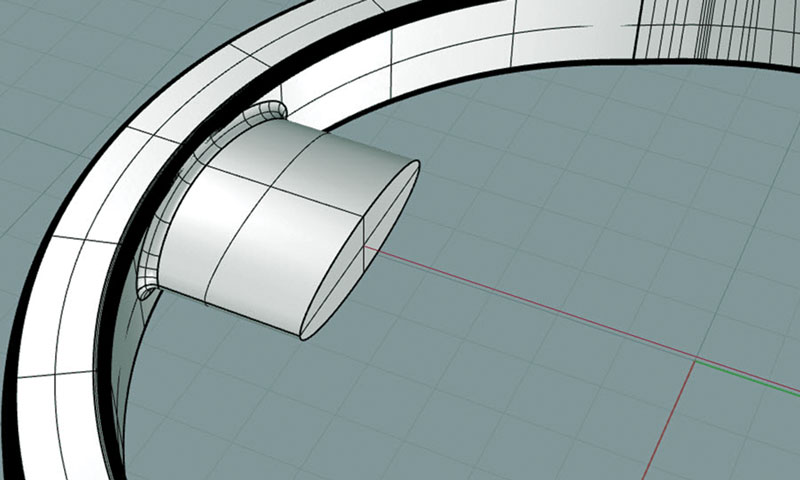
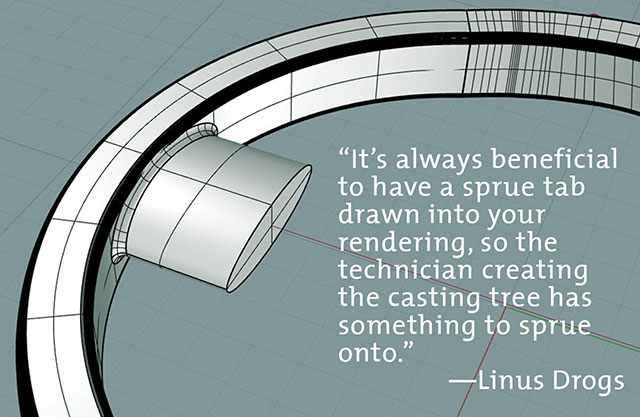
“It’s always beneficial to have a sprue tab drawn into your rendering, so the technician creating the casting tree has something to sprue onto,” says Linus Drogs, president of Au Enterprises, a custom jewelry manufacturer in Berkley, Michigan. He adds that it doesn’t have to be a full-blown sprue: “It’s just a little extension of the part in the right location that you can then build off of.”
If you want to include sprue tabs in your CAD files, be sure to give their location as much thought as you would if attaching the actual sprues. “They have to be carefully planned,” advises Drogs. “It can’t be haphazard. You need a purposeful design plan.”
Location, Location, Location
But Drogs cautions against investing too much time and energy into creating sprues as part of a CAD file—not unless you have an understanding of physics and how molten metal will flow into a model. What looks like a good location to you, may not be the best location in order to obtain an ideal cast model.
There are two groups of people in casting, Drogs says, and “they’re diametrically opposed when it comes to sprue location, size, and number.” On one side you have the casters, who want to cast as perfect a model as possible. On the other side you have the folks who will be finishing the piece, who want a model that’s easy to clean up after casting.
“Finishers want the sprues in the simplest, fastest, easiest locations for finishing the product. They want the ‘lollipop’ model, where there’s one sprue placed at the base of the piece,” says Drogs. “Casting people will go a little larger on the sprues and may be conservative and want multiple sprues, or want to sprue to a location on a pattern that might be more complex.” Such tactics will lead to more cleanup and more costs, two things jewelers typically don’t like to see.
Dennis Busby, the casting director at Stuller Inc. in Lafayette, Louisiana, has been responsible for millions of parts cast over his 35 year career, and he recommends that you yield to the recommendations of your caster. It will likely lead to a superior cast product, he says, even if it doesn’t save labor in the manufacturing process.
“Spruing to the thickest cross-section of the part, which is typically the shoulders or top of a ring mounting, ensures liquid metal is fed into the casting as it solidifies,” he says. “This minimizes the chance of shrinkage porosity as the molten metal loses volume during cooling.”
“There are no shortcuts,” adds Drogs. “You have to understand some of the physics that are going on and address them properly.”
Less Is More
If you’re hesitant about placing a sprue in an ideal spot because of the cleanup work involved, you may try to get around this by placing more sprues in other areas. If so, remember: As with many things in life, less is more.
“Overspruing is just as bad as underspruing,” says Drogs. “You can oversprue a piece and create a hot spot—an area where you have all of this heat being generated from metal sitting there trying to solidify, which can increase the metal-to-mold reaction. You wind up with a hot region that can superheat the model surface, leading to more outgassing.” This, he says, can lead to gas porosity or a deterioration of the model surface.
Overspruing can also create weak spots, thanks to the turbulence of metal streams encountering one another in the mold.
“You want to keep the metal flowing as smoothly and evenly as possible,” says Joe Lovato, technical sales manager of Legor Group USA in Albuquerque, New Mexico. “When multiple streams of metal meet as they enter the flask cavity, resistance is created as the metal tries to feed in.” This resistance, he explains, can result in shrinkage or a weak spot in the casting because of gases that become trapped as the metal starts to solidify: “You could wind up with a distorted piece or one that’s super weak at that point.”
To avoid this, he recommends to “always start with one sprue. It’s the most efficient way and it costs the least since there’s less metal in process.” If one sprue isn’t sufficient to avoid fill or shrinkage issues on a certain side of the piece, try adding a second sprue to that area. “I recommend trying to do everything with as few sprues as possible,” Lovato says.
Size Matters
Unfortunately, there is no set formula to determine the best size sprue you should use for a specific part. There’s no consensus among casters on an ideal sprue size, either.
Lovato says that at Legor, they use 3 mm as the starting sprue size point for most standard jewelry items. “That will feed a ring or a standard-size pendant,” he says.
Meltzer, who mostly casts platinum group metals at TechForm, says that a good general rule of thumb is to make sprues 1.5 to 2 times the diameter of the part being cast, though he cautions that “it’s not a hard-and-fast rule.”
And Busby at Stuller recommends that sprues “be at least 75 percent of the cross-section for gold, and more for platinum.”
Given this, you may be tempted to make the sprue slightly larger than what you think is needed. After all, wouldn’t it be better to have more metal flowing faster to the model?
Not necessarily, cautions Lovato.
If the sprue is too large, you run the risk of creating heat zones in the largest parts of the model. “These heat zones can start to suck metal away from cooler parts of the casting [such as the band or shank of a ring], pulling metal back into the sprue,” he says. “This can create issues with shrinkage and incomplete fills, and it can affect the overall strength of the piece.”
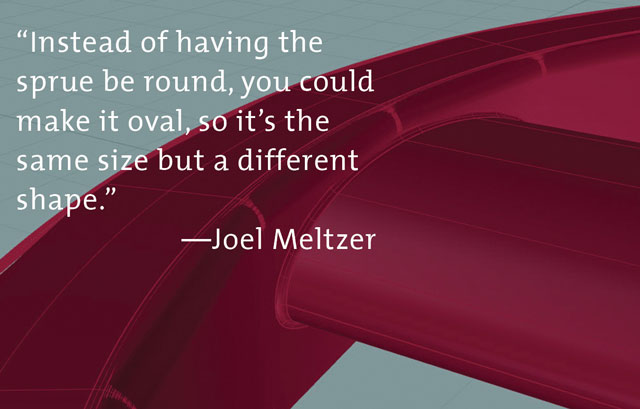
This is a situation where it’s best to rely on your caster’s years of expertise to determine the best size sprue for your models. And don’t worry if your caster recommends using a sprue that’s slightly larger than the piece it’ll be feeding into. While that may seem odd (or even impossible), keep in mind that the sprue shape isn’t fixed and can be changed to accommodate the part being cast.
“Instead of having the sprue be round, you could make it oval, so it’s the same size but a different shape,” says Meltzer. “You can always change the shape of the sprue, within reason.”
One area on which most casters do agree is that sprues for platinum castings should be shorter than those for gold. Platinum’s higher melting temperature means that the metal doesn’t stay in liquidus form as along as lower temperature alloys. “There’s not a lot of room for error in getting the metal in place as quickly as possible,” says Meltzer.
“Because platinum is so much more sluggish [than gold], people will increase the diameter and decrease the length of sprues for platinum,” says Lovato. “The longer the sprue, the cooler the metal is as it enters the piece. If you use too long of a sprue, you’re not going to feed in enough metal fast enough.”
The same reasoning applies to higher karat golds. “It’s been my observation that the higher the karat, the more important spruing becomes,” says Busby. For example, 18k alloys tend to have narrower freezing ranges than their lower-karat counterparts, so creating larger or adding additional sprues would increase the chance of success. Additional sprues are also recommended for certain alloys that lack good fluidity, such as some rose gold formulations.
In the end, it all comes down to that fluidity: Getting as much metal as quickly as possible into your mold. And if it all seems a little complicated and overwhelming, don’t fret. You can always turn to your caster for their expertise—something all of our experts urged. Together, you can ensure that your metal—and your profits—continue to flow smoothly.