

Full Disclosure
A call to disclose new sapphire treatment
By Deborah A. Yonick
(First published in March 2019 MJSA Journal)
There’s a new sapphire treatment in town, and it’s one that GemResearch SwissLab (GRS) believes requires full disclosure.
This new, distinct treatment process for sapphire combines conventional heating with a high-pressure, high-temperature (HPHT) process to give colorless or light blue stones the desired blue hue. These treated stones first appeared in Sri Lanka in 2015, and it was at that time that dealers initially contacted GRS.
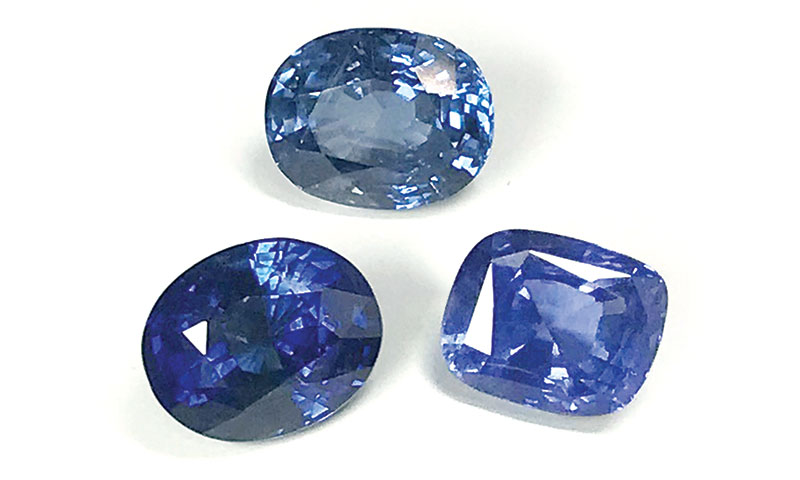
GRS first became aware of this after it discovered treated stones in parcels from 74 different customers that supplied stones to GRS labs in six locations around the world. “The fact that it started to appear as non-disclosed, unrecognized, and mixed into high-value lots from many different customers that supplied stones to GRS labs in New York, Hong Kong, Paris, Sri Lanka, Bangkok, and Switzerland shows it has penetrated the world market,” says Edward Cleveland, a researcher for GRS.
Since discovering the treated stones, GRS has conducted multiple examinations, which have led it to believe that the additional HPHT process requires full disclosure and industry-wide conformity to create a harmonized method of identification.
Treatment Origins
According to a GRS white paper, HB Laboratory Co. Ltd. in South Korea first successfully treated corundum with this new HPHT technique in 2009, but commercial production didn’t start to appear until 2015. “Dealers contacted GRS explaining that previously untreatable rough was suddenly being purchased at significantly higher prices, so it was thought that it was for a diffusion process,” says Dr. A. Peretti, founder, CEO, and research director at GRS. He cites Madagascar and Sri Lanka as the preferred sources of stones for this treatment, as HPHT treatment on stones from basaltic sources (such as Nigeria and Australia) has been unsuccessful.
Peretti says buyers close to the source are paying much less for HPHT-treated stones compared to similar quality sapphire having undergone traditional heat treatment. “But the price difference and disclosure of HPHT sapphires becomes blurred as these stones reach the end consumers.”
The Potential for Problems
In its research, GRS found that the HPHT process creates a weakness in some of the sapphires, perpendicular to the surface. “During parting or hammering, the stones would fracture toward the center of the gem, which is unusual for corundum,” says Cleveland. “Sapphire is very hard, ranking 9 on the Mohs scale. This change in its physical property could make some of the sapphires more brittle.”
One of the reasons that GRS is calling for disclosure of this treatment is because it believes that there’s a chance that the girdles in some of these sapphires are in danger of chipping during mounting and un-mounting.
“Sapphires are faceted first, then treated and re-polished,” Cleveland explains. “Our research shows that the effect of the potential brittleness produced by the new treatment is strongest in the outer areas of the stones. The girdle is an area that is very sensitive to breaking in the mounting and un-mounting process. These stones should be disclosed properly so the jewelry manufacturer can make their own observations and apply special care. Some of the HPHT sapphires did not pass the GRS stress tests (hammering, sawing, and applying stress with hard objects under the microscope), but we are not necessarily applying the same type of stress to the stones as a manufacturer does.”
The sapphires’ color is stable and there are no non-accepted color agents involved, says Cleveland, who notes that research has been picked up by many research teams after the first GRS report on the treatment was published last fall. “More statistical data is needed to investigate these gemstones and the possibility for brittleness.”
Detection & Disclosure
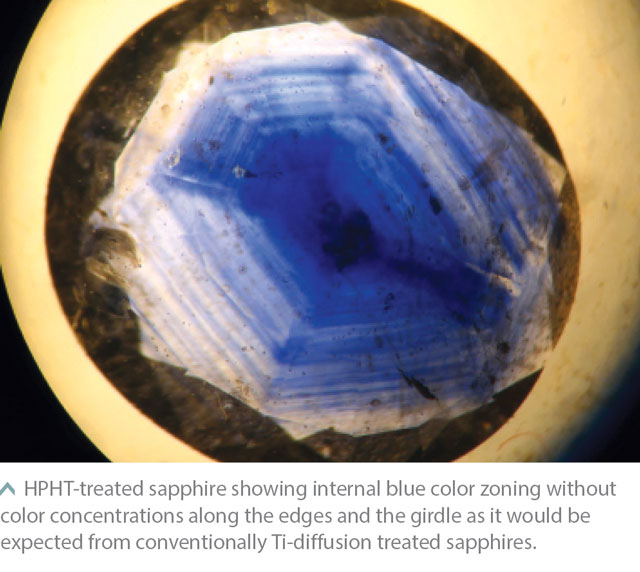
A combination of high-tech and microscopic methods must be used to separate stones, Peretti says. “FTIR spectroscopy shows a classical broadband signature. However, we found that HPHT affects the outer part or rim of the stone and not the core. Stones that were conventionally heated and later HPHT treated retained the signatures of both conventional and HPHT-treated stones. It is a real challenge in identification that needs years of practical testing experience.”
After testing, GRS discovered different types of infrared spectroscopy lines and new types of inclusions, such as healing patterns and particles in the cracks. “This type of healing looks very different, because there is no annealing process involved,” Peretti says. “We also discovered synthetic graphite inclusions.”
If no high technical analysis is available, Cleveland advises gem buyers to look through a loupe for fluid inclusions—feathers that have very small brownish cracks emerging from them. “Also, look for graphite fillings in surface reaching cracks.”
Peretti and Cleveland say they are surprised that the Laboratory Manual Harmonization Committee (LMHC) decided that the process does not require further disclosure beyond stating they were heat-treated. Late last year, LMHC said in a statement to the industry that the new sapphire heat treatment was incorrectly named HPHT in the trade. “Current scientific knowledge and available data from the LMHC laboratories indicate that the latter treatment is essentially a form of heating, and as such is similar to most known heating techniques,” said the statement. “It consequently does not currently require specific reference on the laboratory reports of the LMHC members.”
The point was made that it cannot be called HPHT, as lower pressures were used for treating the sapphires than are applied to treating diamonds, says Cleveland. But according to the manufacturer, the atmospheric pressures are about 1,000 times higher than the standard pressure used for conventional heating, making it different than traditional heating.
“The machine used for this process is capable of much higher pressures,” says Cleveland. “It’s theoretically possible to increase the pressure even further at a later point for this treatment. We expect the manufacturer to continue experimenting for better results and assume it might happen in the future.”
Cleveland underscores that the product is valid and there is a market for it, but that full disclosure of the treatment process must be made so that the buyers can make their own informed decisions. If GRS’ experience of testing in New York is representative of the market, Cleveland suspects that there’s a chance that a very small percent of sapphires at the Tucson gem shows this year may be at risk of being undisclosed.
“Buyers should be specific and demand that this product be disclosed, particularly now as the loophole for non-disclosure of this product seems to be closing,” Cleveland says. “It may be the last time that somebody can try to sell this material with certificates from other labs that have a different philosophy of disclosure.”