

FTC Guides, Finalized
FTC Trade Commission releases its revised Guides for the Jewelry, Precious Metals, and Pewter Industries
(First appeared in the September 2018 MJSA Journal.)
By Shawna Kulpa
It’s been a long time coming, but in late July, the Federal Trade Commission (FTC) released the finalized updates to its Guides for the Jewelry, Precious Metals, and Pewter Industries. The revision process began in 2012, when the FTC first announced it would update the “Guides,” as they’re called, which recommend how jewelry can be promoted and sold in order to avoid consumer deception. Six years later, after many comments from consumers and the industry (including from a coalition of industry associations led by the Jewelers Vigilance Committee), the new guidelines have been finalized—and are effective immediately.

The revisions mark the first time in 22 years that the Guides have been fully updated. To help you comply with them, we’ve compiled a list of the changes. (The full text of the revised Guides is available at the FTC website, ftc.gov.)
Precious Metal Thresholds
One of the biggest changes made to the Guides is when items can be described as “gold” or “silver.” Previous Guides advised against using the words “gold,” “silver,” or their abbreviations to describe or mark a product unless the amount of precious metal it contained met or exceeded specified thresholds. Those thresholds were 10k fineness for gold (41.67 percent pure gold by weight), 900 parts per thousand (ppt) for coin silver, and 925 ppt for sterling silver.
The FTC removed the thresholds for gold and silver alloys. It now says sellers can use gold terms to describe a product (or part thereof) composed throughout of gold alloy, regardless of karat, if they qualify the term with an equally conspicuous, accurate karat fineness disclosure.
“You can have 8k gold and use the word ‘gold’ as long as the fineness is disclosed,” says Sara Yood, senior counsel for the Jewelers Vigilance Committee (JVC) in New York City.
The term “silver” can now be used to describe a product or part composed throughout of an alloy containing less than 900 ppt silver, as long as the term is accompanied by an equally conspicuous, accurate designation of the item’s silver content.
However, the Guides recommend a 925 ppt threshold for the terms “solid silver,” “sterling silver,” “sterling,” and the “Ster” abbreviation, while reserving “coin” and “coin silver” for products that are 900 ppt silver.
Originally, the FTC set the thresholds due to concerns that, since products containing a small amount of precious metal were likely to tarnish and corrode at a faster rate that those with higher amounts, consumers might be deceived or confused. However, in its most recent proceedings, the FTC cited a 2016 Harris study suggesting that “most consumers will understand that a product containing less gold than traditional gold jewelry may perform differently from higher karat gold.” The FTC used the same study to justify the removal of the silver threshold as well. Note: During the revision process, industry associations (including MJSA) had recommended that sellers of below-threshold gold and sterling be allowed to identify the percentage of precious metal in such items, but that the items not be stamped or described as “gold” or “silver.”
When it comes to platinum, the Guides remain unchanged, as the FTC believes consumers expect platinum products to be substantially composed of pure platinum, whereas gold and silver alloys have traditionally been mixed with base metals to create jewelry.
Metal Coatings
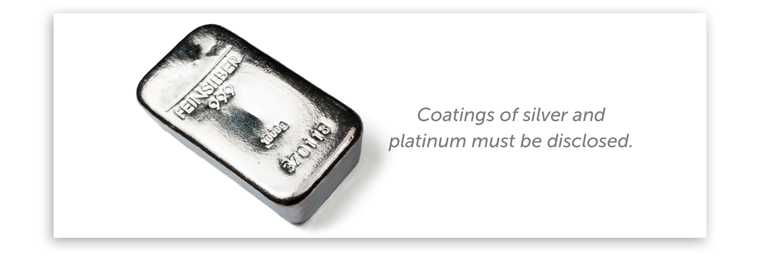
The previous Guides required only gold-plated items to be disclosed. Now, coatings of silver and platinum must also be disclosed (e.g., “sterling silver plated” or “850Pt. Plated”). The Guides also state that sellers should disclose the purity of the coating if it is under 24k gold, 925 ppt silver, or 950 ppt platinum.
This new rule includes rhodium coatings that cover other precious metals, such as rhodium-plated silver or white gold items.
“We advocated for this,” says Yood. She notes that the previous Guides did not require any disclosure be made when an item was plated with rhodium. “We advocated for it because consumers weren’t being told about it. Consumers didn’t know that their white gold pieces could be re-plated for a low fee.”
According to the JVC, when it comes to electrolytic gold plating specifically, the previous Guides had different thickness requirements for “gold plate” (0.5 microns/20 millionths of an inch) and “gold electroplate” (0.175 microns/ 7 millionths of an inch). The revised Guides now use the 0.175 micron standard for both “gold plate” and “gold electroplate,” and require a 10k minimum fineness.
In addition, the revised Guides have removed the terms “gold flashed” and “gold washed,” which had previously been used for items with an electroplating that did not meet the minimum thickness of fine gold.
For mechanical applications, the Guides retain the previous standard for the use of “gold filled,” “gold overlay,” and “rolled gold plate(d)”: The coating must constitute at least 1/20 the weight of the item, as long as the coating has at least a 10k fineness and the karatage is conspicuously marked. For items that don’t meet that standard but in which the precious metal constitutes at least 1/40 of the total weight, “gold overlay” and “rolled gold plate(d)” can still be used, as long as both the fraction and the karatage are conspicuously disclosed (e.g., “1/40 10k rolled gold plate”). The revised Guides also still say “gold plate” and “gold plated” can be used for mechanical applications, but the standard is now the 1/20 (if used alone) and 1/40 (if used with a fraction) weight minimums. (Note: The JVC has contacted the FTC to clarify these mechanical standards.)
Finally, sellers must be able to as-sure the reasonable durability of any coating. But what exactly “reasonable durability” means is still up for debate.
“What would a reasonable person expect to happen? We don’t know that answer,” says Yood, who points out that expectations for durability will vary widely based on the type of item in question, such as a ring versus a brooch. This is going to elicit “some interesting interpretations,” she adds.
Multi-Metal Pieces
New to the Guides is a section dealing with marketing products that contain more than one precious metal. The section states that it is unfair or deceptive to misrepresent the relative quantity of each precious metal in a product that contains more than one precious metal.
The Guides provide the example of using “Platinum Silver” to describe a product that contains more silver than platinum by weight. Instead, companies are advised to list precious metals in the order of their relative weight, from greatest to least. For example, the JVC says that a product that is made up of primarily sterling silver with 14k gold accents should be described with the sterling silver before the gold (“Sterling 14k”).
However, metals can be listed in a different order as long as it is made clear that the first metal listed is not predominant, such as “14k gold-accented silver.”
Lab-Grown Diamonds
One particularly hotbed issue the FTC addressed in its revised Guides is how lab-created diamonds can be described. Previously, sellers could use the terms “laboratory-grown,” “laboratory-created,” “[manufacturer name]-created,” or “synthetic” before the word “diamond” to describe a lab-grown diamond (provided that the manmade diamond shared the same optical, physical, and chemical properties as a mined diamond). The same rule still applies. The one change that the FTC made was removing “synthetic” as a recommended descriptor, although it hasn’t prohibited its use.
In addition, although the term “cultured” can be used to describe lab-grown diamonds, the revised Guides advise against the use of the term unless it is accompanied by a clear and conspicuous disclosure that the product is not a mined stone. The FTC offers some recommended disclosures, such as “laboratory-created,” “laboratory-grown,” and “[manufacturer name]-created,” but notes that they do not need to appear in immediate conjunction with the term “cultured.”
When it comes to terminology, the revised Guides retain the previous version’s ban on use of the terms such as “real,” “genuine,” “natural,” “precious,” and “semi-precious” to describe lab-grown and other manmade products.
Diamonds
Citing the fact that there are multiple ways to create a diamond, the FTC has updated its latest Guides to remove the word “natural” from the basic definition of a diamond. Unqualified use of the term “diamond” should be used only to refer to natural diamonds.

Gemstones
One of the biggest updates to the new Guides is its handling of the use of varietal names (such as emerald or ruby) for gemstones. The updated edition prohibits the use of incorrect varietal names to describe a division of gem species or genus based on color, type of optical phenomenon, or other distinguishing characteristics of appearance. The FTC specifically cited the use of the term “yellow emerald” to describe a golden beryl or heliodor, as well as the term “green amethyst” to describe prasiolite, as varietal name examples that are now prohibited.
“This is a clear, easy win for consumers to make sure that they’re not being misled,” says Yood.
When it comes to marketing composite gemstone products, such as lead-glass–filled rubies, the Guides now advise companies not to use an unqualified gemstone name, such as ruby, to describe these products. The Guides also recommend against calling them “treated [gemstone name]” or using unqualified terms such as “composite [gemstone name],” “hybrid [gemstone name],” or “manufactured [gemstone name]” to describe them, unless the term discloses clearly and conspicuously that the product does not have the same characteristics as the named stone. Also, if the composite gem requires special care, that should be disclosed. As an example, the JVC says that a compliant description of a lead-glass–filled ruby would be “composite ruby—lead-glass–filled—special care required.”
Yood says that this change was done to protect consumers. “They weren’t being told that they were being sold unstable products.”
In addressing manmade gemstones, the revised Guides retain the ban on terms such as “real,” “genuine,” “natural,” “precious,” and “semi-precious” to describe such gems. However, they now state that sellers of manmade gemstones can use words or phrases other than the ones listed in previous Guides (“laboratory-grown,” “laboratory-created,” “[manufacturer name]-created,” and “synthetic”) if they clearly and conspicuously convey that the product is not a mined stone. Again, such stones must share the same optical, physical, and chemical properties as the named stones.
Finally, the revised Guides have eliminated a previous section that stated “[i]t is unfair or deceptive to use the word ‘gem’ to describe, identify, or refer to a ruby, sapphire, emerald, topaz, or other industry product that does not possess the beauty, symmetry, rarity, and value necessary for qualification as a gem.”

Pearl Products
The FTC added a new section to the Guides recommending that sellers clearly disclose treatments to pearls and cultured pearls that are not permanent, create special care requirements, or significantly affect value. The JVC offers the example of dyeing pearls as one such treatment that would have to be disclosed, since altering the color would significantly affect the value of the pearls.
“The American Gem Trade Association already requires [that dyeing has to be spelled out] in their disclosure agreements,” says Yood. “This shouldn’t be a surprise to anyone in the industry.”
Handmade Products
In previous editions of the Guides, the FTC indicated that a product could be described as “handmade” or “hand wrought” if it was made entirely from a list of specific raw materials, such as “bulk sheet, strip, wire, and similar items that have not been cut, shaped, or formed into jewelry parts, semi-finished parts, or blanks,” as long as the entire shaping and forming of the product was done by hand or via manually controlled methods. The revised Guides retain that guidance but add “precious metal clays, ingots, and casting grain” to the original list of acceptable raw materials.
“Cast products can be considered handmade if [the casting process] is done by hand,” explains Yood. “Therefore, we asked the FTC to include the raw materials used in casting to be added to the list.”