

From the Deep
Kent Raible fuses his way to victory
By Shannon L. Brown
The perfect idea for a particular 7.47-carat cross-cut indicolite tourmaline eluded designer Kent Raible of Mossyrock, Washington, for years as he sought a design that would continue the swell at the top of the Stephen Avery-cut stone. When inspiration finally struck, Raible produced From the Deep, his 18k yellow gold, 20k rose gold, and platinum pendant with garnets, rubies, and diamonds. The design rose organically from the sea to earn him first place in the gold/platinum category of the 2015 Saul Bell Awards.

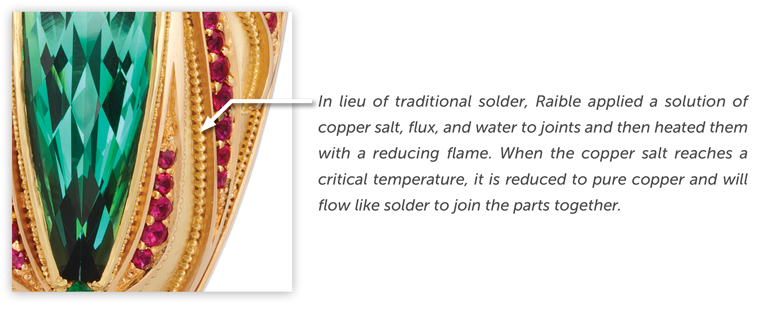
Once inspiration finally struck, Raible did a rough pencil sketch to get the proportions right before he began working at the bench on the pendant. He used his own 18k yellow gold and 20k rose gold alloys with accents of platinum because he knew they would work well with the copper salts he uses to fuse (instead of solder) everything together.
He began by first making the bezel setting for the tourmaline. Rather than create a setting that simply wrapped around the stone, he took a solid 3-mm thick bar and rolled it down to 0.8 mm. He would later carve out the seat for the stone.
Next, he formed the two pieces that comprise the bulk of the pendant—the area surrounding the tourmaline and the exterior of the bail. To create them, he used dapping tools to form the shapes in yellow gold sheet. The end result is slightly asymmetrical but probably only to his eyes. (He admits that he didn’t notice it until near the end and it seemed so slight that it didn’t need to be fixed. “If it had been more, I would have gone back and fixed it,” he says.)
The hinged bail has an inner layer of rose gold sheet that was hammered and formed into a curved saddle shape so that the bail would not have any sharp edges to allow for the free movement of the chain. The edges of the sheet were then trimmed and the interior and exterior pieces of the bail fused together.
With the bail created, Raible fused the end of the tourmaline’s bezel to the bail before fusing the main pendant section to the bottom of the bezel. To accent the bail, Raible added graduated diamond-shaped yellow gold pieces that run up and over the top of it. Each of the diamond shapes was fused into place. He then cut the bail to fit a hinge he crafted that would allow the chain to be changed.
He originally only planned to use granules for decorations around the large tourmaline, but as he constructed the piece, he envisioned ruby-set rose gold arms growing outward from the bail, wrapping around the center stone like a sea creature’s tentacles. He cut forms from a 1.8-mm sheet to create the arms and fused them in place.
Although he didn’t plan to set the stones until later, he created platinum triangle settings that would fit next to the diamond shapes on the bail as well as below the tourmaline, where he planned to set a 0.02 carat tourmaline to add flare but also cover a barren spot on the pendant. “The area needed to be elevated to match the red gold tentacles,” explains Raible.
“Once all the major parts were locked down and properly fused, then the pieces was cleaned up and the granules added,” he says. This finishing touch involved fusing hundreds of granules ranging in size from 0.3 to 2 mm. The tiniest granules in graduating sizes zigzag snugly along the sizes of the large bezel then up and over the bail next to the diamond shapes. Slightly larger granules trace the edge of the rose tentacles and frame the outer edge of the piece. Raible used granules ranging in size from 1.2 to 2 mm in the area under the large bezel. With the pendant properly adorned, Raible set the stones as the final step.
Raible’s initial vision became something much more as he worked, organically growing from a simple, but elegant design into something that rose from the deep. “As I worked, I saw my original heroes in my work: Heikki Seppa for anticlastic, John Paul Miller for granulation, and Albert Paley for tentacle forms and other little elements,” he says. “I saw their reflections in something of my own, and hope the results truly honor them.”