

From Small Changes…
At Lashbrook, the quest for improvement never ends
By Shawna Kulpa
It’s not many managers who will freely proclaim their jobs are “almost 100 percent waste.” But that’s the conclusion reached by Eric Laker, owner of Lashbrook Designs in Draper, Utah, when his company embraced the kaizen principle of continuous improvement. First adopted by the Japanese and one of the central tenets of “lean” manufacturing, kaizen helps managers to get down into the core areas of a business to eliminate waste and increase efficiency. The changes may be small, but cumulatively they can lead to major improvements. For Lashbrook, the process that led to Laker’s conclusion started about three and a half years ago, when the company was in the middle of a four-year stretch during which sales grew 50 percent annually.

“We weren’t growing because manufacturing was efficient,” confesses Laker. “It was because our ideas and products were catching on. But that growth was causing a lot of internal pain. We were working a lot of overtime and not hitting some of our due dates. A lot of mistakes were made and rework was rampant. This loss of time and material was very expensive. We were getting stuff out the door, but we knew it could be done better.”
Around that same time, Eric McCuistion came on board as director of manufacturing and he had taken some courses in the study of lean manufacturing. Shortly afterward, Laker brought in a consultant who specialized in lean.
“We had the consultant come in and work with us on a few occasions over several months,” he explains. “That got the ball rolling, and we eventually started attending workshops. Lean is a little bit of a religion: Companies that do it really well want to proselytize, so there’s a regular schedule of seminars at companies that have been practicing lean for 20 years. We took tours of companies and looked at their different processes, focusing on what things used to look like, what modifications were made to get [the company] to its current state, and what [lean] did for them.”
Advertisement

Laker and his team also did a lot of research. They found that no one practicing lean manufacturing claims to have it perfected—not even Toyota, which first introduced the concept to the modern business world and is often cited as doing it the best. It didn’t take long for the Lashbrook staff to realize that lean manufacturing goes hand-in-hand with kaizen—the quest to improve never stops.
“I don’t believe you could be lean without doing kaizen,” Laker says. “There’s a saying that goes with lean: ‘We do everything the best way we know how, understanding that we don’t know the best way to do anything.’ We have to constantly be looking for a better way.”
When they started implementing the principles at Lashbrook, Laker and his team looked toward Toyota for inspiration. “Toyota’s been doing it the longest, and they don’t ever stop,” he says. “They’re constantly changing and improving.”
To be successful with kaizen, though, Laker knew he had to get his team on board. “The most important thing to us is the culture,” he says. “You can’t force lean from the top down. You have to get people to buy in and value that themselves.”
So Laker met with his team in brainstorming sessions about particular processes. “We had to ask ourselves, ‘How can we cut time/labor/travel out of this process?’” he says. “In order to improve, we needed to reduce waste. We needed to eliminate any activity that didn’t add value to the customer.”
Breaking Free of the Cell
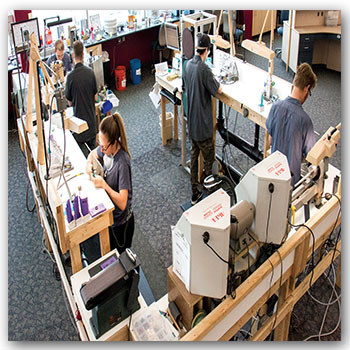
The process led Laker and his team to look at how the company’s workspace was oriented. “The building we moved into two and a half years ago was previously a dental lab,” Laker says. “It already had work cells in place that were conducive to the type of work we do.” However, he adds, “while the shapes were aesthetically pleasing, it was not as functional as we would have liked.”
So about 10 months ago the company focused on ways to make the work cells more efficient. “The original cells were a series of L-shaped desks that faced each other. That gave us eight work positions at a sitting level.”
At Lashbrook, no one does the same operation all day every day, so four to five workers make their way around a cell as they work on a piece. To reduce the amount of movement needed as employees move from station to station, the company redesigned the work cells into a U shape arrangement. “It shrunk the work cells dramatically,” says Laker. “Using extra space is always wasteful. The movement needed is much reduced, and it puts teammates closer together. If someone’s working on the inside of the U, the farthest distance they’d have to move is seven or eight feet. With the original cell, the distance was up to 20 feet.”
In addition to changing the shape of the work cells, the Lashbrook team also raised the work surfaces so employees can stand. “Our original workspace was designed for someone who sits down in one spot all day,” Laker says. “That’s not what we do. In the new cells, no one sits. Getting up and down takes more time. Plus, the physical approach to the work is better from a standing position. You don’t have the same issues with lethargy when people are standing.”
Laker admits that his employees were a bit skeptical about some of the changes, but he says that once everyone had a chance to move through the new cells, they loved it. “Everyone had an opportunity to try it, and I don’t know of anyone who voiced a concern after trying it. In fact, I’m in trouble because the new cells aren’t happening as fast as my finishers would like—they want to be standing up!”
But since the kaizen principle is about continuous improvement, Laker has continued to modify the work cells, which are now in their third iteration. “We’ve removed barriers between work cells that made communication difficult as well as made it more difficult to pass products between them.
“And we’ve started building our own tool holders and storage,” he adds. “We have a laser that allows us to design and cut out acrylic shelving and racks [so they can] hold specific tools and supplies perfectly. This makes sure that nothing takes up more space than necessary, and that everything can be where it’s supposed to be all the time.”
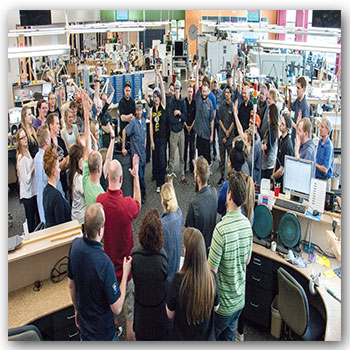
Laker encourages his team to initiate changes at their stations. “Every morning at 8:30 we have a production meeting,” he explains. “There are 40 of us in a circle and a rep from each team or area talks about the improvements they made the day before. It may be as simple as moving something so that it’s within arm’s reach.”
Employees are encouraged to track their progress over the course of the day. “There are several white boards around the production floor, and one main [board] that tracks historical data,” Laker explains, adding that the boards have time slots for every half hour of the workday, with goals for the number of rings that should be done during that time. “Employees update the board every half hour so they know if they’re behind schedule. It’s all a part of a lean operation: You can’t be making small improvements every day if you don’t know where you are.”
The company also has several large monitors hanging from the ceiling that are within easy view of everyone. Updated constantly, the boards show how much the company has shipped that day, how many orders have been taken, and how they’re progressing toward the monthly goal.
Cleanliness Is Next to Godliness
Team building is a critical part of the continuous improvement process. Laker believes that employees must buy into the process and value it themselves, otherwise there could be a revolt if they were asked to do something unpleasant or undesirable—such as cleaning the bathrooms.
“One of the books [2 Second Lean by Paul A. Akers] we read in our research was about a company in Washington state that was interested in implementing lean manufacturing. The author and executives from other U.S. manufacturers toured companies in Japan, and when they arrived at one factory they were immediately assigned to get on their hands and knees and scrub the floor. The owner of the company explained that when they made the switch to lean manufacturing, they got rid of their cleaning personnel and made it the responsibility of the workers. They weren’t paid for it, but everyone just started showing up early and cleaning every day.” This created a culture where even the small things mattered to everyone.
Inspired by the story, Laker’s team implemented a similar system at Lashbrook. “There’s a rotation for cleaning the bathrooms,” he explains. “I’m in the rotation, every director is in the rotation, and just as often as everyone else. We did this because we want them to be part of a team, to take ownership, and to recognize that cleanliness is part of efficiency. We pay our people for it, so it’s costing me more money, but it’s helping to instill the principles. We’re always trying to get people to think differently about what they’re doing.”
While Laker admits that he did get a little attitude at first about the cleaning, he’s amazed at how clean the bathrooms have been since the change. “People are more careful about cleaning the bathroom after using it,” he says.
And that dedication to cleanliness is carrying over to the rest of the facility. “Everyone comes in early and the first 20 minutes of the day are spent cleaning workstations,” Laker says. “Jewelry production is dirty and grimy. We’re in a mostly carpeted environment with white ceilings, and we’re working to get to the point where the work environment is almost pristine all of the time. We believe this will add value to the customer: If someone is in a clean environment doing a detailed process, it’s easier to be particular. It comes more naturally to look at the piece and want it to be perfect.”
That striving for perfection is having an effect on the company’s bottom line. Since implementing kaizen and lean manufacturing, the company has doubled the size of its business, but that doesn’t mean they’re going to start resting on their laurels. After all, continuous improvement requires continuous effort.
“Our waste error is down 60 to 65 percent, but we’re always making improvements,” Laker says. “Our business model is to make anything the customer wants, and when making so many different things from scratch in a short period of time, quality control is a challenge. We’re constantly working on that and cutting our error rates so almost nothing makes it out the door wrong.
“Sometimes the improvements are huge,” he adds, “sometimes they’re tiny, but anything you can do to cut a couple of seconds out of a process you do hundreds of times a day adds up over the course of a year.”