From INventory to OUTventory
How you can turn your stock faster and free up cash
By Andrea Hill
Depending upon the industry, inventory is among the top five costs for most organizations. In the jewelry industry, inventory is the number one cost. With average inventory turns in the industry between 0.9 and 1.2 times per year, it is safe to say that most of the working capital of the entire jewelry industry is tied up in unmoving and slow moving inventory.
A critical skill for running a profitable jewelry business is inventory management. Good inventory management skills enable you to better predict which items you will need and when, create more effective relationships with vendors, and anticipate cash and credit requirements before they become a cash crunch. Ready to make more money? It starts with these behaviors.
Where’s My Cash?
A common experience in the jewelry industry occurs in the first quarter of each year when the books are completed. You’ve turned a profit! The feeling of euphoria lasts for about 25 seconds, when the reality sinks in that you have little or no cash to show for it. If this has happened to you, chances are that your profits were sitting on shelves in your storeroom or safe. The answer to this problem is to increase inventory turns. You know what inventory turns are and you can do the calculations, but have you stopped and considered the most basic theory of turns? It goes like this:
Imagine you are a child and you open a lemonade stand. Your mother will permit you to make only one pitcher at a time. Each pitcher will pour 10 glasses, your cost for the lemonade packet and sugar are 50 cents, and you are selling each glass for a dime. If it takes you all day to sell that one pitcher of lemonade, you will make 50 cents. But each time you sell through the pitcher, you can make another 50 cents. So if you can turn that lemonade two times in one day, you make a dollar, four times equals two dollars, and so on. Your ability to make money is directly tied to the number of times you can turn that lemonade pitcher into 10 glasses of sold lemonade.
Aging Inventory Is a Business Killer
To increase your turns you must decrease your dead inventory, releasing that cash to purchase more desirable products. Your options for reducing excess inventory include:
- Negotiating a restocking or inventory swap with your vendors.
- Hosting a sale or an event.
- Melting down metals and repurposing diamonds and gemstones.
- Selling to a liquidator.
- Trading with another small manufacturer or studio to see if either of you can make better use of the other’s old goods.
Your goal should be to turn your inventory a minimum of three times per year, and for 80 percent of your inventory to be less than six months old. Sound daunting? Remember that you don’t have to accomplish it all at once, but if you set the goals and start the work, you will begin to gain cash flow velocity in your business fairly quickly, and it will continue to grow over time.
Start with Planning and Forecasting
How do you avoid making the mistakes that got you into inventory trouble in the first place? The answer lies in sales planning and inventory forecasting. Follow these steps:
- Start by writing the total sales for each month in the past three years on a calendar. Now write what percent of each year’s sales took place in each calendar month. This is your “level” demand. If you don’t see a pattern from year to year, it’s probably due to erratic sales activity, including the common but inadvisable sales strategy called “waiting for the phone to ring.”
- Once you know your level demand pattern, forecast your anticipated monthly sales for the next year. Decide how much sales growth you want for the year and apply the anticipated sales according to your historical level demand pattern. If your past demand was very erratic, consider making a conscious effort to smooth your demand or bump up typically lower sales months.
- After creating your sales forecast for the year, plan the sales and promotional activities you must engage in to accomplish each monthly goal. Make sure you have enough selling events on the calendar to achieve your sales growth goals.
- With your sales and marketing planning in hand, analyze your product sales for past years. Which items or groups of items sell consistently year after year? Which items have strong seasonal demand? When you introduce new items, what are the typical sales patterns? When you open a new wholesale account, what is a typical stocking order? Pay close attention to items customers request that you are consistently out-of-stock on or do not offer. Your goal is to develop a sense of which items you should make only when requested, which items you should keep a minimum amount of on hand and what that amount should be, and what your maximum amount on hand should be for each item.
- Identify when you will be in inventory buying and building mode to prepare for new account openings, seasonal demand, or your own events and promotions, so you can anticipate when you will need the cash to pay for those investments. Even if you hire a professional forecaster, he or she will not make a perfect forecast, so don’t let lack of experience or fear of math stop you. The very act of engaging in this planning will add tremendous insight to your inventory buying practice, and your cash flow will improve accordingly. Each time you practice this art of forecasting, you will get better at it, and your inventory position will continue to improve.
Parts Is Parts? No, Parts Is Cash
Once you are on the road to eliminating useless inventory and making the right inventory, turn your attention to inventory control. If you have very few items and very low dollar values, you can probably do this with a spreadsheet, a manual card system, or a visual system. But the jewelry industry now has several excellent inventory management and manufacturing systems to choose from (almost all combined with sales and CRM functionality), which are priced reasonably for every size of business. Your best bet is to invest in a system designed to help you accomplish the inventory control processes described here. (Go to the Business Equipment section of the MJSA Buyer’s Guide Online for a listing of member companies that supply these systems.)
Your goal is to bring visibility to your inventory from the moment you order it to the moment you sell it. This means that every item in your inventory, from the smallest finding to your finished goods, should be recorded to track every purchase order, purchase/manufacturing cost, sales transaction, and any other type of inventory addition or subtraction. Think about your inventory in terms of components and finished goods. Components are any items that are used in the making of a finished good—even if you sometimes sell them individually, such as a replacement chain or a rare gemstone for a collection.
The way you keep track of which components are used in which finished goods is through creating build instructions, also called assembly instructions, kits, or bills of materials. To maintain inventory accuracy and reduce the risks of not having components when needed or buying too much of the wrong things, track the removal of the component items from inventory as they are converted into finished goods inventory. Again, if you run a cottage design shop with only a few people involved in the manufacture of your items, you can probably manage this process through a visual system by separating your components into bins and paying close attention to which components are required for which (and how many) finished goods. This will help you forecast which items you can afford to buy in bulk, and it will help you avoid running out of key components when you are in a time crunch. It will also help to prevent you from buying too many of an item that it will take years for you to consume.
Time for Inventory Management
Creating reduction strategies for dead inventory, improving your merchandising and buying behavior, and bringing visibility to your day-in-day-out management of inventory can take as little as six months or as much as a year. But as much work as that is, it is only the beginning. All that effort is simply laying the essential foundation for the truly exciting work that is inventory management, which begins with analyzing inventory turns and monitoring idle inventory.
Analyzing inventory turns. If your initial goal is to turn your inventory two times per year, then theoretically you will have no more than six months of inventory on-hand at any given time. But as you know, inventory is rarely equally stocked across all items, so analyzing inventory turns by finished item and component is essential. To do this, you will need to know how much demand you anticipate for each finished item in a year, and how many finished items each component goes into. Your analysis will look something like Chart 1.
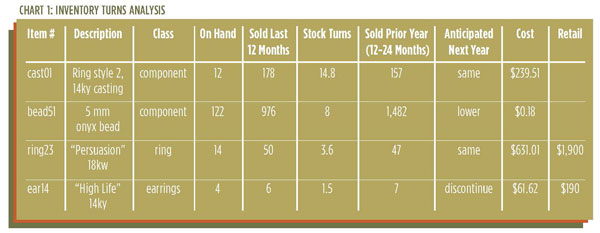
When you have this information on all of your items, you can view your turns not only in aggregate but also in detail. This is the information that enables you to promote slow-moving items, decide where (and where not) to cut prices, incorporate overstocked components into new finished designs, negotiate for better prices on fast-movers, and generate customer goodwill. Here’s how, based on the analysis shown in Chart 1:
- You have an opportunity to get better casting fees or casting efficiency on cast01, which is on track to turn 14.8 times (178 projected sales divided by 12 on hand) in the next year.
- You should keep an eye on the onyx beads because sales seem to be trending down; perhaps some of the finished items they were used in have been discontinued. Future purchases, if needed at all, should probably be smaller than past purchases.
- The High Life earrings could be used as a customer goodwill gesture. You could either donate them to a charitable auction to get publicity for your business, use them as a giveaway to generate traffic, or even gift them to a particularly valuable customer. Once the four pieces are gone, you should discontinue these earrings. A $62 cost item that sells only six or seven pieces per year is more of a drain on resources than a valuable product.
Monitoring idle inventory. Nothing bogs a business down faster than idle inventory. You would not take your hard-earned income and stash it in a safe deposit box where it was unavailable to pay your mortgage, utilities, or credit card bills, but small business owners regularly stash cash in idle inventory that makes that cash unavailable to buy new, more desirable, faster-moving goods. Monitor your idle inventory on a monthly basis so you can be proactive about eliminating slow movers while they still have some potential life in them. An idle inventory analysis will look something like Chart 2.
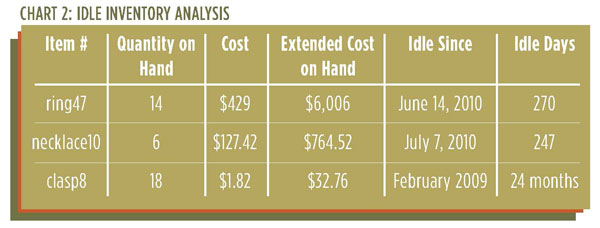
The analysis in Chart 2 indicates the importance of promoting ring47 and necklace10 to eliminate them permanently from inventory. Once your inventory management program is in place, you don’t want to see most inventory sit idle for more than six months. Yes, there are those extraordinarily exceptional items that you use to attract attention, which may wait a long time for the right buyer—but they should be carefully selected and represent a very small portion of your overall inventory position. For the rest, consider a combination of scrapping and promotion to eliminate them from inventory.
For purchased components, the ideal approach is to negotiate with your vendors a program whereby you can exchange a percentage of slow-moving inventory for better-moving inventory on a scheduled basis. Neither you nor your vendor benefits when inventory sits in a cabinet gathering dust. But your vendors are far more likely to take three-to-six-month old inventory that hasn’t moved than 24-month-old inventory that hasn’t moved.
Consider lowly little clasp8 in Chart 2. By itself it’s not doing much damage, but if you have 47 slow-moving findings of that type, you could be sitting on $1,000 or more of dead inventory. If it makes sense to use those findings, quickly, in other finished goods, do so. Otherwise, throw them in with your sweeps, get the cash, and move on to something more productive.
If you intend to stay in business, make money, and fund a desirable retirement, you should sharpen your inventory management skills. After all, the time is going to go by either way. Wouldn’t you rather spend it gradually increasing your cash flow and income, learning exciting new skills, and sleeping well at night?
Sponsored by