

For the Boys
Untitled by Ryan Roberts
Second Place, Men’s Wear Category
2012 AGTA Spectrum Awards
By Shannon L. Brown
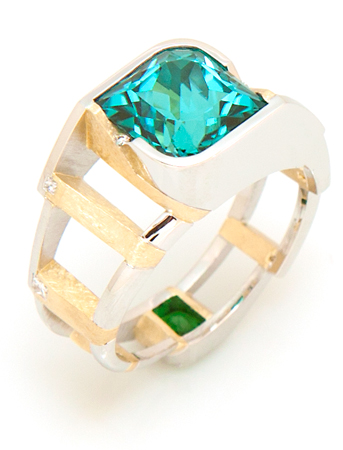
When a renowned gem cutter commissions a design from you, there’s no doubt you are going to put your best foot forward. In Ryan Roberts’ case, his best effort not only pleased the client, Stephen Avery, but also garnered second-place honors in the men’s wear category of the 2012 AGTA Spectrum Awards.
“For him to choose me to make the only piece he’s had commissioned for himself was an honor,” says Roberts, owner of Ryan Roberts Ltd. in Santa Fe, New Mexico. Avery was so impressed with a ring that he saw Roberts’ wife wearing that he wanted a masculine version of it. The resulting platinum and 18k ring features an untreated 6.42 carat indicolite tourmaline from Afghanistan, a 0.59 carat tsavorite garnet, and a sprinking of diamonds.
Roberts had designed his wife’s ring a decade earlier for another competition, taking best in show. Turning the soft feminine design into one with masculine lines was particularly challenging for Roberts, who doesn’t usually make men’s jewelry.
Considering that his normal approach to design is to sit down at the bench and start fabricating, this ring required a different take. Due to the extensive planning needed to duplicate the design concept in a more masculine form, Roberts decided to sketch first. The design has a series of mirror images: the two settings at the top and bottom, both sides of the shank, and the gold stair-step elements. Roberts used the shape of the center stone—a “bi-symmetrical” cushion cut with two sharp corners and two round corners—as his guide. He took cues from it by making curves where the setting meets the stone’s curves but keeping the other lines of the setting and the ring straight.
Roberts began fabricating around the center stone, forming one side of the setting from platinum sheet, then tracing it on paper and duplicating it for the other side. While it appears that the setting is a combination of platinum and gold, it is actually fabricated entirely of platinum, with the gold added later. The platinum envelopes the gemstone and then extends down on either side to meet with the ring shank.
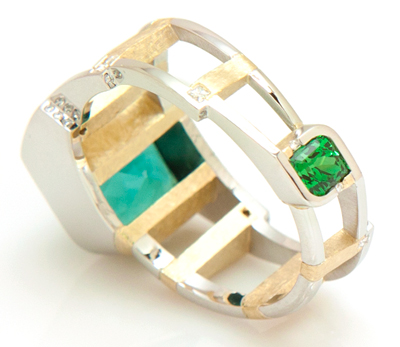
A mirror setting for a tsavorite garnet in the same cut came next. Roberts then fabricated the four platinum side elements, stepping them down from top to bottom on each side to precisely meet the garnet’s setting. After soldering all of the platinum components, he carefully cut out sections to accept the stair-step inserts made from his own 18k yellow gold alloy. Shaping the components to fit exactly was a painstaking process.
He soldered each 18k gold section in place and used a hand graver to etch a line where each of the two metals meet to create a clear definition point between them. Had be been in possession of a laser welder when making the ring, Roberts said he would have opted to use it instead of solder to ease assembly, positioning and tack welding the components to ensure they came together exactly as planned.
Before setting the stones, he gave the platinum a high polish and the gold a heavier satin finish, using a rod honed to a point to create a distinctive swirled pattern in the gold. “I like polished white metals because the whole idea is that they’re kind of coloress, but polished gold picks up too much of its environment, so you lose that gold color,” he says. “Also, I wanted to create definition. That’s another reason why the platinum and gold are finished differently.”
With the ring assembled, Roberts set the larger stones by hammer setting them from the top and pulling the edges up and over them. He then flush-set the round diamonds in the gold on either side of the tourmaline and garnet, as well as under each graduated section of platinum. Finally, he set the princess-cut diamonds at one end of each gold bar where it meets the platinum. After a final polish, the custom-design-turned-contest-entry was complete—and Roberts had successfully modified the original feminine design into an equally stunning masculine version. “I just had to beef up all of the elements and make exactly what the client wanted,” he says. “I wasl really, really pleased with it.”