

Flight of fancy
Michael Barin captures nature as art with his silver butterfly ring
By Shannon L. Brown
Thousands of Monarch butterflies migrate every year to Big Sur, California, creating a majestic sight Michael Barin of Michael Barin Fine Jewelry in Carmel, California, always enjoys. When he saw watermelon tourmaline “wings” at a Tucson gem show, he immediately wanted to recreate the butterflies’ beauty, choosing to do so in a silver and diamond ring with tsavorite garnet accents.
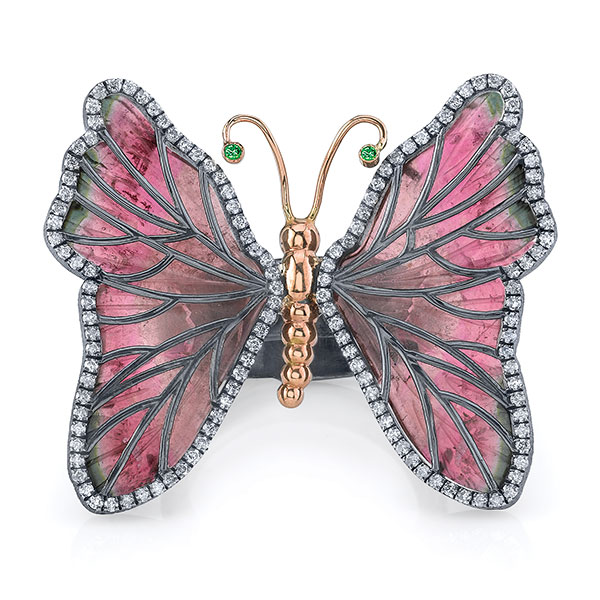
After melting grains of his trademarked recycled silver alloy that he calls “Organic Silver,” Barin poured the liquid into an ingot mold. Once the metal solidified, he created a 4 mm sheet by putting the ingot through a rolling mill multiple times. “The rolling mill hardened the metal and compacted the grain structure, making the metal stronger and producing a clean sheet of silver as a base for the wings,” he explains.
Once he had the sheet ready, he laid the tourmalines on it and outlined the shapes with a fine point Sharpie. He then drilled tiny holes to insert a saw blade and cut out the outline of the wings.
With the wings cut out, Barin used a metal compass to measure a 2 mm wide border and cut out the center portion of the wings, leaving tabs on the inside of each wing that he would later insert into the butterfly’s torso. He soldered wires onto the underside of the border, creating prongs to support the stone wings. He then applied a texture to the border before pavé setting the 132 diamonds (1.07 ctw) that line the edges of the wings.
To craft the filigree pattern that lies over the tourmalines, he used a similar process but chose a narrower ingot mold before pulling the thin metal through a drawplate to compress the metal until the wire reached his desired 1.2 mm circumference. “The wire is semi-polished by coming through the draw plate, compressed, and now a very clean surface,” he says. He twisted the wire into the right shape using pliers, mandrels, and handmade tools of copper and brass, chosen because they wouldn’t damage the silver as much as harder metals. He arranged the wires according to a pattern he had drawn on paper, using a laser welder to tack them in place. Once he had all of the wires assembled and the pattern complete, he soldered each joint to secure it.
To create the butterfly’s torso, Barin melted 14k rose gold grain and poured it into graphite molds he created. The seven beads were prefinished and filed into the correct shape then soldered together to form the body. The butterfly’s legs and antennae were made from drawn wire using the same process as the filigree wire. He soldered the legs to the butterfly’s torso.
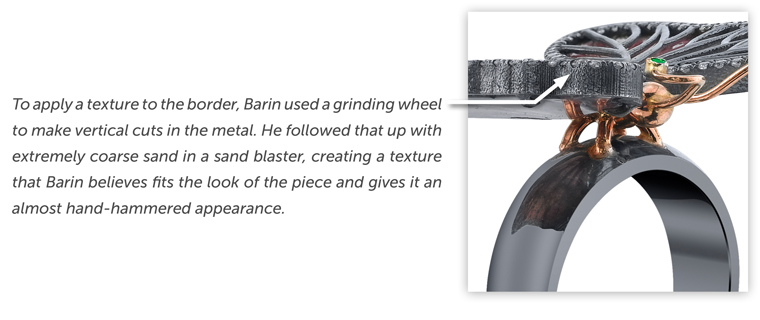
The ring band was cut from purchased tubing and shaped. To connect the butterfly to the band, Barin cut slots in the band that corresponded to the legs. He then inserted the legs into the band and soldered them in place, adding stability to the top-heavy ring. He also cut out sections of the torso’s sides and inserted the tabs he’d left on the side of the wings to secure them to the butterfly’s body.
Next, he soldered a ball onto the end of each of the two antennae and set a tsavorite garnet in each before soldering the antennae to the torso. Barin then inserted the filigree work into the wings, soldering it in place. With the entire piece complete with the exception of the stone wings, Barin applied a patina with a proprietary solution.
The last step was to set the tourmalines. He inserted them into the metal border from underneath, securing them using the wires he had previously soldered to the bottom of the border. Barin’s butterfly was now ready to take flight.
“Hand fabricated jewelry truly is an art form, a lost art,” says Barin. “I love the overall smile this ring puts on people’s faces when they see it. It’s wearable art.”