

Fire and Ice
Eva Martin’s earrings give the wearer a choice
By Shawna Kulpa
Would you rather perish from fire or ice? That was the subject up for debate one evening between Eva Martin’s two young sons who were playing Would You Rather?, a game that involves choosing your fate from two different (and usually unappealing) scenarios. Upon hearing her sons discussing the pros and cons of the dire options presented, Martin was reminded of a Robert Frost poem she had learned in school, “Fire and Ice.” Thinking of the poem, Martin began sketching ideas for a piece that showcased both concepts. Eventually she settled on a double-sided earring design that would allow the wearer to switch the earrings between the “fire” and “ice” sides.
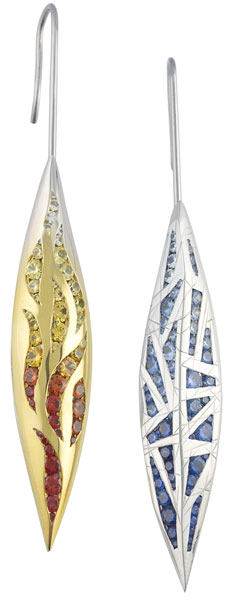
“I always start with copious amounts of sketches,” she says. From those bits of papers scattered about her house, Martin translated her design into CAD using Rhino. “I go straight to CAD and translate my sketches into it. It’s easy to be constrained by CAD, so I’m constantly referencing my sketches.” To represent the two sides, Martin settled on a flame design for fire. For ice, she looked no further than her town of Boston. “I looked at a lot of ice,” says Martin, who jokes that she had a never-ending supply of it this past winter. “When ice floats, it creates haphazard crazy geometric shapes. I started playing around with that idea and it reminded me of ice on a river or a lake.”
Martin designed the earrings as four sides (two fire, two ice) that she would later weld together. Because she wanted the earrings to turn, Martin included a space inside the top of the earrings for a spring-and-plunger mechanism that would allow the earrings to spin. To find a spring small enough to fit, she scoured watchmakers’ websites and catalogs. Eventually she found what she needed in an electronics catalog: a contact probe. “Used in electronics to detect currents, the contact probe measured ¾ mm in diameter and had an interior spring that made it perfect for the earrings,” says Martin. To hold the probe in place, she added a 1.5 mm long tube to the center of the fire sides of the earrings.
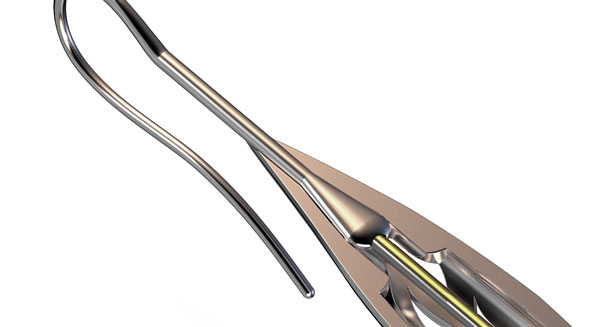
Because she planned to use the ear wires to activate the spin, Martin chose to make them from a titanium alloy that is difficult to bend and deform. It was important that the wires be kept straight, since they would serve as the plunger mechanism. When she formed the wires, she added a paddle shape to the end that would rest against the contact probe inside the earring. When pushed down into the earring, the paddle end of the wire unlocks and allows the wearer to turn the earrings. When the wearer has the chosen side facing forward, she releases the ear wire and the probe’s spring pushes the paddle back into place, locking the earring into position.
With the design finalized, she sent the CAD files off to be printed and the models cast in palladium. When she received the models back, she cleaned them up and channel-set 5.5 ctw of precision-cut sapphires. She polished and finished the earrings and then sent the two fire sides to be plated in 18k yellow gold. When she got them back, she polished the tops in order to make the gold gradated, believing that a whiter top would look better next to the titanium ear wire. In addition, she accented the ice sides by hand engraving lines to connect the jagged shapes, adding to the appearance of cracked ice. Once she had the look she wanted, she inserted the probes and ear wires and welded each fire side to an ice side, completing the earrings.
What was initially inspired by a choice between two dreadful options, yielded a pair of earrings that allow the wearer to choose between two beautiful designs. As she designed them, Martin was thinking of entering them in the 2014 Saul Bell Design Competition, sponsored by Rio Grande. Since her earrings were selected as a finalist in the competition, it looks like she made the right choice.
Photo courtesy of Rio Grande. Rendering by Eva Martin.