

Design Simplified
Randy Erickson celebrates CAD
By Peggy Jo Donahue
When Randy Erickson of Erickson Jewelers in Iron Mountain, Michigan, went to a trade show seven years ago, he was a man on a mission. He was in the market for a rapid prototyping machine and a CAD program to go with it. “I looked at one of the top models, and I really liked it,” he recalls.
But then destiny and serendipity took a hand. “I stopped at the Model Master booth and I was intrigued by how intricate a model that mill could cut,” he says. “It was nice, crisp, clean, and detailed cutting.” From there, it was quick leap to learning about the ArtCAM JewelSmith CAD program by Delcam, which Model Master resells. “It was so easy to use—I worked with Randy Hays, who knew the program inside and out. They let me try it out and it was amazing.” Erickson ended up purchasing both the Model Master and the ArtCAM Jewelsmith software. [Editor’s Note: Hays, formerly with Model Master in sales and training, is now an ArtCAM JewelSmith reseller with his own company, Artisan CNC.]
Winning Vision
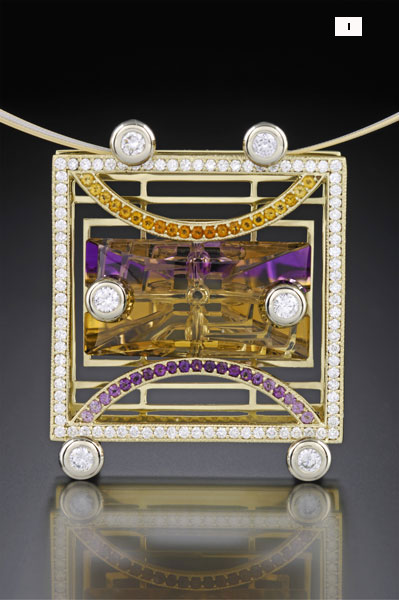
A few years after that purchase, Erickson used his CAD/CAM skills to make an ametrine pendant that won first place in Division 2 ($5,000 and up) of the Michigan Jewelers Association design competition (above). The design was driven by a gorgeous rectangular ametrine, which included unusual round openings on both of the short sides of the gem. Erickson planned to use those openings in tension setting the gem into the pendant.
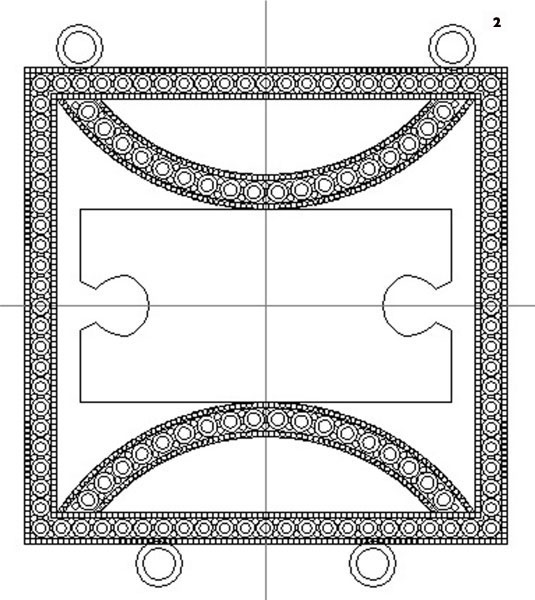
The jeweler scanned the ametrine, traced it, and brought the image into the 2D view of ArtCAM JewelSmith. He set it into his planned design for the upper plate of the pendant (above). The process allowed him to see exactly where he needed to place the 3 mm hollow tubes that he would use to tension-set the ametrine.
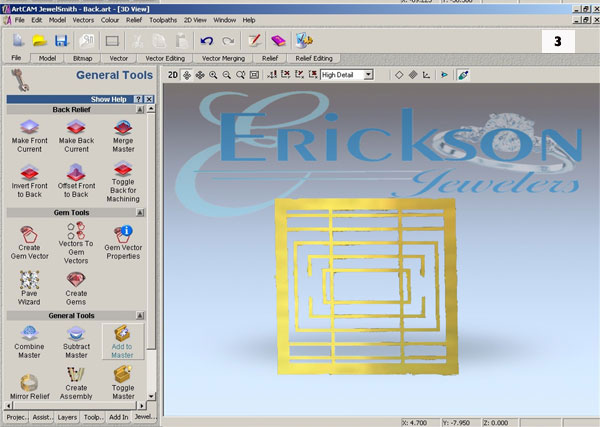
Next, the jeweler designed a square back plate for the pendant, with a rectangular central pattern that mirrored the design cut into the gemstone (above). Erickson left openings in the next-to-innermost rectangle on either side, into which he planned to laser weld the tubes that would serve as tension setting prongs for the ametrine.
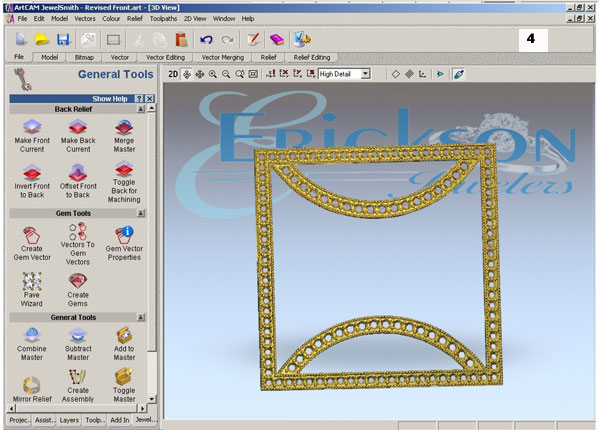
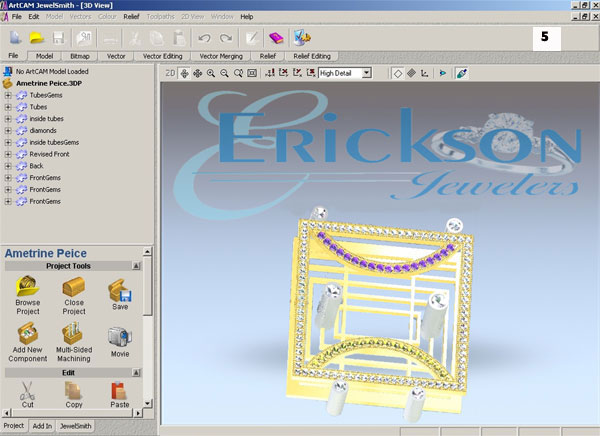
The jeweler then designed the square upper plate of the pendant. He planned to pavé set the outer frame with diamonds and pavé set the arcs on the top and bottom with amethyst and citrine pavé that went from pale to saturated to pale in color. The jeweler intended these arcs to steady the ametrine, too (above).
After milling the pieces, Erickson cast, cleaned, and polished them. He set the diamond, amethyst, and citrine pavé in the upper plate. He then laser welded bezels to the four 3 mm tubes that would attach the upper and lower plates of the pendant at the top and bottom of the pendant’s frame. He also placed bezels in the two tubes that would tension-set the ametrine. Next, he set diamonds into all six bezels.
Then, he laser welded the four outer tubes to the top and bottom of the upper plate’s frame. Leaving enough room between the upper and lower plates to give the culet on the ametrine enough space, he lasered the same four tubes to the lower plate as well. This brought the two plates together to form a frame for the ametrine.
To set the ametrine, Erickson positioned the gem over the center of the pendant. He placed the final two tubes through the round openings on both sides of the gem. When the tubes were providing the correction tension to hold the stone in place, the jeweler then lasered them into position on the lower plate. (above, shows the completed setting, minus the ametrine.)
The jeweler says ArtCAM Jewelsmith helps him “immensely” cut down the time he spends on designing and making each piece of jewelry, “which makes the company more money,” he says.
“It really has been a life-changing experience from the standpoint of falling in love with creating jewelry, too,” says Erickson of his conversion to CAD/CAM technology. “There once was a time when I could see in my mind a piece I would like to create, but I was unable to because I am not an advanced wax carver. But with ArtCAM, there hasn’t been anything I could dream up that I could not create.”