

Delicate Gems Gallery
A gallery of high-wear pieces featuring delicate gems
Editor’s Note: In the January 2013 print edition of MJSA Journal, six designers share examples of pieces that showcase delicate gemstones. They explain what they did in the design and fabrication process to ensure those gemstones not only look their best, but also stay safe during both the creation of the piece and subsequent wear.
In this online article, you’ll find additional designs featuring stunning but fragile gems, and read about the designers’ approaches.
Katie Decker
Katie Decker LLC, Houston, Texas
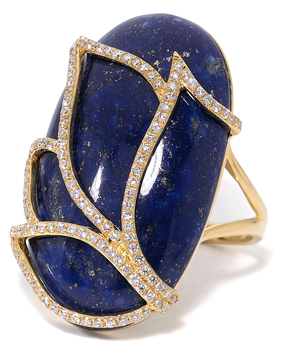
I find it amazing that nature can produce the vibrant blue color we see in lapis. This particular stone inspired me to design in a very organic way so as not to take away from its natural beauty. Keeping in mind that lapis is relatively delicate, I decided to use an overlay in the creation of this ring. The diamond-set 18k gold flower petal overlay not only enhances the stone, but also protects it from daily wear and tear without being as overbearing as a traditional bezel.
I designed the piece without prongs because I thought they might disrupt the organic look of the ring. The gemstone is placed on the backing and the overlay is simply laser-welded into place. This piece shows a key benefit of a laser’s ability to weld next to heat-sensitive gemstones.
Dawn Muscio
D. Muscio Fine Jewelry Studio, Atlanta
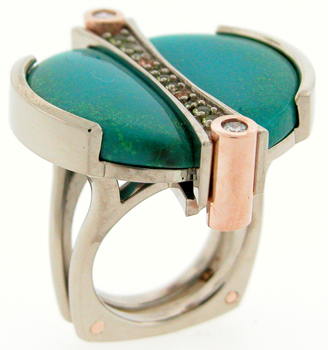
When I purchased the two half-moon shaped chrysocollas in this ring, I had intended to create a pendant with them. If you imagine the ring top minus the shank dangling from a chain, you have my original idea. But when I showed the sketch to my business partner, she encouraged me to interpret the design as a ring instead, creating a large statement piece that was unlike the more traditional rings that I usually make.
I took her advice and added a shank to the design and cast the shank and partial bezel setting in palladium in two pieces. After soldering the components, I slid the two chrysocollas in from the center and tucked them under the partial bezels on each side. The bezels are undercut to allow the gems to snug in under them without requiring you to hammer down onto the soft stone. (Chrysocolla ranges in hardness from 4 to 5 on the Mohs scale.)
The center bar component, which is channel set with peridots, further secures the stones. Two 14k red gold pegs that protrude from the center of the ring slide up through the bar, riveting it in place. The red gold pegs complement the bezels on the edge of the bar, and are echoed in the details at the base of the shank. The peridots pick up on the aqua green tones in the chrysocollas.
When complete, the unique setting style gives the illusion of one stone while securely holding the fragile half moons in place.
Pamela Froman
Pamela Froman Fine Jewelry, Los Angeles
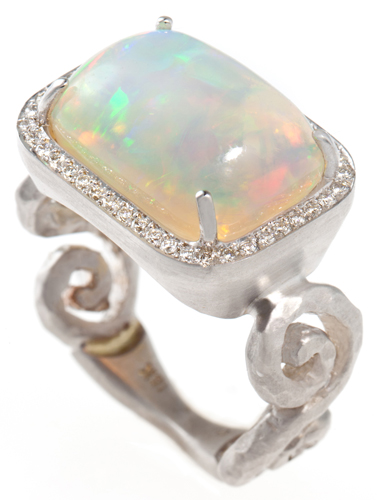
In my one-of-a-kind Ellie Ring, I chose to frame a delicate 4.24 carat Ethiopian opal in diamond pavé. The frame serves a dual purpose: It protects the edges of the delicate stone and provides a brilliant border for showcasing nature’s own work of art. To further echo and accentuate the natural beauty of the stone, I fabricated the ring in 18k white crushed gold, which has an organic texture. Because the opal protrudes considerably from the diamond pavé frame, I used prongs to secure the stone in place and protect its four corners.
A special added bonus for the wearer is a filigree cutout gallery that I laser weld beneath the stone, which you can just barely see when looking through the stone from the top of the ring. This adds another layer of intrigue to the piece.
Set from the back, the opal is covered with the filigree cutout gallery that is laser welded at the edges, taking advantage of the laser’s ability to weld next to heat-sensitive stones. As an added bonus for the wearer, you can just barely see the edge of the gallery when looking through the stone from the top of the ring, which adds another layer of intrigue to the piece.
Photo by Jay Lawrence Goldman Photography
Alishan Halebian
Alishan Jewelry, Irvine, California
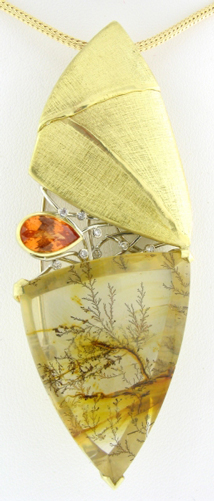
When presented with a gemstone as inspirational as this dendritic quartz cut by Dieter Lorenz, it’s essential to add one’s interpretation of the gemstone without conflicting with nature’s brushstrokes or the gem cutter’s amazing work.
I decided to create a mirror image of the gemstone’s shape in very thin 18k yellow gold sheet, leaving an opening between the quartz and the gold component that I filled with a web of white gold set with diamonds. The 18k gold has a folded fabric appearance and a multi-layered hand texture on the surface, resonating the unique natural textures of the dendrites in the quartz beneath it. The web in the middle adds balance and structural support to the piece without overwhelming its delicacy. I nestled a spessartite garnet between the two components because I loved the color it added, which again enhanced balance.
Technically, the web also creates a framework for me to hold the quartz in place. Wires extend down in the back of the quartz subtlety and attach to three gold V-shaped prongs that hold the quartz in place. I chose these prongs because they protect the gemstone’s delicate corners well, but they do not intrude with the stone’s landscape.
Dawn Muscio
D. Muscio Fine Jewelry Studio, Atlanta
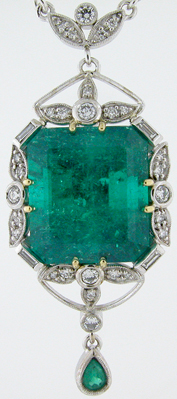
In this custom design that I created many years ago, the client requested a Victorian-inspired pendant built around a heavily included 18-carat emerald. The client wanted white metal for the piece, so I fabricated an elaborate diamond-set 14k white gold basket in which the emerald would sit. Four baguettes set at each corner offer some protection to the delicate points of the gemstone. Considering the fragile nature of this emerald, I didn’t want to attempt to push prongs over the cut corners. Instead, I decided to place the prongs on the larger flat sections of the gemstone to avoid putting pressure on the small points. Furthermore, I used 18k yellow gold for the prongs because it is more malleable than the 14k white gold used for the bulk of the piece. It also adds some warmth to the design, which the client appreciated. Sometimes a choice made for a technical reason can be interpreted as an added aesthetic when presented to the client.