

Crystal Clear: Casting
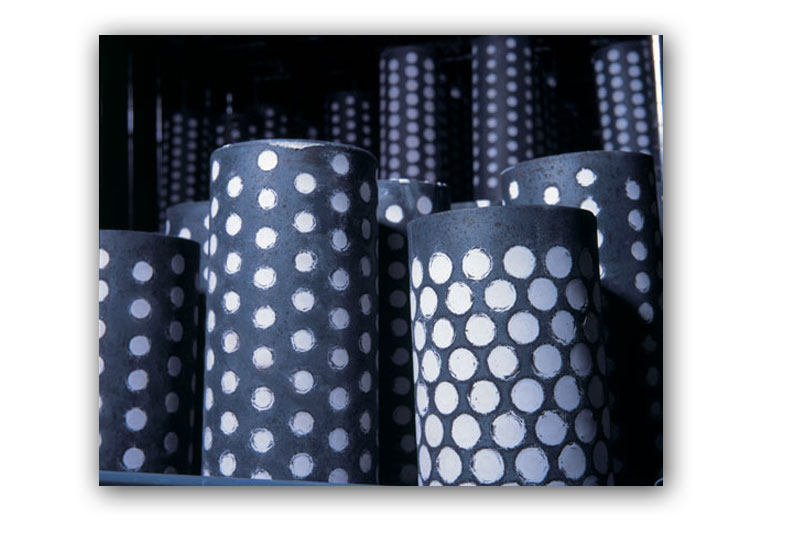
Where the water goes in gypsum-bonded investments, and why it matters
By J. Tyler Teague
Most folks in the jewelry industry use gypsum-bonded investment to cast gold and silver items. In this Tech Sheet, J. Tyler Teague delves into the material science behind how the investment sets, and how that chemistry can affect your casting success.
Gloss Off and Green Strength Explained
Gypsum-bonded investments usually contain about 25 to 30 percent gypsum (CaSO4) with the remainder comprising some form of silica (cristobalite, quartz) and a small percentage of additives that control the setting time, fluidity, wetting, vacuum rise, and in some cases, the release of respirable silica. When mixed with water, the gypsum dissolves to form a hemihydrate in which each molecular compound contains at least 0.5 but fewer than 2 molecules of H2O. As you pour this mix into the flask and vacuum it, the increasingly soluble hemihydrate continues to suck up the mixture’s water and morph into the dihydrate form (1 molecule of CaSO4 • 2 molecules of H2O). It keeps on doing so for as long as 1 to 1.5 hours until no free water remains.
During this absorption process, the gypsum dihydrate begins to form crystals in the spaces between the silica particles. (Go figure: more liquid = solid formation.) This process of taking water out of the slurry to form crystals creates the effect we call “gloss off,” which makes it appear as if the investment is drying. The formation of these gypsum crystals locks all the crystal structures into place. In addition, their growth causes the investment to expand (between 0.10 and 0.45 percent) and leads to a compressive force as the mold material is contained by both the metal flask on the outside and the parts on the inside. The combination of lockup and compression creates what is known as “green strength.”
How to Use Water to Your Advantage
I’m telling you about “gloss off” and “green strength” to explain why the mold isn’t dry—all the water remains in the investment. You can take advantage of this chemistry to improve mold strength.
• Use a lower water-to-powder ratio; this makes the silica crystals settle closer together, so the gypsum crystals don’t need to fill as much space. Typically, I use a 40:100water-to-powder ratio, but to increase green strength I might go down to 38 percent water. On the downside, using less water also makes the investment mold less porous, and any gases generated by the metal-mold reaction won’t pass as easilythrough the mold material. If you’re casting metals with a reactive copper content, such as brass, copper, sterling, or rose gold, I would opt for more water (40:100) for greater gas dispersal (particularly if you’re casting heavy pieces).
• Apply hygroscopic expansion, which is more commonly used in the dental industry, although some jewelers apply it as well. I recently saw this used in a small mass-customization factory northwest of Chicago and was given permission to tell others (so I am).
As I said earlier, the dihyrate crystal formation uses the water available in the investment; when all the water has been used, the formation stops. But if you gently immerse a just-invested flask under warm water before it has set, hygroscopic expansion takes over: The water surrounding the flask will replace what’s being absorbed by the gypsum transformation, enabling you to increase the size and number of the gypsum crystals and thus create greatly enhanced green strength. Using warm water (boiling water is way too hot) and keeping the flask in for an hour or so will give you the maximum expansion—up to 4 percent.
Since the water will make contact with the exposed investment only at either end of the flask, this trick works well primarily for small flasks. I imagine that a jeweler using large 4 x 8 perforated flasks might get some benefit, but the water has a long way to travel. However, if there were a permeable wrap that allowed some water to also pass through the perforated sides, without the CaSO4 hemihydrate leaking out—that would be perfect. So to all you readers out there: Anyone up for inventing a microporous shrinkwrap that can cover perforated flasks?
• Dissolve 1.5 to 2 percent boric acid (H3BO3) to your investing water: This will form additional crystals during normal setting expansion and add additional strength to your mold. Because the boric acid powder will dissolve only in warm water, try this: Heat up only about 25 percent of the entire amount of water you’ll need for investing (to about 150oF), dissolve the powder into it, and pour the saturated mixture back into the rest of the water. This will speed up the cooling process so you can begin investing sooner.
A helpful hint: Boric acid offers benefits for other types of investments as well. It is commonly used as a fire retardant for textiles, among other things, so if you happen to be burning out materials that don’t burn easily (like, say, resins), then a boric acid addition to a high cristobalite investment allows you to exceed normal burnout temperatures. The use of boric acid water in this type of investment allows the top temperature of your burnout to go to 815oC (1500oF). If you have enough available oxygen, resins “flame on” around 420oC. But depending on the type of oven you’re using, the size of your flask, and how much material is in your flask, the char that can be left over in the mold cavity looks like huge investment inclusions and causes all kinds of defects, including rough surfaces and non-fill. The extra heat can help to reduce char residue, although it’s still better to modify your materials and process to eliminate resins at lower temperatures.
Why Green Strength Matters:
Thermal Expansion During Burnout
This extra mold strength comes in handy during the burnout phase. Most things expand as they heat up and shrink as they cool—those are the rules. Investment mold materials abide by those rules, but their thermal expansion depends on the percentages of cristobalite and quartz silica materials they contain.
Gypsum-bonded investments usually contain both cristobalite and quartz silica materials. During the heating/burnout process, the crystals of these materials interlock, expand, and exerta much higher compressive strength to the mold. This is a good thing: Not only does it offset the dimensional change caused by the evaporation of water from the investment mold, but it also helps to manage the shrinkage of both the wax during burnout and the precious metal alloys as they cool during casting.
Your goal is to give your mold enough green strength to keep them stable until that thermal expansion (a.k.a “phase change”) occurs. This is where the percentage of cristobalite and quartz comes into play. Quartz goes through its phase change at about 500oC to 600oC, while the cristobalite additions expand between 200oC and 300oC—the more christobalite in the mix, the sooner you’ll get to the phase change and its added strength. Unfortunately, cristobalite is the more expensive of the silica materials, and the price of the investment will reflect how much cristobalite it contains. You’ll have to weigh the costs and benefits—but when you do, add in labor to the equation: Besides thermal expansion strength gains, cristobalite it is also what makes your investment molds easier to break out when you quench.
Regardless of how careful you have been up to this point, using the wrong burnout schedule can ruin everything. The first temperature of your burnout schedule is intended to create some low-energy steam pressure to melt and push the wax out of the mold cavity. Thanks to physics, no matter how high your oven temperature is set, the flask temperature cannot exceed the vaporization temperature of water (212oF/100oC) at normal atmospheric pressure. Increasing your oven to an excessive temperature before the water has evaporated can generate a lot of steam pressure, and that pressure can erode the mold cavity and/or cause fracturing of the mold—either of which will create casting defects.
Both the cristobalite and quartz crystals have phase changes that they go through when they experience some significant thermal expansion. It’s a good idea to ease through or hold those temperatures to allow the expansion to happen with the least stress to your mold as possible.
Bottom Line: Mathematics and Quality
Successful, repeatable, quality casting requires the application of mathematical concepts, probability, and statistics. You want to increase the probability of quality castings while reducing the probability of defects and failures. This means understanding the materials you are working with and maximizing every opportunity to ensure your casting quality and your profit margin. I want you to make more money, have cool stuff, and share your success with your employees so they can do the same. Jewelry isn’t nutritious, it won’t keep you warm at night, and you can’t ride it out to the woods to go hunting. So, in this country, the only purpose of making and selling jewelry besides artistic and emotional expression is moving money from one bank account with disposable income to another bank account with less disposable income. So, get to it!
J. Tyler Teague is the founder of JETT Research (jettresearch.com) and Proto Products (protoproducts.com) in Nashville, Tennessee.