

Cosmic Connections
Ezra Satok-Wolman crafts a tribute to Pythagoras
By Shannon L. Brown
The mathematically inclined designer/goldsmith Ezra Satok-Wolman, owner of Atelier Hg & Co. Inc. in Ontario, Canada, crafted an 18k palladium white gold brooch in honor of the ancient Greek mathematician Pythagoras, who saw order even among the stars. His Pythagoras’ Cosmos Brooch with “stars” of natural deep violet-blue diamonds garnered Satok-Wolman second place in the 2013 MJSA Vision Awards’ gold distinction category.
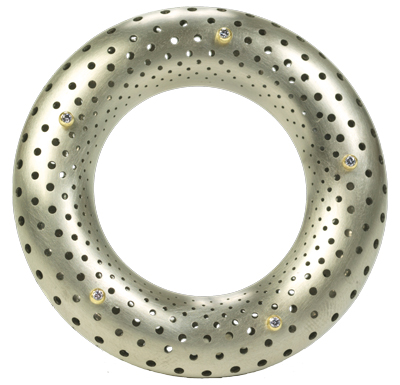
The mathematically inclined designer/goldsmith Ezra Satok-Wolman, owner of Atelier Hg & Co. Inc. in Ontario, Canada, crafted an 18k palladium white gold brooch in honor of the ancient Greek mathematician Pythagoras, who saw order even among the stars. His Pythagoras’ Cosmos Brooch with “stars” of natural deep violet-blue diamonds garnered Satok-Wolman second place in the 2013 MJSA Vision Awards’ gold distinction category.
Having already made one torus brooch in gold, Satok-Wolman knew his starting point: a flat piece of 0.6 mm sheet, this time white gold instead of yellow. The first brooch required five practice runs in copper sheet before working in gold. This time, Satok-Wolman went right in with 45 grams of gold—his own alloy of 75 percent gold and 25 percent palladium—from which he cut two donut shapes.
He gently scribed concentric rings on the outside of each piece. “Having some guides is incredibly helpful,” he says. “It’s important to do complete rotations of hammering, whether on the internal or external curve of the torus, and the lines help keep everything accurate and circular.” Resting the flat torus on a larger sandbag to cushion the hammer blows so he didn’t compress the metal, Satok-Wolman began striking what would be the inside of the brooch, raising the outer and inner edges with a small embossing hammer.
Next he hammered the metal against a 22 mm ball punch in a vise, using it much like the stake in anticlastic raising. During a two-week process, he continued striking and shaping the piece on the inside, moving to gradually smaller ball punches until he reached 12 mm. As part of the laborious fabrication method, Satok-Wolman stopped to anneal each half about 10 times.
“I was delighted when the two halves met up perfectly,” Satok-Wolman says. “The first time it works out it seems to be a miracle.” He welded the halves together with the Spirflame Karat250 micro welder from Spirig. Then it was time for carefully calculated embellishment.
To accurately drill the pattern of holes, which combine the golden ratio and the phyllotaxis pattern found repeatedly in nature, Satok-Wolman drilled holes at 9-degree intervals around the circumference. He then glued balls on those holes and wound silk cord in a complex pattern around the torus to denote exact locations for drilling. After marking each point where the silk intersected, he removed it and began calculations. “I charted out each hole size, making it as close as possible to the golden ratio in terms of the drill bit sizes I was able to acquire,” he says. Drilling from the center outward in eight concentric rings, he drilled a total of 640 holes.
Using a technique he learned from his mentor, Italy’s Giovanni Corvaja, Satok-Wolman beaded the tips of five lengths of 0.8 mm 19k yellow gold wire using his Spirflame welder. After pre-drilling the centers of the beaded tips, he inserted each wire through one of the holes in the torus and soldered the settings in place. He then set the 1.3 mm blue-violet diamonds, the spheres sparkling like stars in the cosmos.
Preferring to matte finish his pieces, Satok-Wolman began by sanding the white gold with 220 sandpaper, working up to 600 grit before applying a pumice finish using a paste made from pumice powder, dish soap, and water. The hand fabricated 18k white gold clasp, which is made from a nickel-based alloy to offer added strength, was the final addition.
With every aspect of the brooch carefully calculated, the designer achieved the results and the sense of order that he wanted in the piece. “I envisioned Pythagoras staring up at night,” he says, “amazed by the stars and unable to see anything beyond the pentagon shapes they made.”