

Cool Gold
Testing Blue and Purple Gold Alloys
By Linus Drogs
Editor’s Note: In this online exclusive, Linus Drogs of Au Enterprises in Berkley, Michigan, presents the results of his experiments casting blue and purple gold. A related study, aimed at improving the crack resistance of 14k blue and 18k purple gold alloys, was summarized in the March 2010 MJSA Journal. (The results were first presented at the Santa Fe Symposium on Jewelry Manufacturing Technology.)
Blue gold. I began by casting the 14k blue gold into a simple band. Using standard casting equipment (I use a Neutec machine with argon cover gas) and a flask temperature of 600°F (316°C), we cast the band at 1,050°F (566°F). The material cast successfully with no noticeable surface irregularities. As you can see on the casting, the oxides that form on the surface have a distinctive blue hue; however, when you polish off the oxides, the color of the actual metal is closer to a silvery gray with a bluish hue. Anyone in the industry who knows metal colors would say it looks blue, but a consumer would think it’s actually more of a gray color. Giving the casting a sandblasted finish as opposed to a high polish enhances the blue tone.
When casting this material, one reason for not obtaining a blue hue could be overheating the metal and burning off the gallium, which gives it its color. In conducting these trials I was careful not to overheat the metal and I do not think I overheated it dramatically, but this material is very sensitive to exact melting temperatures, so even a slight variation could result in a loss of color. Anyone casting the material should be aware of this.
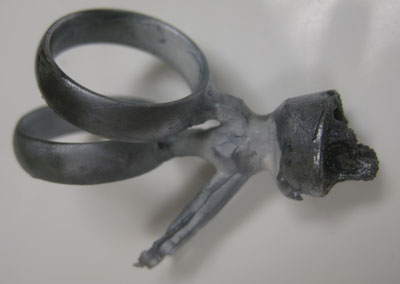
As a secondary test, I dropped the casting temperature for the band down to 950°F (510°C) in an attempt to get a deeper blue hue in the finished casting, but as seen in the result pictured here, the light blue hue is all that we could achieve with this alloy.
Although this alloy is definitely more durable than previous blue gold formulations, it still isn’t suitable for standalone cast jewelry pieces. Realistically, the best casting application for blue gold is in co-casting with a much stronger metal. Again using my standard casting machine without modifications, I cast the first part of the ring with a standard 18k yellow gold alloy. I then co-cast the 14k blue to the 18k part using a flask temperature of 600°F (316°C) and a casting temperature of 1,000°F (538°C). I got a nice tight fit between the two parts and the blue gold didn’t pull away from the yellow. With a co-casting, you can give the blue gold a protective barrier that makes it more resistant to wear.
A downside of casting blue gold is that you can’t re-melt it and start over. Once you heat it and burn off some of the elements, it’s essentially dead.
Purple gold. Unlike blue gold, which doesn’t require special casting equipment, purple gold requires a more complicated casting setup with vacuum, backfill, and cover gas. Considering it melts at a much higher temperature than blue gold (1,940°F/1060°C), 18k purple gold cannot be co-cast with other gold alloys—even palladium white gold alloys—because the melting temperature range is not wide enough apart to prevent blending when the second alloy is cast. Therefore, purple gold is suitable only for casting with 95 percent platinum and palladium alloys.
I began my experiments with purple gold as I did with blue-casting the material alone to test castability and color. Using a modified Ecco casting machine that allows for no oxygen to enter the casting chamber and a flask temperature of 1,200°F (649°C), I cast the purple gold at 2,200°F (1,204°C). I achieved very good cast quality and a true deep purple color.
I tried to co-cast the purple with 18k palladium white gold, but the co-casting was not successful because the melting temperatures of the alloys were too close and the materials blended.
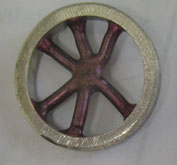
In addition to requiring higher-temperature casting equipment, purple gold has a tendency to absorb gas. You must use an oxygen-free environment-cover gas or vacuum alone won’t cut it-to prevent the aluminum from oxidizing. If you deviate from the casting parameters even slightly, you lose the purple color and get a very gray product. By following the procedures above, I was able to get a successful purple gold casting with good color.
You can treat a cast purple gold component as a gemstone. Since you can’t weld, bend, or shape it, you can simply cast the piece you want and glue it into place in a protective structure of traditional jewelry alloy. You could also pin or bead set it, but you’d have to treat it like a piece of onyx.
Linus Drogs is owner of Au Enterprises in Berkley, Michigan.