

Chain and Findings: A Buyer’s Guide
Tips for selecting the right components
By Shawna Kulpa
It seems like such a simple thing to order clutches for your latest earring design, or a set of chains to showcase your newest pendants. But is it really just as simple as picking out any old finding or chain? Not really. Here’s a breakdown of some of the areas and questions you should consider to ensure you’re making the right decision.
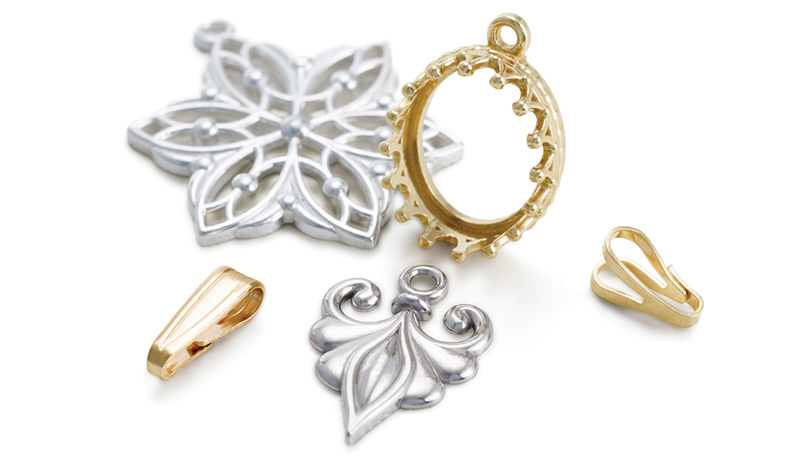
What Is Its Purpose?
Knowing exactly what you want a component or chain to do is critical when making a buying decision. Here are a few initial questions to ask of yourself and your supplier:
• What type of information do I need to have?
No detail is too small to share with your supplier. You’ll want to have on hand the dimensions of the piece you’re creating, as well as how you plan on integrating it with the chain or component.
“From a technical standpoint, more often than not, customers are looking for a finding that fits with another finding,” says Adrienne Keleher, product manager, findings for Stuller Inc. in Lafayette, Louisiana. “So product dimensions are one of the more common questions we have to ask.” For example, if a customer is ordering a box clasp, knowing how wide and deep a chain is allows the supplier to determine the required dimension for the clasp’s opening.
If you’re sourcing findings, consider what they will attach to. For example, if you’re searching for earring backs, you’ll want to know the weight of the earrings they’ll be securing. Are they heavy and in need of supportive backs, or would lightweight backs suffice? In this case, you’d also need to know the size of the earring posts onto which the backs will be fitted.
“You can’t put a post that’s too wide through an earring back that’s too small,” says Keleher. “Make sure we know the dimensions so we can help select the right part for you. The more information about the job or what you’re trying to do with [the component], the easier it is for us to help you with that solution.”
• Does it matter how a component was made?
Depending on what the piece is going to be used for, you may want to inquire as to how the finding you’re considering was made. Cast items tend to offer a better depth of detail and are often available in a wider variety of sizes and shapes. On the other hand, die-struck items, although lighter than cast items, tend to have better durability, which is why parts that are typically subjected to a lot of wear, such as heads, are often die-struck.
• How durable must a chain or component be?
Findings may be small, but they play critical roles in jewelry, so how well- made they are is key.
“A finding must be made to last,” says Richard Blake, president of Grassmann-Blake Inc. in Millburn, New Jersey. “It needs to be a certain amount of weight to be durable. Proper temper is also important.”
The durability of chains is also critical, especially if the chain will be used to suspend a pendant.
“If you’re looking to put a heavy piece on the chain, you might want to ask about a chain’s tensile strength,” recommends Vincent Ferrante, vice president of marketing for National Chain Group in Warwick, Rhode Island. Because the tensile strength of a chain depends on the style of chain, the alloy it’s made from, and the size of the chain, it’s important to provide your chain supplier with the weight of anything you wish to hang from it. They can use that information to help you identify the chains that will best support that weight while also achieving the look you’re trying to create.
But how do you know if a product will hold up and do what it’s supposed to do for the long haul? Don’t be afraid to ask for a sample or to purchase one unit so you can try it out.
“We don’t have a minimum order requirement, so a customer can purchase [a finding] and take a look at it,” says Nials. “They can check the quality.” Then, if you decide to place an order, you can refer back to that piece when you receive your order. “You can make sure that it’s the same quality.”
Ferrante also recommends asking for samples from chain suppliers. “We have a sample line that we can show them,” he says. “They’ll test them, use them to help them make the choice. And for the most part, there’s no charge for the service; we just ask them to return any samples they’re not happy with.”
• How can it meet my price point?
When purchasing chain or findings, price point is a critical consideration, but how do you balance price with the issues of durability and quality? You don’t want the components in your piece to fail, but that doesn’t mean you shouldn’t keep an eye on the ultimate bottom line of the piece.
When it comes to findings, most suppliers carry a range of price points in most styles—best, better, good. While it may sound like a good idea to invest in the most durable item with the best quality, you have to first assess whether or not it makes sense for the project at hand. You need to ensure that the cost of a component is in line with the rest of the piece. After all, there’s no sense in using a clasp that costs more than the rest of the bracelet it’s securing.
“You can’t put a lightweight spring ring on a heavy chain,” says Blake. “It depends on what the application is. If you’re stringing up Tahitian pearls, you don’t want to put a 29-cent spring clasp on it.”
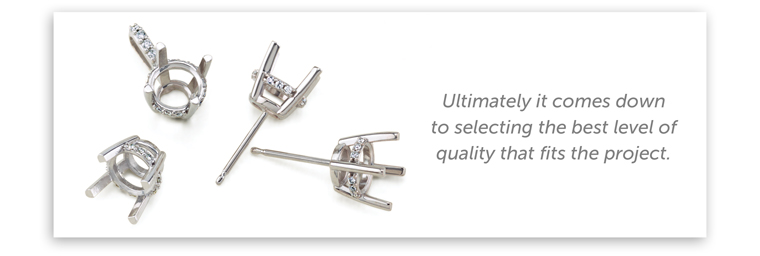
Ultimately it comes down to selecting the best level of quality that fits the project. “If it is a luxury or fine piece of jewelry, you want to use a well-designed, well-made finding that enhances your project,” advises Kendall Steven, owner of Legacy Findings in New York City.
Keleher recommends that buyers ask themselves a simple question: “Does it meet the quality standards consistent with the rest of the job I have on hand?”
From Whom Should I Buy?
It goes without saying that you should seek out reputable sources for all of the products you use in your jewelry, even the tiniest of components. Before selecting a supplier, consider these questions:
• What products do they keep in stock?
Given the full breadth of products most chain and findings suppliers offer, it’s not realistic for them to keep every SKU fully stocked at all times. But because you sometimes may need components at the last minute, it’s worth knowing which products your supplier keeps in stock, and if they stock enough to fulfill your needs.
• Do they offer technical support?
Most components seem simple enough to work with, but it’s helpful to know that you have a resource to turn to when you do encounter a problem. “Do they offer technical support so that if you get stuck, they can help you out?” asks Nials. When selecting a supplier, ask about the type of support they offer their customers and when it is available. While you may never need to avail yourself of the help, it’s nice to know it’s there in case you need it.
• What services do they offer?
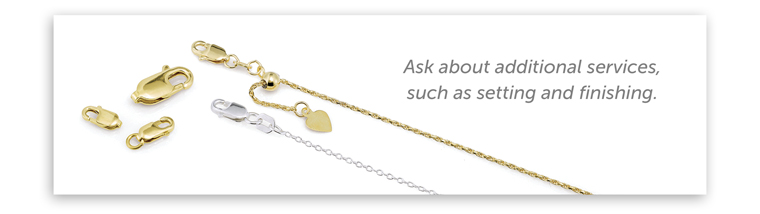
When shopping for a chain or findings supplier, don’t just focus on the products a supplier offers. Ask about additional services, such as setting and finishing. Depending on the volume of product being ordered, many chain manufacturers will offer a variety of additional options, such as tagging of products with your barcode or custom carding of chain.
“Some of our customers ask us to batch their chains in certain quantities,” says Ferrante. “If they order 1,000 rope chains, they may want them batched in groups of 25 to make them easier to count when they come in.”
• What is the supplier’s return policy and warranty?
Even after doing your homework, you may still wind up with the wrong parts for the project at hand. Ask potential suppliers about their return policy and any type of warranty that they offer. Under what conditions will they take back returns? Does the item have to be defective in order to return it? And what do returns entail?
“If a product is not functioning properly, we may ask you to return the product or send us a picture so we can see what’s going on,” says Keleher. “It’s not that we want proof to replace it, it’s how we quickly determine what the problem is and what actions need to be taken to correct it. If you purchase a product and you’re not happy with it, tell us. Feedback is critical as it assists us in maintaining consistency and quality in our findings.”
And be sure to ask about the time frame in which returns can be made. While many suppliers will have a set time limit on returns, it’s worth asking about your options for any components or chains used in pieces that do not sell well.
“If you add an item to your line and it’s not selling, sometimes you can return it after a year or two with a restock fee,” says Nials.
• What delivery options do they offer?
Rush orders pop up, accidents happen. Despite your best-laid plans, there are times when you may need a component on short notice. Ask suppliers about their delivery options, how quickly rush orders can be fulfilled, and what type of costs may be involved.
“Jewelers are often working on last-minute jobs and inevitably things can go wrong and they need to be able to get that finding overnight,” says Keleher. “You don’t want to be left holding the bag on a job.”
Considering Custom?
What happens when you’ve perused the websites and catalogs of various suppliers, searching for a particular type of finding or chain, and simply can’t find what you want? Some suppliers are happy to work with their customers to create custom components and chain, but there are a few factors to consider.
• How many of the item are you looking to buy?
Whether the piece is going to be created from scratch or by modifying an existing finding, most suppliers will have a minimum volume requirement to make the job worth their efforts.
“We need a certain minimum because it costs a lot of money to make a mold or tool and die,” says Blake. “It’s expensive making up a new product.”
If you’re interested in only a handful of a special product, you might be better off modifying an existing component.
• What special fees will be charged?
Expect to pay a special fee to have a custom chain or component made for you. Sometimes the fee will depend on how the component will be made. A cast piece for which you supply the design or model will likely cost less and have a lower volume minimum, depending on how many models can be cast at a time. If the component needs to be die-struck, expect to pay a bit more.
“Die-struck is a lot more entailed,” says Nials. “Some equipment runs $2,500 to $7,000, depending on the complexity of the piece.” However, she notes, “if it’s a simple change, such as changing the metal of a piece, there usually isn’t a fee.”
Don’t be afraid to try to negotiate with your supplier. “If a customer has an idea, I can negotiate with them to pick up the expense of the model or die making if we can add the piece to our line,” says Nials. “If they want it exclusive, they have to pick up the charges.”
• What type of details do I need to provide?
If you’re going to have a chain or component made for you, be prepared to provide your supplier with specifics on what exactly you want and expect, including weight, dimensions, and price point, as well as to supply it with CAD renderings or detailed drawings that illustrate your vision of the piece.
“We would need all of the specifications for an item,” says Nials. “We’d also need time to analyze a prototype, agree on a delivery schedule, and agree on final quality. For example, does the customer want [the part to have] a high polish, a matte finish, or to be oxidized? How important is consistency? If it’s a little charm, it may not matter if each item varies ever so slightly, but if it’s a mechanical piece that has to hold something in place, consistency is important. And if the customer wants a single component to attach to handmade chains that vary in dimension, then we’ll need to build a part with some tolerance for that variation. We need to consider everything.”