

Cause and Effect
William Travis Kukovich talks philanthropy
By Irina Hawkins
Editor’s Note: As business owners, jewelry designers and retailers are sometimes approached by local and philanthropic organizations interested in partnering up for good causes. This occasional column will look at the ways some jewelers are partnering with charitable organizations, the reasons why, and how they make it work.
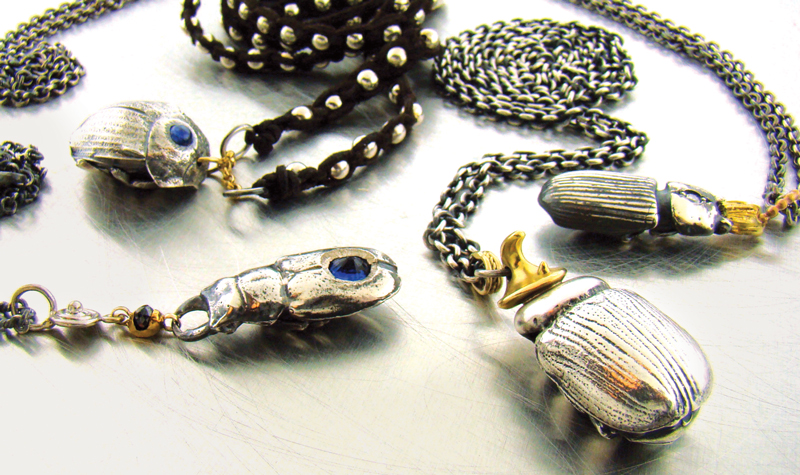
When William Travis Kukovich, owner of William Travis Jewelry in Chapel Hill, North Carolina, was diagnosed with stage two breast cancer at the age of 26, he thought, “Was I middle-aged at 13?” He considers the ordeal to be the biggest turning point in his life. The illness changed the way he approached everything—it made him strive more, aim higher, and “go for it on a bigger level.” He realized that he wanted not only to be the best at his chosen profession, but also to help others, ultimately delivering on both fronts. A recipient of 17 AGTA Spectrum Awards, Kukovich can safely say that he didn’t slack off in realizing his professional goals. To achieve his humanitarian dreams, he creates jewelry to benefit the causes that are dear to him. “I do philanthropy through my art, using my talent and my skills,” he says.
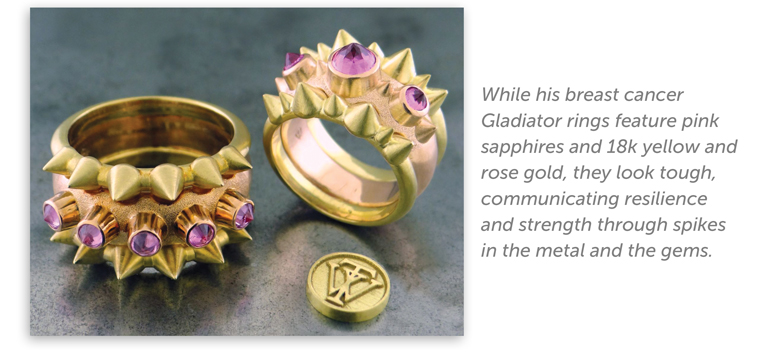
To empower men and women with breast cancer, he created Warrior, a line of jewelry for “warriors,” his term for people who are battling the disease. They sell the rings at wholesale “for anyone who has been dramatically affected by cancer.” Kukovich says, “I was sick of the cushy, nice, tidy pink ribbon that doesn’t appeal to sufferers who have to become gladiators.” While his breast cancer Gladiator rings feature pink sapphires and 18k yellow and rose gold, they look tough, communicating resilience and strength through spikes in the metal and the gems. Kukovich says the rings became “wildly successful” because people wanted jewelry that expressed their willingness to fight. His rings are “like tattoos meant to remind you that you’re going into battle every day, that you should get ready to go to war with cancer. No one who survives cancer is a sissy!” Kukovich has given some Gladiator rings to a breast cancer charity in Chapel Hill to auction off, and donated approximately $6,000 from sales of the rings.
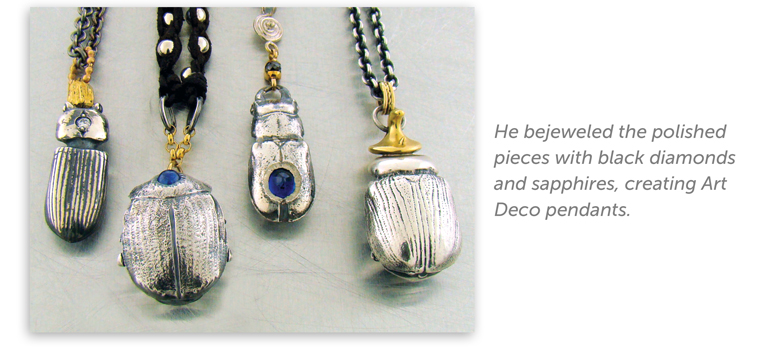
Another cause that’s close to his heart is art. Kukovich donates to the North Carolina Museum of Art in Raleigh. “In awe of what they were doing,” Kukovich says he couldn’t write a big check but wanted to contribute in a different way. Inspired by the museum’s Egyptian exhibit, he created a limited-edition collection he called The Art of the Scarab (above) to auction off and to sell in the gift shop. Kukovich stumbled onto the idea of using beetles as molds while skimming the invaders out of his swimming pool. He decided to try casting them in sterling silver and 18k yellow gold. He bejeweled the polished pieces with black diamonds and sapphires, creating Art Deco pendants. The jewelry was so popular that four of the seven scarabs, which were displayed at the museum, sold even before the opening of the auction. The pendants brought in about $15,000 in final proceeds for the museum’s foundation.
Even though he donates jewelry to be auctioned off for a good cause, Kukovich says that artists should approach auctions with caution. He often explains to the organizers that the bidders are not giving a dime until they go over the price he assigns to the piece, which takes into account his labor and material costs. That’s why—before every auction—he gives a speech and lets the crowd know what amount they need to go over. “I found it’s always valuable to remind them that until they go over the cost of the piece, the donor is the only person who is donating at the end of the day,” he says.
Kukovich advises that jewelers who are looking to get involved in charitable giving select only a couple of causes dear to their hearts. For instance, in addition to raising money for art and breast cancer research, Kukovich helps individuals affected by autism. Because his younger brother and his aunt both have the disorder, he joined the board of Autism Speaks, a social services organization based in Boston, and became the art director at Extraordinary Ventures in Chapel Hill—a non-profit that employs autistic adults, where he helps out with anything craft-related. “Never give to anything you don’t believe in,” he says. “You won’t be good at it. You’ll do better if you find a cause that means a lot to you.”