

Casting Call
Dawn Muscio designs a palladium bowtie worthy of the red carpet
By Shannon L. Brown
With the red carpet in mind as a final destination for her piece, Dawn Muscio of D. Muscio Fine Jewelry Studio in Atlanta began thinking of a necklace and earring pair to enter in the 2012 Palladium Alliance International Design Competition. But then she changed her mind. Why make something so expected, she thought. Why not make something different—something a man might wear.
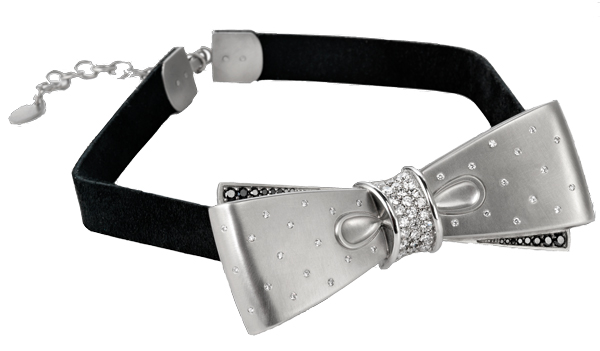
The result was a full-size palladium bowtie with white and black diamonds on a leather strap—and the unique piece took grand prize in the design competition.
But despite being a bowtie, the piece isn’t just for men; Muscio designed it to be worn by either a man or a woman. Deciding to use a pattern reminiscent of fabric, Muscio considered plaid but settled instead on white polka dots with a black accent. “We wanted to bling it out a little bit but keep the black-and-white theme,” she says.
She began by building a sketch to scale in CAD. At 90 mm across and 35 mm tall, the bowtie couldn’t be cast in one piece. She decided to cast it in seven interlocking pieces: the knot in the center, which has a slide through for the leather; the two dimples that sit on the bowtie; the right and left sides of the bowtie; and the two corresponding pieces for the back, which are pierced to make them lighter.
After first bringing all of the parts to a tripoli finish inside and out, she used palladium solder to attach the dimples to the top ribbons. She set them into a cast indentation that allowed the solder to flow into it and not onto the flat surface. “This made less work for me in clean-up,” she says. “Time spent in CAD makes it seem like more work, but it makes the final finish much faster.”
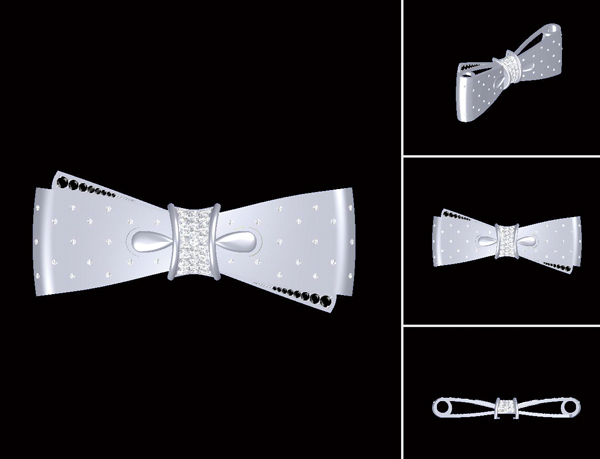
Muscio then prepped the bead work for the black diamonds on the bowtie and the white diamonds on the knot. She did this early on because the areas where the black diamonds are would be harder to access after the piece was assembled. Continuing the soldering process, she lined up the two bottom halves of the bowtie by sliding them into notches on the knot and attached them. She soldered the two top ribbons of the bowtie to the knot, then laser welded the seams at the sides of the bowtie near where a row of white diamonds would be set, completing the assembly.
After applying another overall tripoli finish, she used a special pitch block to hold the larger-than-average piece of jewelry stable and bead-set black diamonds on the edge—16 in all, graduating from 1.3 to 3 mm—and white diamonds in the knot—30 in all, graduating from 2.5 to 3.3 mm. She then cut seats to flush-set the 34 1.5 mm white diamonds into pilot holes pre-drilled in CAD.
After giving the knot a high polish, she masked it off with the aluminum foil tape used in HVAC installations and repair, then used a satin wheel brush to apply a satin finish to the rest of the bowtie. Her finishing touch of burnishing around the edges of the flush-set white diamonds—the polka dots—brought them to life.
With her initial inspiration to design a piece for men only, Muscio had planned to make a belt buckle fastener for the leather strap—something that would give it flair but be hidden by a gentleman’s collar. “When I figured it might be worn by a woman, I wanted a little more of a feminine quality, so I came up with a chain link with a tail that trails down the neck for another little dramatic detail,” she says. The chain also enables the wearer to adjust the length, making it a truly unisex piece that fits a neck size from 13 to 17 inches.
“I wanted it to look like fabric interpreted in metal, and I truly achieved the vision I had in my mind’s eye when I started out with pen and paper,” says Muscio. “I definitely knew that I had a really stunning piece when I was at the last step. I remember placing it on my model for the final fitting and thinking, ‘Wow, I think this could actually win this thing.’”