

By Your Side
Claudia Kretchmer pays tribute to her father in a two-stone tension ring
By Shannon L. Brown
When a customer showed Claudia Kretchmer of Steven Kretchmer Design in Scottsdale, Arizona, a two-stone tension ring her father Steven had designed, it touched her heart and sent her in a new direction. “I was so moved by seeing it again that I wanted to design a whole line of [two-stone tension] rings,” says Kretchmer, who is CEO of the company her deceased father founded.
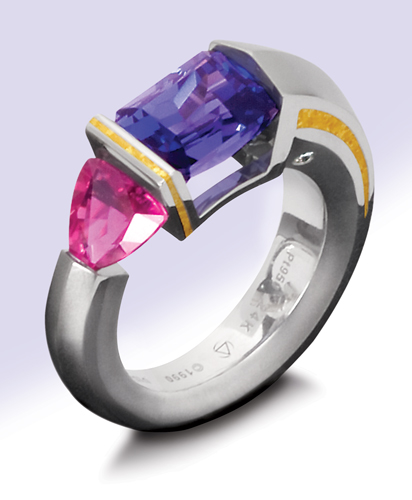
One of the first results of that inspiring moment is the ring shown here, which uses the tension from a 1.3 carat trilliant-cut Vietnamese ruby to support a 3.61 carat emerald-cut tanzanite. The gems rely on each other for security: If the ruby is removed, the tanzanite is loosened; the tanzanite cannot move unless the ruby does.
After designing in CAD and printing a model, Kretchmer had the ring cast in the company’s patented “tension set” platinum alloy. The hard and springy platinum measures 290 on the Vickers hardness scale—more than two times that of conventional platinum. The casting was then cleaned up and shaped, as very little of the ring’s details, such as the gothic rudder peak on top or the inset side, were clearly defined in the casting.
Shaping for the ring began with files, working from a coarse 0 to a 4, and using needle, barrette, square, and 3-square files, depending on the area. Sandpaper was then applied with custom-made steel hand-sanding tools, starting with 320 grit and working down to 2,500, then 4-0. All finishing, with the exception of a bit inside the finger hole, was done by hand due to the fact that a lot of pressure must be applied against the platinum.
One of the most nerve-wracking parts of making this ring was cutting the seats for the stones, which required test-fitting the gemstones more than 20 times. Gradient tension was created by cutting out just enough metal to seat the stones tightly. The center bar between the ruby and tanzanite was slowly worked. “If it’s too thick, it doesn’t have enough play, so the ruby doesn’t exert enough force on it to snug up to the tanzanite,” she says.
The tip of the ruby was set fairly deep into the left side of the shank, while the opposite side of the ruby rests against the bar lower than the tanzanite. “If the two gemstones met at exactly the same spot, you’d have to cut opposing seats on each side of the bar, and it would be too thick to have the proper spring to create the tension needed,” says Kretchmer.
After refining the seats for the stones but not setting them, Kretchmer’s team cut the channels for the gold inlay, followed by polishing with 4,000 and then 8,000 grit platinum compound. They then flowed their “secret recipe” of molten crystallized 24k gold into the channels. Once the metal solidified, they used an assortment of filing and sanding tools to flatten the surfaces flush with the platinum.
Because the ring features areas of high polish and matte finish, it had to be finished carefully. The areas that are high polish—the bar between the stones and around the tanzanite, as well as the inside of the ring—were masked off with a very fine-tip wax pen before the rest of the ring was given a glass-bead blast.
At last, the stones, including a 0.01 carat diamond that accents the side of the shank, were set. After a brief final polish, the ring was complete—resulting in not only a beautiful piece of jewelry, but also a captured memory.
“I knew I wanted to make one of my father’s inline rudder rings, then found these two stones and fell in love with the depth of their color and how unusual they were,” says Kretchmer. It’s hard to ignore the symbolism in the ring’s two gemstones, relying on each other for support and, only together, completing the vision.