

Big Shot
Casting Case Studies: The Case of the Platinum Mamba Knife Handle
By Shawna Kulpa
When it comes to casting, bigger isn’t always better. Although many casting problems can be traced back to parts being too small, causing fine details to become muddled, larger items have their own share of problems.
Take the Case of the Platinum Mamba Knife Handle.
The case started when TechForm Advanced Casting in Portland, Oregon, was approached by longtime client Finch Jewelers in Lancaster, Pennsylvania, to cast a one-of-a-kind knife handle in platinum. Commissioned by Cabot Gun Co. in Sarver, Pennsylvania, Finch Jewelers worked with a nearby jewelry designer, Valerie Jo Coulson, to create a handle featuring finely detailed inlay, including three pieces of onyx as well as pavé-set diamonds.
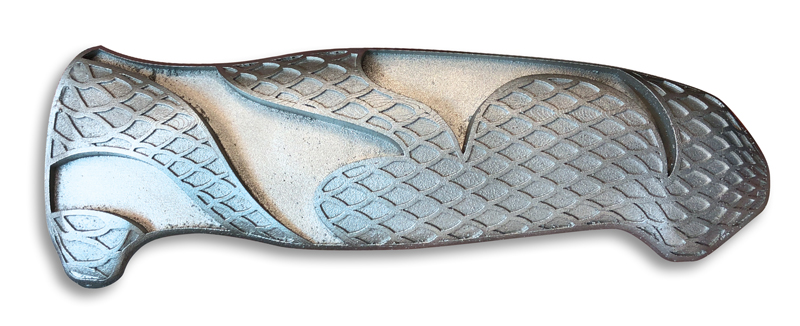
One of the first red flags that arose was the sheer size of the handle. “It was 130 mm long and about 37 mm wide, with a thickness that varied a bit,” says Kevin Mueller, director of operations at TechForm. “It was going to require more than 400 grams of platinum for the pour.”
The company had done large castings in the past, though, and the dimensions of the knife fell within their machine’s capabilities—“It was starting to stretch the limits…but it was still doable,” Mueller says. The team decided that they were up for the challenge.
Given the size of the piece, Mueller and his team would have preferred to receive the CAD file, which they could then print on a 3-D printer. However, the client had already had the handle milled in two halves, and it opted to send one of the halves to TechForm. The decision immediately raised a warning flag for Mueller.
“Milled wax works great in a lot of castings, but it can cause havoc during burnout from the sheer size and thickness of the piece,” he says.
They decided to give it a shot, though, and the wax arrived at TechForm in good shape. After a light clean-up, the team went about spruing it. They settled on adding a total of eight large sprues, which they attached to the inside of the wax to avoid marring the inlay details. “These were not your average-size sprues,” jokes Mueller, who notes that the sprues measured 3 mm by 9 mm.
Once the wax was sprued and invested, it was onto burnout, where problems started to arise. When the flask was removed from the oven, the TechForm team noticed large cracks in the investment—a direct result of the wax mold expanding during the burnout process.
“Milled wax expands a lot more than most people think,” Mueller says. “In smaller pieces, you don’t notice it as much. But with larger pieces, it’s more obvious.
“Had this been a small pour, we might have said, ‘Let’s go for it,’” he continues. “But considering how many ounces we were going to pour, we didn’t want to take the risk. [The metal] could shoot through the other end of the mold and ruin the machine. It was not going to be good.” The combination of the weight of the pour along with the size (large) and location (dead-center) of the cracks meant that attempting the pour would be too risky to undertake.
Rather than take a chance with the cracked investment, the team brainstormed to find a better solution. They first considered making a rubber mold of the handle and injecting it with wax, since “injection wax doesn’t expand,” Mueller says. But they were concerned that, because of the handle’s size, any shrinkage that occurred during the molding process could warp the model a bit. This would make the insertion of the custom knife blade difficult, if not impossible.
“We talked about modeling the wax but didn’t want to take the chance with unknown shrinkage,” Mueller explains. “Warping is inherent in the wax when it’s cooling down or when removed from a mold. I know people can inject and keep things perfectly flat, but it was a variable we didn’t want to have for an already difficult casting.” Warping is a problem especially with large, flat objects since they take longer to cool down, and there’s a greater tendency for an edge to be pulled in a different direction.
Instead, the TechForm team had Finch Jewelers send over the CAD rendering of the complete handle. They then printed one half of the handle on a Solidscape 3-D printer, which they opted to use because that printer’s wax-like material doesn’t expand during burnout. They started with just one half of the handle, given the time needed to complete the print.
“It took 50 hours to print because of its size,” says Mueller, who notes that they set it up to print over a weekend. “Other printers could print it faster, but we wanted to make sure it was going to work. Speed wasn’t an issue.
“We had no problems,” he adds. “The pattern looked good when de-waxed from the support material.”

They then moved on to casting. While the company usually has only two people overseeing a casting job, for this project, they enlisted the help of two additional casters. “We wanted multiple eyes on it in case anything went wrong,” he says. With a platinum melt of this size, the company was particularly worried about the crucible failing during the melt. By having multiple sets of eyes watching the melt and crucible, they would be more likely to quickly spot any problems, such as the crucible starting to deform.
All of the precautions and preparation paid off—casting the first half of the handle was a success. The team then subjected the piece to hot isostatic pressing (HIP), a treatment they use to eliminate any sub-surface porosity and make the platinum stronger and more ductile. The process can also reveal internal problems with the casting.
“We wanted to make sure there weren’t any surprises down the road,” says Mueller. “We didn’t want to waste that printing time [for the second half of the knife] if we had large voids in the first casting. Fortunately, it told us that the spruing method we used was spot-on and it had good solidification.”
With a successful cast under their belt, they outsourced the printing of the second half of the handle and then followed the same casting procedure.
After making sure there were no obvious defects, they gave the handle pieces a light pre-finish and then sent them to the client for the final finishing and assembly. And the Case of the Platinum Mamba Knife Handle was closed.