

A Matter of Trust
Made in the USA case study: How to compete using a U.S.-based subcontractor
By Shawna Kulpa
Note: The following case study is part of MJSA Journal’s “Made in the USA” series, which focuses on how jewelry manufacturers are staying competitive, particularly against overseas counterparts. Past case studies can be ordered in our bookstore.
Like the great Billy Joel sings, it’s all a matter of trust.
That’s certainly the case when it comes to the relationship between a jewelry designer and a contract manufacturer. Just ask Melissa Clayton of Tiny Tags in Acton, Massachusetts.
Trust drove Clayton to seek out a U.S. subcontractor when she decided to expand her company’s line of personalized mother’s jewelry. She needed to trust that rush orders wouldn’t be delayed by weeks. She also needed to trust that her communications would be understood, and that the quality she expected could be achieved. As she puts it, “Trust is a big issue.” And as the following story shows, she found exactly what she was looking for—right in her own backyard.
Clayton started her company seven years ago, when she and her husband were living in California. “I was working as a CPA [Certified Public Accountant] and decided to stay at home after I had my first child,” she says. “I had seen ‘mommy jewelry’ around and fell in love with it.”
She started “playing around” and went online to learn how to stamp items by hand. “I wore a few of my pieces,” she remembers, “and friends saw them and wanted some too. I’ve had the entrepreneurial bug for as long as I can remember, and I saw the potential for business there.”
Like many entrepreneurs, she started small—“I was the mom doing hand stamping in her basement,” she says. She developed a line of sterling silver, 14k, and 24k gold-plated personalized jewelry, and business grew slowly. But she recognized the limits of her own abilities, and last year she realized she would need help if she wanted to grow the business further.
“I wasn’t able to focus on sales and marketing because I was too busy making all of the products,” she explains. “There was also very little variation in my original product line. I offered pieces in different metals, but all the shapes were circles. I wanted to be able to offer more variety and have more finished and higher-end pieces with gemstones and laser engraving. I knew I would have to outsource anything I wasn’t good at, and I needed people with expertise in jewelry.
“I also wanted my business mobile,” she continues. “By outsourcing all production, I was not tied down to any geographical area.” This was especially important as she and her husband were in the process of moving from California to Massachusetts.
When Clayton began looking for a subcontractor to produce her product, she was unsure at first where to begin. But she knew one thing she wanted in a manufacturing partner: A company that would produce her goods in the United States. She had dealt with an overseas company during the early years of her business, and had not been happy with the experience.
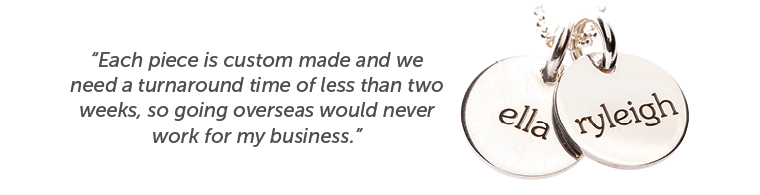
“I worked with a Chinese company and had them embed gemstones in my tags, but communicating with the company was extremely challenging,” she remembers. “E-mails had broken English, and it never felt like a ‘partnership’; it felt like a transaction. I wanted a subcontractor who was a business partner, who could bring ideas to the table and help grow my business.
“There was also the added expense of shipping overseas and the time it took to receive product,” she says. “I couldn’t have my product sitting on a boat for six weeks.”
Her experience also left her with concerns about quality. “I wasn’t happy with the original samples they sent,” she says of the Chinese company. “I thought they had done a poor job in embedding the stones, and there was glue visible in some of the settings.” Her concern was only compounded by the stories she heard from colleagues who had also worked with overseas contractors: “The first batch you get might be sterling, but the second batch might not be all sterling,” she says.
And as if that all weren’t enough, Clayton had come to a realization that finalized her decision to work with a U.S. contractor: She simply didn’t feel comfortable going overseas. “It wasn’t in line with the brand I was trying to create,” she says. Working with companies outside the United States was simply no longer an option.
So she set out on her search, and put in a call to MJSA for help finding contacts. Clayton said she wanted to start with local companies—Massachusetts and Rhode Island, specifically—and received a list of contractors that were potentially good matches. She followed up with each one and explained exactly what she was looking for: A company that could make tags in a variety of styles and personalize them with a laser engraver. In addition, she needed a company capable of doing fast turnarounds on her products, and whose quality she could trust.
Because her company was still small, she initially had trouble finding a manufacturer willing to do the limited runs she required, as well as do high-end laser engraving and meet the turnaround times—until she came to one that not only met her criteria, but was right in her backyard.
Located in Attleboro, Massachusetts, TharpeRobbins was only an hour’s drive away, an added bonus for Clayton. “It worked out well that I could physically go down and meet with them,” she says. The company wound up having the right equipment to accommodate what Clayton required, and they had everything necessary to do the limited production she needed.
Clayton easily ticks off the advantages of working with such a “homegrown” partner, starting with turnaround. “If I went overseas, they couldn’t turn things around in five days,” she says. “But with companies here I can have rush orders done in five days”—although she jokes that even that “is still too long for half the dads that shop!”
Clayton credits that capability with helping her to grow her business by 50 percent last year. “I’m looking to double my sales this year, and I don’t think it would be possible with an overseas contractor,” she says. “Each piece is custom made and we need a turnaround time of less than two weeks, so going overseas would never work for my business.
“As part of my growth plan I’m looking at having TharpeRobbins drop-ship some of my products,” she continues. Between the quality issues and communication barriers she previously experienced with an overseas company, she believes that a drop-ship relationship would not be possible if she weren’t using a U.S.-based manufacturer. The fact that TharpeRobbins is so nearby is icing on the cake.
“I really got lucky,” she says “Because they’re local, I was able to go down and meet with the woman who will be the last person to see the product. We sat down and I got to emphasize the heartfelt present she was in charge of sending out—they’re not shipping out toilet seats. I needed to trust that she understood what we’re trying to do.
“I was able to look her in the eye and see that she got it,” she continues. “She’s a mom herself and understood my jewelry’s message, and I know she’ll make sure everything will be perfect. That’s priceless, and it’s how I want to do business.”
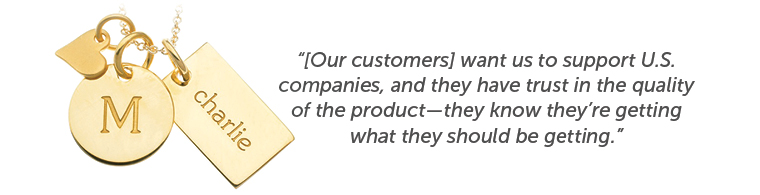
And customers seem pleased with her mission as well. “I just did a trade show and every time I said things were locally made, people were thrilled,” she says. “We also did a ‘behind the scenes’ video demonstrating how and where our products are made and posted it on our website. Our customers loved it. They want us to support U.S. companies, and they have trust in the quality of the product—they know they’re getting what they should be getting. Being made in the USA is a big selling point.”