

On Red Alert
The trials and tribulations of working with red gold
By Shawna Kulpa
“You like potato and I like potahto. You like tomato and I like tomahto. Potato, potahto, tomato, tomahto Let’s call the whole thing off.”
Brothers George and Ira Gershwin may have been talking about vegetables in their famous lyrics from the 1937 film Shall We Dance, but a similar type of sentiment is shared in the metallurgical world when it comes to red gold. Whether it’s called red, rose, or even pink gold, it’s all one and the same: An alloy that many jewelers have sworn off using after tearing out their hair in frustration.
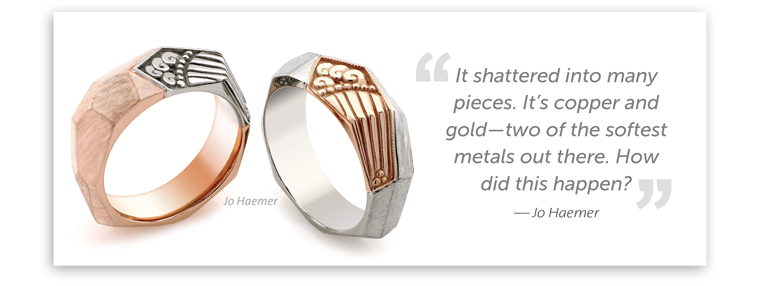
“I’ll never forget the first time we cast a piece in 18k rose gold,” recalls Jo Haemer of Timothy W. Green Jewelry in Portland, Oregon. “We air-cooled it and then dug it out of the investment. It looked perfect. But as soon as [my partner] Tim put the ring on a mandrel and hit it with a rawhide mallet to round it up, it shattered into many pieces. We were gobsmacked. It’s copper and gold—two of the softest metals out there. How did this happen?”
Even if you haven’t experimented with the metal yourself, you’ve likely heard similar stories about working with the “red devil” and its brittle 18k castings, its extreme oxidation during torchwork. But with consumer interest in rose gold jewelry continuing to grow, now might be the perfect time to take another look at this challenging metal. And since, as with so much in life, preparation is key, take this opportunity to learn about the difficulties in working with red gold and the various ways those challenges can be overcome.
The Hard Facts of Casting 18k Red Gold
Ask any jeweler about the first time he or she cast 18k rose gold, and you’ll likely hear about an experience similar to Haemer’s (and often told with words unfit for print). Haemer is accurate in that gold and copper are soft metals. The problem arises when they’re mixed together as a binary alloy, as they are to create 18k red gold. This can lead to the phenomenon of ordering if the alloy is allowed to slowly cool down. Often associated with binary alloys, ordering alters the crystal structure of the alloy, making the atoms difficult to shift out of position. And 18k red gold’s typical ratio of copper and gold lends itself perfectly to this phenomenon. “[The alloy] tends to segregate at low temperatures,” says Dr. Shan Aithal, a corporate metallurgist at Stuller Inc. in Lafayette, Louisiana. “As it cools, copper can no longer bear sitting with gold, but the copper doesn’t come out randomly. The atoms form an ordered structure, alternating layers of copper and gold atoms.”
While neat and orderly is a great setup for your bench, it’s not a great arrangement for the atoms in a red gold alloy. “With 18k red gold, there’s almost exactly a mix of 50 percent gold atoms and 50 percent copper atoms,” says metallurgist James Binnion of James Binnion Metal Arts in Bellingham, Washington. “The difference in size between the atoms makes them want to segregate, and it’s really easy for them to fall into that ratio. The planar layers that then form through the crystal structure make the alloy very, very hard and very brittle,” says Binnion. If the cast flask is allowed to air cool, the resulting pieces, as perfect as they may look, are likely to shatter when they’re worked at the bench.
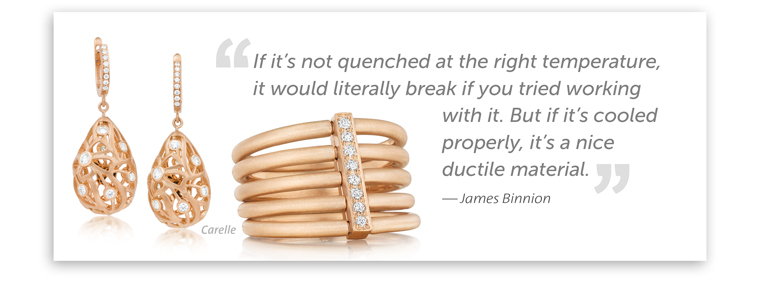
To prevent this, metallurgists recommend quenching while the metal is still hot. “The best thing to do with 18k is to quench it as soon as it loses its color,” advises Binnion. “If it’s not quenched at the right temperature, it would literally break if you tried working with it. But if it’s cooled properly, it’s a nice ductile material.”
However, you shouldn’t quench the whole flask, which could release silica from the investment. “You don’t want to quench casting flasks because the silica gets into the air [through] the steam and then you’re breathing it in,” says Binnion.
One option is to quench only portions of the flask. “Sometimes you can just quench the button and part of the flask in a pan of water,” says Aithal. This cools the metal, but not the investment. “Do it two to three times and then quench the whole flask.” This process also avoids the risk of thermal shock to any stones that may have been cast in place, he adds.
Binnion recommends simply letting the flask cool down and breaking the metal out when it’s cold. “Once it’s free of the investment, heat [the casting] until there’s a visible glow to it and then quench so you can take the ordering out of it.”
Some alloy manufacturers may try to avoid this problem by adding another metal, such as silver or zinc, to the alloy. “The additional metal acts as a mediator and keeps everything in solution,” says Aithal. Just the presence of a small amount of an additional metal is enough to keep the gold and copper atoms from ordering.
Although this helps the alloy to avoid becoming brittle, it usually doesn’t have too much of an effect on the alloy’s overall hardness. Binnion notes that silver in particular changes the overall hardness of an 18k red gold alloy by only about 15 points on the Vickers scale.
“Most of what’s being sold as 18k red gold probably has about 4 percent silver in it, which gives it some buffering from being a super-hard material,” he explains. “But it still gets pretty darn hard.”
The one downside to adding another metal to your 18k red gold is the possibility that the hue may change. The metals most often added tend to be white; therefore, although you’ll eliminate the need to hot quench the alloy, you’ll also reduce the red tone. “People have to accept the loss of red from the ideal color,” says Aithal.
The Dark Side of Soldering Red Golds
Casting isn’t the only area where red gold needs some special attention. Most jewelers using the metal have discovered that it doesn’t always behave in a similar way to its more common yellow and white cousins.
One of the first things jewelers may notice is the alloy’s habit of rapidly oxidizing when it is heated, especially when compared with yellow gold.
“Because there is so much copper in the alloy, it tends to oxidize easily when you apply heat to it,” explains Aithal. He notes that this problem is usually more prominent when working with 10k and 14k red alloys. “18k is more forgiving,” he says. “The more copper in the alloy, the more problems you’ll have [with oxidation].”
Luckily, the solution for the oxidation of red gold alloys is simple: Pickle.
“Pickle will remove oxidation,” says Aithal. “Once you dip it in pickle, [the oxidation] goes away.”
If you do encounter stubborn oxidation that doesn’t disappear after a dip in pickle, Angela Busby, technical trainer for manufacturing at Stuller, notes that the discoloration can also be removed with radial bristle brushes. They are especially useful in any areas that are hard to polish, she adds.
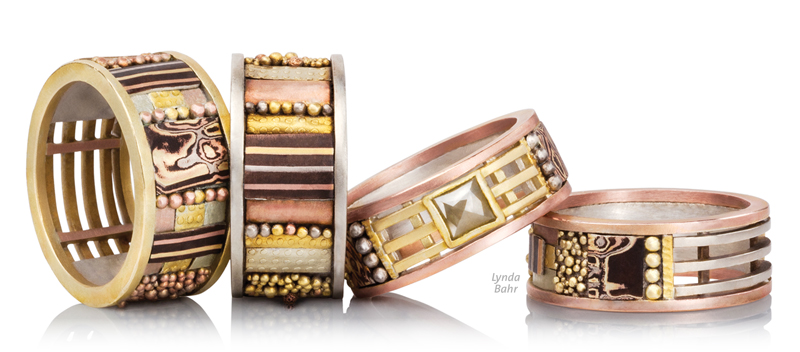
This is a handy tip to have, given that exposing copper-heavy gold alloys to a lot of heat and pickle can lead to depletion gilding. That’s an issue that Lynda Bahr, owner of Lynda Bahr Jewelry in San Gregorio, California, has had to deal with. The mosaic pieces she creates require a lot of soldering, and she needs to repeatedly place her pieces into pickle to remove the resulting oxidation.
“The copper oxidizes when heated, turning the surface black,” explains Binnion. “Then the pickle removes the oxide, leaving a depleted gold surface. The more copper in the alloy, the more it oxidizes when heated, and the worse the problem is.”
Bahr discovered this was happening to the 14k rose gold in her pieces, causing the fine gold in the alloy to come to the surface.
“It starts looking like yellow gold,” she explains. “I have to remove the fine gold so it looks more like pink gold again.” To remove that layer of gold on the surface, Bahr sands the area with a very fine steel wool.
To help reduce the oxidation of rose gold alloys during soldering operations, Aithal recommends covering the soldering area with a mix of boric acid and alcohol.
“When I fabricate with rose gold, I always use a thick paste flux usually reserved for silver and copper, and not the thin, watery flux for gold,” says Haemer, who relies on Handy or Dandix paste flux as well as on a mix of boric acid and alcohol. “Soldering can be a little dicey, as the red solders are slow to flow. The paste flux doesn’t burn off during the lengthy heating process, while keeping any oxides from forming where I want my solder to flow.”
Bahr also prefers any type of flux that contains borax, often making her own with denatured alcohol and borax. “Other fluxes tend to burn off faster,” she explains. “Borax helps the solder flow faster, and it’s a good protection for the metal when soldering at high temperatures.”
One of the reasons why it’s helpful to speed up the solder flow is the high melting temperatures that most hard and medium red-gold solders have. “You have to be very, very careful when using [these] solders,” says Aithal. “Some will melt at nearly the same temperature as the red gold you’re soldering.”
The red-gold solders tend to have high melting temperatures because there are few elements that can be added to lower their melt points significantly. One of the most commonly used elements is zinc—but it comes with a price.
“[Zinc] lowers the melt point but it turns the beautiful rose gold into a yellow color,” explains Aithal. “You would think that the zinc would bleach it, but the metals don’t mix like paints would. When you mix copper and zinc, you get brass. As you increase the zinc content, it turns from red brass to yellow brass. It doesn’t let you retain that red color.”
Cadmium is another element that has been used to lower the melting point of red-gold solder, but it’s toxic and no longer in use in the jewelry industry. “Cadmium is more powerful for lowering the temperature, and it will not change the color, but you don’t want to inhale cadmium oxide fumes,” Aithal says.
(Aithal also notes that his employer, Stuller, has recently come up with an easy rose-gold solder that is cadmium-free but contains some other additives that lower its melting point. “It melts at 1,400°F, when most other solders melt at about 1,500°F to 1,600°F,” he explains. “The color is not the best color, but it has enough pink color that people can work successfully with it at the bench.”)
“Many of the available solders are not a very good color match, and the solders that do match are pretty high temp,” says Haemer. For that reason, she prefers to fuse the actual metals when she’s working with 18k or higher red gold, thus avoiding the balancing act between matching and melting.
Bahr also tries to avoid soldering rose gold to itself in her mosaic pieces, which contain not only 14k rose gold, but also yellow, white, and green gold, as well as sterling silver and mokumé gane. Most of the time, her solution is to solder a mosaic’s various components to a silver base using silver solders, which have lower melting temperatures compared to that of gold solders. When she can’t avoid soldering together two rose-gold components, she uses a rose-gold easy solder. “It’s really difficult to use hard or medium 14k pink solder,” she says. “I have used [those] solders, but there was a lot of swearing that went on because [the components] would melt before they would solder.”
Busby notes that, in an attempt to avoid dealing with rose-gold solder, some jewelers will resort to using a yellow-gold solder (with its lower melting temperature) and then plate the final piece to achieve a cohesive rose color. This isn’t something she generally recommends, though, because the plating will eventually wear off. Haemer agrees: “Plating is only molecules thick and wears off easily, especially on a ring.”
Aithal adds one more option: laser welding, which he believes is likely the easiest solution for most jewelers. “The laser is the best alternative to soldering,” he says. “It can handle most things nicely.”

In addition to the above tips, jewelers should remember one more: Don’t fear red gold. While there are marked differences between working with red gold and yellow or white gold, once you learn and master the intricacies of quenching and soldering red gold, you’ve won half the battle. You may even find the “red devil” isn’t so devilish after all.
“When comparing it to standard yellow gold, it’s not too terribly different,” says Binnion. “Red gold is a little harder at 18k [than 18k yellow], and softer at 14k. You’ll want to keep that in mind for mechanical stuff, such as settings, since it’s a little softer. I like working with it better than 14k yellow gold because it’s a little more ductile and easier to work with.”
So remember: If your first few attempts at mastering the red-hued alloy don’t work out, don’t call the whole thing off. Keep at it and you may eventually discover that you like working with it better than with any of its relatives.