

Capital Kick-Start
A look at how to successfully raise money through crowdfunding
By Terri Wallo Strauss
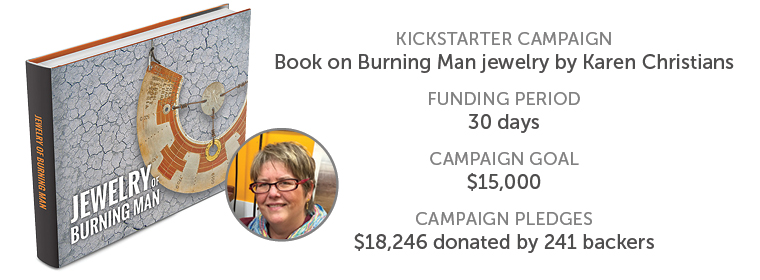
When Karen Christians, a jewelry teacher and founder of Metalwerx, a school for jewelry and metal arts in Waltham, Massachusetts, got the idea for a jewelry book, she didn’t put on her best clothes and prepare to meet with a banker. Rather, she went to her computer and started a crowdfunding campaign on Kickstarter. Christians, who co-authored the book Jewelry of Burning Man with Christine Kristen and George Post, eventually raised $18,246 with 241 backers last May. To cover the costs of self-publishing the book, she turned to crowdfunding because she was familiar with the process through her involvement with Artisans Asylum, a nonprofit community craft studio located in Somerville, Massachusetts, which has a history of raising $5 million collectively. Christians saw that success firsthand and says the Asylum made it easy for her to access “crowdfunding experts” and learn from their success.

Sound easy? Not so fast. Crowdfunding, which is the act of asking for financial contributions from people online for a new project or enterprise, is showing itself to be an exciting funding alternative to traditional lending—if done right. Before jumping into the crowdfunding arena, it’s important to understand a little more about the process.
The Basics
There are basically four variations of crowdfunding project types: donations and philanthropy, which is primarily used by people with either a philanthropic cause or a life-changing event, such as illness, death, or adoption; reward, where a funder may receive something tangible in exchange for their pledge, such as an e-card, T-shirt, piece of jewelry, or the finished product; a lending model, where borrowers pledge to pay back the lenders over a pre-determined timeline with a set interest rate; and an equity model where the funder provides an investment in exchange for revenue sharing or equity. (The equity model is still undergoing examination by the U.S. Securities and Exchange Commission and is only available now to accredited investors, not the average Joe—yet. Once it is, experts predict the floodgates will open even farther on crowdfunding.)
This new method of financing a business has become a popular alternative to traditional lending for many reasons. It is fast-paced, can generate buzz about your product, and provide you with the funds needed either for a specific project or to gauge interest in your design.
“Crowdfunding is all about sharing wealth and ideas in ways that were less effective and efficient prior to the advent of the internet,” says Michael Melfi in his book, The Simple Secrets of Crowdfunding: Using the Internet to Fund…Everything. Melfi, who is an intellectual property attorney and digital entrepreneur, got interested in crowdfunding a few years ago and quickly became an expert in this new way of funding.
With the internet and today’s increasing social media habits, crowdfunding has become widespread. According to Massolution, which compiles news and statistics related to crowdfunding, in 2013, the crowdfunding industry grew to more than $5.1 billion worldwide. It’s difficult to determine how many people in the jewelry industry have tried crowdfunding, but a quick search of some of the more popular platforms shows hundreds of jewelry projects, some successful and some not.
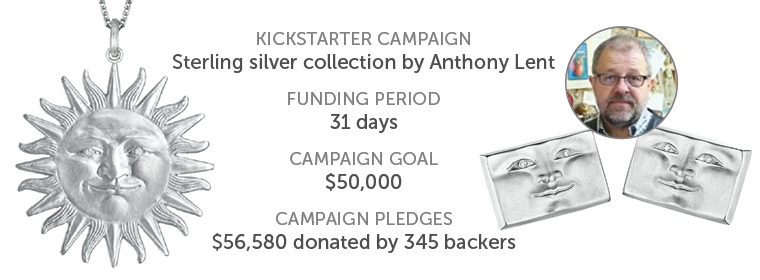
Take the case of Anthony Lent, a Philadelphia-based jeweler. Lent and his two sons run a family business, where he has spent years specializing in 18k gold and precious gemstones. When the family decided to launch a new collection in sterling silver, they turned to Kickstarter to finance it. “My brother and I decided to reach out to the Kickstarter community to see if other people love our father’s work as much as we do,” explains Lent’s son David on their campaign page. “We don’t have the personal wealth or financial connections to build an entire business from scratch, but a successful Kickstarter will keep our studio running and help spread the word about the art of Anthony Lent.”
Family friend Steven Syrek offered to help with the campaign. As a Ph.D. candidate, he says despite his lack of crowdfunding knowledge, the one thing he does know how to do is research. He read books, countless online articles, and all the information Kickstarter offers for potential crowdfunding candidates. He spent hours poring over campaigns that were successful as well as ones that went unfunded, looking for reasons why some worked and others failed.
The group decided to raise $50,000, launching their campaign at noon on May 10, 2014. By the end of that first day, they had raised $1,000. By the end of the 31-day campaign, they had raised $56,580. They reached out to their network of friends, contacts, and customers constantly throughout the month. They also added updates to the Kickstarter site—even adding new rewards and suggesting to people who had already pledged, how they could pledge more. Through their campaign, they raised not just capital for a new project, but the company’s profile as well.
Is It Right For You?
According to Melfi, crowdfunding can be “a game changer for many.” Not only can it provide funding, it also allows you to have a direct conversation with consumers and pitch your idea with very little startup cost. And it doesn’t end with the campaign: There’s always room for potential investors to follow up later. As Melfi points out, it’s easy to monitor and manage, and you can do it from your own kitchen table.
There are also disadvantages: For a successful campaign, crowdfunding requires lots of preparation and research and the ability to reach out to as many people as possible. As more entrepreneurs dive in, you’ll face stiff competition, and there is also the chance your innovative idea could get stolen. (To minimize the risk, experts say to protect your intellectual property first by filing the needed paperwork for trademarks, patents, or copyrights, and don’t provide information on how you manufacture.)
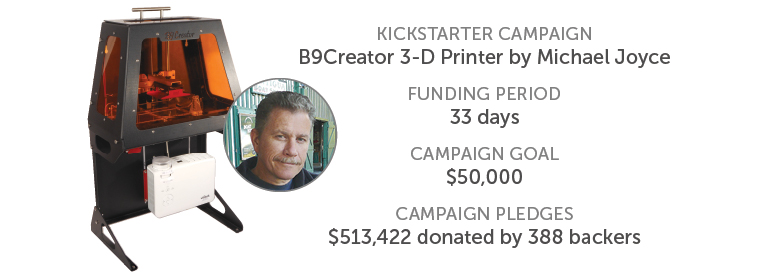
The hard work and risk was worth it to one entrepreneur: Michael Joyce, who developed the B9Creator 3-D resin printer in 2012. With no start-up capital available unless he took out a mortgage on his home, Joyce decided to turn to a Kickstarter campaign after seeing a few other companies do it. This type of campaign worked for his business because it essentially presold his product for him, allowing him to know how many printers to make.
Joyce admits his campaign by today’s standards was somewhat amateurish, yet it struck a nerve, and he met his funding goal of $50,000 on the first day, eventually receiving more than $500,000—and selling far more printers than he ever imagined. He later developed an upgrade to the printer and, in 2013, received another $290,000 through a second campaign on Kickstarter that mostly targeted people who had purchased the first printer.
“The Kickstarter campaign allowed me to get noticed,” says Joyce. “Since it did so well to begin with, the tech blogs picked it up.” It also changed his business model. Joyce thought he had developed a printer that would be mainly used by DIY hobbyists. He partnered with jewelry designer Gary Dawson of Gary Dawson Designs in Eugene, Oregon, to cast pieces created on the printer, and now 80 percent of his business is from the jewelry industry. Joyce went from inventing in his basement to a company with six employees.
It doesn’t have to be the latest invention to get noticed, though. “Anyone can raise funds by using crowdfunding, but it’s important to note it is not right for every project, and success depends on your willingness to do the work necessary prior to launching your campaign,” says Melfi.
Giving It A Go
If you’ve decided crowdfunding is a good fit for you and your company, the first step is to compile roughly the same information you would show a banker if requesting financing. That means having a business plan, even if it’s not a formal one. Outline your goals, objectives, ideal timeline, mission statement, history of your group, and some financial info, including what you will be doing with the funding.
Make plans, advises Melfi: Where do you want to be financially as you launch the campaign? Post campaign? A year from now? It’s important to get focused so you can explain to people why they want to support you and your business goals.Your goal is to outline your credibility so backers believe in your ideas, are excited about your business, and ultimately want to fund your project.
For example, in the case of Anthony Lent, the campaign detailed the costs of designing, tooling, and prototyping for the new sterling silver collection as well as the promotional materials (e.g., website, documentary) to promote the business. Demonstrating this level of planning shows potential backers that you are credible and will likely follow through with your plans.
Choose a Platform
The next step is to choose a platform on which to launch your campaign. While many people have heard of some of the popular ones, such as Kickstarter, Indie-gogo, Funderbuilt, and GoFundMe, there are actually more than 500 platforms. Melfi cautions that just because one site is well known doesn’t mean it’s going to bring you more money. It’s important to research the various platforms available as all are not equal and some may be a better fit for your project than others.
In addition to hosting crowdfunding projects, most platforms will also help create presentations for prospective supporters and track funders. Most platforms describe in detail what is needed as well as what they can provide in the way of marketing to and tracking your funders. Pay attention to the resources each platform provides, such as tools and a dashboard that shows you the specifics of your campaign. Look closely at the terms of use as well as the ease of use—especially if this is your first crowdfunding attempt.
Each platform comes with its own set of restrictions and fee schedule; some require a percentage of pledged funds, while others charge a flat fee. Some have “flexible funding,” which allows users to raise as much money toward their goal as they can, while others have a “fund it 100 percent or not at all” policy, which means that if you don’t meet your fundraising goal, you don’t receive any of the money pledged.
Decide on Rewards
Since most jewelry designers tend to run reward-based campaigns, another thing that you need to consider are rewards for your donors. It’s up to the user to decide how many rewards to offer and at what levels (i.e., $1, $250, $500). “There is a financial aspect to rewards,” says Melfi. “If you are raising $5,000 then you need to have more than $5,000 worth of rewards.” Think creatively about rewards—that $5,000 shouldn’t be in hard costs. Funders will pay more for experiences, such as a VIP reception, custom piece, or trunk show. Anthony Lent’s rewards started with a thank-you tweet for those donating $1 to an autographed brochure for a $10 pledge and climbed from there with special die-cast coins, and then various pieces of Anthony’s unique jewelry. At the top of the reward ladder was a New York City vacation and an opportunity to meet the artist and visit the studio—all for a $10,000 pledge.
Think about what makes sense to offer at the various levels. For example, Kickstarter says the most popular pledge amount is $25, so when deciding reward amounts, ensure you have chosen something that is very easy to fulfill at that level. Take the time to look around and see the rewards your competitors are offering as well.
Also, when deciding what rewards you will offer your donors, consider how you will fulfill the rewards. What is the true cost of the reward, adding in production, shipping, and personnel to get it done? Syrek says that rewards, especially the fulfillment aspect, was a tough part of the campaign for Anthony Lent, citing issues or tasks that weren’t considered but took up a lot of time. As simple as it sounds, the act of packaging all the rewards and mailing and tracking them took much more time than originally thought. He says it took months after the end of their campaign to finish all the work associated with it.
“There are numerous tasks,” says Syrek. “It isn’t as if in 30 days you will receive a bunch of money and it’s over. That’s not how it works.”
Experts say it’s common for rewards to take longer than promised, but the most important aspect is keeping backers in-formed. Syrek posted regular updates with photos on their Kickstarter site so that backers felt reassured and part of the process.
Set a Goal
After deciding on a platform for your campaign, you’ll have to set the financial goal for your project. Experts say that it’s important to think of a realistic target, especially if you’re using a platform where a campaign must be 100 percent funded for you to receive any funds.
In addition to covering the costs of the project you’d like to launch, your campaign goal should also include the cost of manufacturing and fulfilling rewards, as well as any professional services you may need, such as legal advice or an accountant, says Melfi. Crowdfunding brings its own set of tax and legal issues, so it’s important to research those with trusted advisors. Federal laws are still trying to catch up to this innovative way of raising money, and state laws vary and are changing frequently.
Finally, remember the platform sites each take their own cut, so factor that into your goal-setting.
Pick a Launch Date
Before you settle on a launch date, consider the amount of time you’ll need to sufficiently prepare to launch your campaign. Compiling financial data, deciding on rewards, and planning can take up a lot of time, so make sure you leave enough time in your schedule to allow you to prepare everything well before your launch.
Syrek wishes he had had more time with the campaign for Anthony Lent. The group began planning immediately after deciding to launch a campaign in March and, just two months later, flipped the switch on their campaign. In retrospect, he says having six months to prepare (which experts recommend) would have been far better.
When selecting a launch date, check the calendar to make sure you stay away from holidays and special events, which can disrupt the momentum of your campaign. Experts recommend mid-week as a good time to launch, giving you the weekend to regroup if the initial response was not as expected. When you’re considering the launch date, also think about the end date: If you start on a Tuesday at 8 a.m., you’ll have to end on a Tuesday at 8 a.m., denying funders a whole last day to pledge. The best time to launch is late in the afternoon, as people tend to be online at that time.
Get the Word Out
Crowdfunding relies on you to build the fan base you need to make your campaign successful—and a successful campaign needs constant communication. The key is to grow your fan base before you even hit the start button on your campaign. Start e-mailing or posting on social media about your company to build your fan base. When you get close to your launch date, start talking about your campaign. Create buzz without ex-hausting your backers’ attention.
Before he started his 3-D printer campaign, Joyce took time to e-mail and put out information about his product to the trade industry. He began to reach out to what he thought at the time was his potential market and tell them about his product. He also created a Facebook profile and joined Twitter. Though social media was not a huge factor for Joyce at that time, it is essential in today’s market, as it is the fastest way to share information with a large audience.
Christians had a Facebook page already up and running when she launched her campaign, but admits that she didn’t have time to really develop social media. Instead, she turned to friends who had large numbers of followers to solicit their aid in broadcasting the word. She also started a website to collect stories and photos for the book, and in doing so, created a buzz that generated $1,200 in pre-sales of the book.
Another way to get the word out is through cross promotion. When launching the Anthony Lent campaign, Syrek found another craftsperson in their area who was on his third crowdfunding campaign. They approached him about a crossover campaign, where each of them would promote the other’s campaign. The craftsperson agreed, and, because he had run other campaigns, he had garnered quite a following; some of his followers jumped onboard with the Anthony Lent project.
Though you need to cast a wide net, Melfi says it starts first with your “tribe”—your network of family and friends who have already demonstrated their support to you in one way or another. Start there and create the excitement, so others will follow. It’s important to have that excitement right out of the gate and keep it going, especially toward the end, as most funding occurs in the first and the last seven days of a campaign.
Hit the Launch Button
Hosting a launch party is an important piece of gathering your “tribe,” say those who have run successful campaigns. Gather your family and friends and create a great event. Make it personal by having it at your studio or some place that connects to your product or idea. Time the party around the launch. Then after you start, remember that a successful campaign must include personal e-mails and even phone calls. Regularly update supporters, so they can share the successful progress and potentially interest their friends in the project, says Christians.
Syrek worked hard to get the word out. “Essentially, I realized that many of those who failed on Kickstarter did so because they expected to be found,” he says. “We constantly communicated with people.” He sent e-mails every three days and posted photos, stories, and other content online. Though you face the risk of pestering your contacts, remember that you have limited time to motivate backers, as most campaigns run for only 30 days. Continuing to update your site is a great way to keep the campaign exciting and fresh. Your goal is not only to reach the backers you know, but to have them share it with others as well.
To make things easier during your campaign and not add extra work to your daily life, Melfi advises clients to prepare most of their marketing materials in advance. You’ll need images, quotes, testimonials, endorsements, past media, and other related content to post. By getting things lined up ahead of time, and scheduling out when things will appear, there will be less wear and tear on your daily life during the campaign.
But don’t fool yourself. Those who have crowdfunded all agree that it was an intense time period.
“The whole month was stressful and it was hard to go through,” admits Christians. Those who have tried crowdfunding quickly realize that watching that barometer move becomes addictive. If you’re in a fully-funded or nothing campaign, those 30 days will be your make-it or break-it period.
Get Personal
In all the planning and scheduling that goes into creating a crowdfunded campaign, it’s easy to lose track of the one key element of the campaign: You. Crowdfunding is about you, your project, and your story. Your campaign should ultimately focus on you, and why individuals should want to give money to help you with your project.
One of the easiest ways to help you reach potential donors is with a pitch video, which should ideally be between two to three minutes in length. Experts cite that campaigns with a pitch video raise 115 percent more money than campaigns that just use an image.
To inspire you, take a look at other campaigns as well, even ones that aren’t in your industry. “There’s no need to reinvent the wheel,” says Melfi. “Scan as many platforms as you can, look at profiles, and watch promotional videos. Even if a campaign has nothing to do with yours, ask yourself: Would I give money to this group? Why? The answers to these questions will help you get clear on how you want to present your own project to the world.”
Although pitch videos have gotten increasingly better over the last few years and are often slick productions, don’t let that intimidate you. Joyce laughs when he thinks about his first video that featured him describing his product. He says that despite it being amateurish, it obviously got the job done because people believed in his idea. “If you’re amateurish, it may be overlooked, if you have an exciting enough product,” Joyce says.
The key is to tell your story and be authentic, says Christians. “It needs to speak from the heart. You need to be genuine, be yourself, and be passionate.”
In the end, remember that this is your campaign and if you want it to succeed, you need to tell your story in an engaging manner. “People work hard for their money and have many things to spend it on, so why should they consider you and your project worth letting go of those hard-earned dollars?” says Melfi.
Christians agrees, especially because she went into it knowing that books don’t traditionally fare well as crowdfunding projects, but felt there was a strong following for the Burning Man event.
“Crowdfunding answers prayers,” she says. “But it’s the hardest thing you’ll ever do.”