

Castings from Nature
Creating jewelry from natural objects
By Daniel Grandi
Designers often based their designs on nature—a leaf, a starfish, a seashell—and some take the next step and actually cast those objects. Casting natural objects poses challenges, but it can also be rewarding—if the designer knows enough about the casting process to see the problem areas nature has created.
Take the case of a spider plant that I recently made into a brooch.
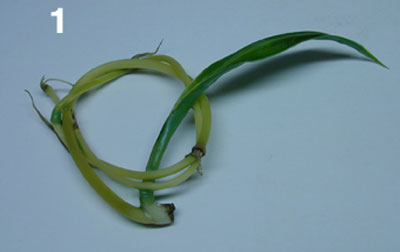
The plant (1) had two major problem areas: The leaf was too thin, and both the stem of the plant (which can easily move in the investing process) and the base of the leaf were too hollow. I began strengthening the stem and base first. Using injection wax, a heavy sewing needle, and an alcohol lamp, I made tiny, unobtrusive wax welds in areas of the stem that I wanted to have connected as part of the design, then filled the hollow areas with wax. This would stop the stem from moving in the investing process. (A wax welder would have worked for this process as well as the needle.)
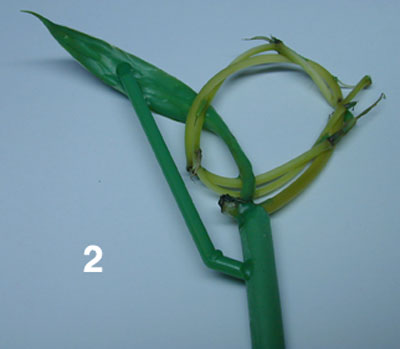
Next, I needed to thicken up the leaf. This was the most important step. Since I planned to cast a metal model that would be used to create a production mold, I needed to build up the back of the leaf at least 1mm to avoid any problems. Once I had done that, I placed the sprues. To guarantee a decent casting, I attached the main sprue to the heaviest point of the plant (a typical rule of casting: The heaviest point is where the metal will cool last, so it should be constantly fed to avoid shrinkage or non-fills in the cast piece). I also attached an auxiliary sprue to the outer part of the leaf, to ensure it received an adequate flow of metal (2).
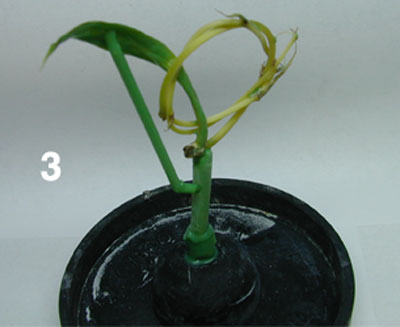
In almost all cases, a good caster will tree and cast a natural product in its own flask (3), since it’s the safest way to ensure results. After investing the flask and casting, I removed the sprues. If I had wanted, I could have added further detail to the design, In this case, I chose to simply add a pin back to complete the project.
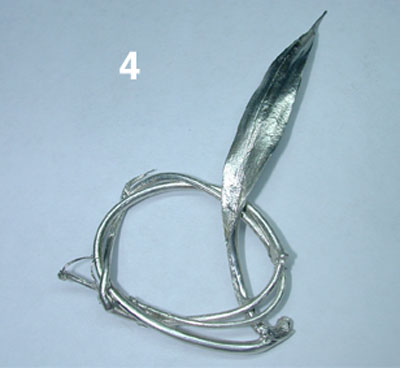
Not all natural objects cast easily. Some, such as seashells, starfish, and rocks, may require RTV (room temperature vulcanized) molds to be made first. If you’re not sure what will work, call your caster and ask for advice before starting your design project.
Daniel Grandi is president of RaceCar Jewelry Company Inc.