

The Cost of a Good Impression
Making the most of Facebook
By Matthew Perosi
Editor’s Note: This is the first in a series of columns looking at how jewelers can best use various social media platforms for marketing their businesses.
Traditional advertising media is usually thought of as print, radio, television, billboards, and direct mail. Each of these were designed to create mass exposure and brand awareness for local businesses. Pricing for this mass exposure is usually billed as “cost per thousand impressions,” or CPM for short. The belief of CPM advertising is to expose thousands of people to your message in the hope that a percentage of them will need your product today, or perhaps will remember your name when they need your product in the future.
It’s typical for CPM pricing to fluctuate based on the supply and demand of prime times or locations throughout a single day, week, or month of the year. Media companies compile broad demographics of consumers who might be exposed to your traditional ad so you can choose the best time and location for your advertising. No matter how well you plan your traditional media advertising, you have to accept that many of the consumers within those broad demographics won’t be interested in what you’re selling. But Facebook has changed all of that.
A Modern Way to Market
When Facebook created its advertising platform a few years ago, it set out to change its process in targeting consumers. Its ad manager system offers distinctly granular targeting of demographics, personal traits, and interests, the likes of which are not available through any other system today. Facebook monitors everything we do and share, and it uses this data to create an accurate profile of who we are and what products we will likely need and purchase.
It’s this granularity that allows you to specifically target consumers who are most likely to respond to your ad. Although this targeting is a powerful way to spend your advertising dollars wisely, it’s important to remember that Facebook is a social network that thrives on interpersonal relationships and commenting. Paying for an ad isn’t good enough; your ad needs to spark a conversation that consumers will enjoy and remember.
Before you consider using Facebook’s paid advertising features, you should hone your social media skills until you can easily spark those organic conversations using non-paid methods. You’ll also need to discover which types of posts your customers like most. I recommend posting photos and videos that show the customer experience rather than simply a product on a white background.

Creating an engaging customer experience is paramount. Don’t think of social media as another way to sell something; think of it as a vehicle that will drive customer interest through friendly conversation. As a jeweler, you should be more interested in the long-term customer relationship that can develop online rather than in the one-off sales. Through those friendly conversations on Facebook, you have the opportunity to convey your mission and core values while building trust amongst those you are engaging.
Building Long-Term Relationships
Cultivating those long-term relationships is easy to do if you can motivate your followers to comment on each of your posts. Motivating your followers to engage with you takes more work than posting boring photos of jewelry with terse descriptions. It’s better to portray the ownership experience through photos and videos, especially if you are using them for Facebook advertising.
You can foster social conversations by asking thought-provoking questions with every glamorous photo you post. Some examples are:
• What is your significant other’s birthstone and have you ever seen them wearing birthstone jewelry?
• Describe the outfit you would wear with this item.
• How would you style your hair if you were wearing these earrings?
Each of these questions invites your followers to leave a thoughtful reply rather than simply liking your post. Most businesses are guilty of posting online without setting aside the time needed to reply to comments. I recommend monitoring your business account on your smartphone so you can swiftly reply to every comment that’s left. You’ll be able to convey your core values and create solid trust among your followers through a combination of the questions and ongoing dialog. That’s what makes social media social.
Investing in Paid Advertising
Don’t attempt paid Facebook ads until your posting and engagement with your audience becomes a routine part of your workday. Each one of your paid ads will broaden your exposure to whatever new audience you target using the Facebook ad manager system. Your long-term success of those ads will benefit from the organic engagement tactics explained earlier.
Most advertisers on Facebook are not correctly combining engagement with paid ads; they simply pay for ads and hope for the best. That’s no different than the mass marketing approach used by traditional media, which will result in a lower Facebook return on investment. When analyzing poorly performing Facebook marketing, I often find that stores are using boring visuals and do not engage people replying to the ads.
A few years ago the CPM of Facebook marketing was very low because advertising space was readily available. Now that more businesses are using the service, the ad space in major metropolitan markets is at a higher demand, which is driving up the price. Facebook juggles their ad space to allow all of the highest bidders to reach specific target audiences. The same ad that costs $10 to reach 3,000 people in three days in a rural area of the country might cost $10 to reach only 50 people in a single afternoon in a major city. As these costs continue to increase, you have to pay more attention to how customers respond.
Be aware that, even though I’m advising you to monitor and reply to comments on ads, Facebook makes that process difficult because it does not show your own ads in your news feed. Furthermore, your smartphone doesn’t usually give you a notification when someone likes or comments on your ad. If you want to combine the organic approach with the paid ad, then you need to make a concerted effort to pay attention to your ad while it’s running. Facebook allows you to monitor your ads through its ad manager, but I find it’s much easier to save or bookmark your ad through your browser before launching it so you can refer to it regularly.
Another important feature Facebook offers is a tracking pixel, which is Java-Script code that you add to your website. It tracks what pages people view on your site and which Facebook ads they clicked on to get there. Each person who visits your site can then be added to a retargeting list for future marketing. This is the feature you use to show ads to people who previously visited your website; it’s especially useful during the holiday season or other times when you want to boost your online sales.
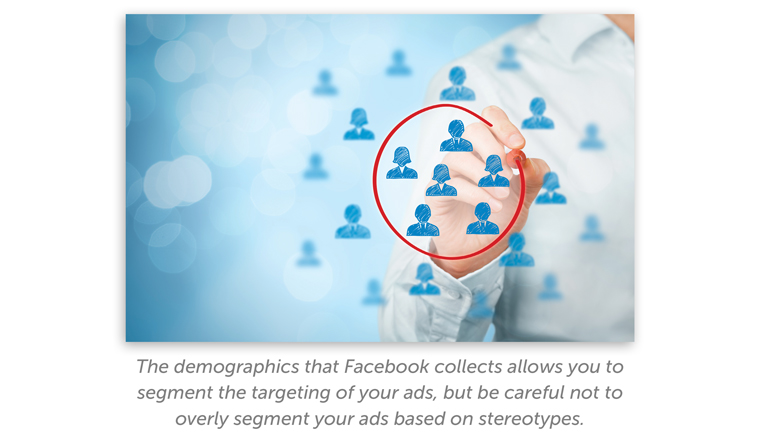
Facebook offers more options for targeting customers online than any other ad system. The demographics that Facebook collects on its 2 billion users allow you to segment the targeting of your ads, but you need to be careful not to overly segment your ads based on stereotypes. Even though Facebook gives you the power to do so, don’t target your customers based on ethnicity or race; instead, target based on common interests and using ad visuals that portray overlapping ethnicity and race.
Targeting will certainty help improve the results of your ads, but I hope I’ve illustrated the importance of continual engagement with your audience rather than trying to fix a bad marketing implementation by increasing your ad budget. I’ve only grazed the surface of how Facebook ads work and the importance of consumer engagement; there’s a lot more to this than these basics.
If you give it a chance, Facebook can become a major part of your continual marketing. The most successful approaches to Facebook require an employee to spend a considerable amount of their day responding to online comments and requests. Don’t be surprised if you have to hire a dedicated online sales employee to manage Facebook for you—it will pay off in the end.