

Minimalist and Monumental
Michael David Sturlin discusses his Ring to Brighten a Rainy Day
By Irina Hawkins
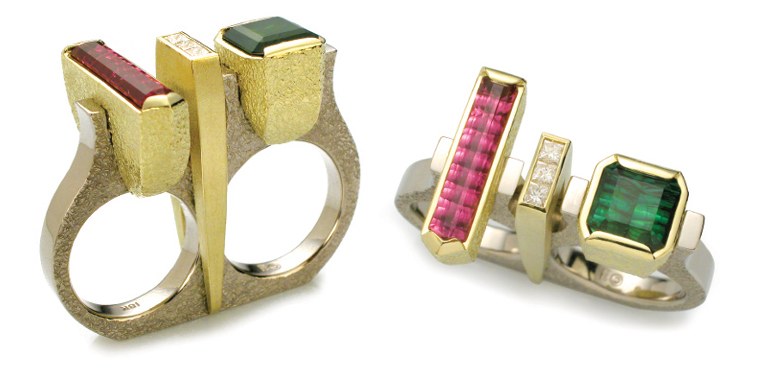
Looking at the ring, one knows right away that the designer—Michael David Sturlin, owner of Michael Sturlin Studio in Scottsdale, Arizona—is a fan of juxtaposition. Made using two techniques (fabrication and casting), the piece features two 18k golds (yellow and white), two textures (smooth and distressed), two finishes (clear and frosted), and two shapes (square and rectangle). These dualities are mirrored in the ring’s two finger openings.
The idea for the ring was born when Sturlin saw the two faceted tourmalines—one pink (3.01 carats) and one green (4.75 carats)—his cutter Aivan Pham showed him. The designer was looking for something special to use as an entry for the AGTA Spectrum competition, and the tourmalines fit the bill. After seeing the stones, he knew he had to fashion a monumental design to do them justice.

He envisioned a statement ring that would be worn on two fingers on the right hand, with each of the tourmalines centered over a finger. Because the position of the gemstones would leave a large gap between them, Sturlin added a tapered yellow gold bezel that runs down the center of the ring, bridging the gap between the stones. “This helped define the jewel as one single ring rather than two joined rings,” he says. The gracefully diminishing line of the diamond-set center bezel takes the eye on a journey, bringing it from top to bottom and highlighting the height of the piece.
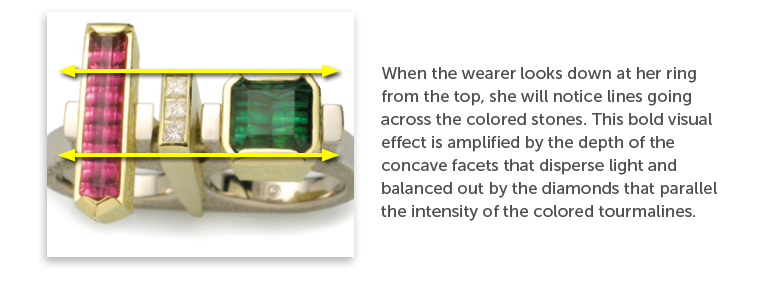
Sturlin added diamonds (0.375 ctw) to the center piece to help accent and enhance the pink and green tourmalines. When the wearer looks down at her ring from the top, she will notice lines going across the colored stones. This bold visual effect is amplified by the depth of the concave facets that disperse light—as Pham cut the stones for the most dramatic effect—and balanced out by the diamonds that parallel the intensity of the colored tourmalines.
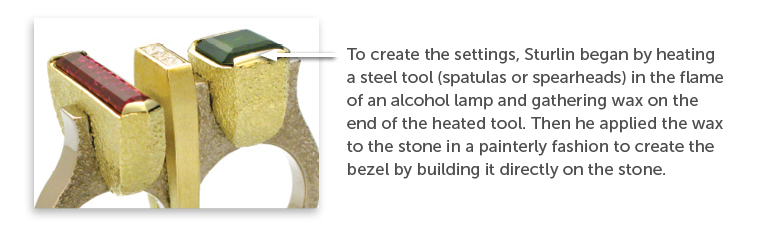
Although he hand-fabricated the body of the ring from a sheet of 18k palladium white gold, Sturlin opted for a more sculptural approach to create the settings for the tourmalines. Because the stones were to be elevated, he felt that traditional fabrication would pose an unnecessary challenge and chose to complete the task by additive wax sculpting, a build-up process that enabled him to achieve the volume and proportion he wanted more easily than building the settings in metal would have. To create the settings, Sturlin began by heating a steel tool (spatulas or spearheads) in the flame of an alcohol lamp and gathering wax on the end of the heated tool. Then he applied the wax to the stone in a painterly fashion to create the bezel by building it directly on the stone.
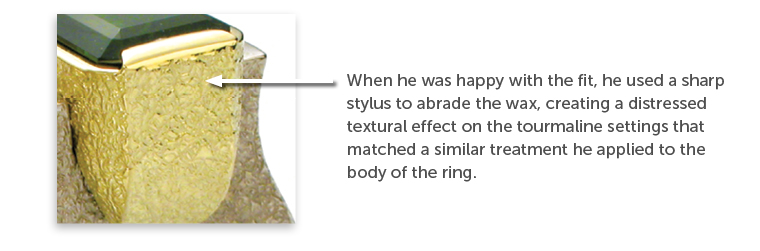
To get the settings to fit into the body of the ring, Sturlin carved out notches on the bottom of each setting that corresponded to the shape and size of the notches he carved into the ring shanks. When he was happy with the fit, he used a sharp stylus to abrade the wax, creating a distressed textural effect on the tourmaline settings that matched a similar treatment he applied to the body of the ring. Sturlin cast the settings in 18k royal yellow gold, believing that this gold offers great structural strength and just the right rich color—a greenish yellow due to the alloy’s high percentage of silver.
He also fabricated the diamond bezel in 18k royal yellow gold but he opted to leave its surface smooth to contrast with the pronounced texture of the body and settings.
Once he had a secure fit between all of the piece’s components, Sturlin soldered them together before carefully fitting and setting the stones. The result was a final juxtaposition—a design that looks unpretentious yet regal, combining the stateliness of size with the simplicity of form.