An Antidote to Convention
Andy Cooperman’s Poison Ring No. 2
By Irina Hawkins
When Andy Cooperman of Seattle got a free snake rattle for buying cowboy boots back in 1991, he couldn’t have imagined that, 26 years later, he’d win a Saul Bell Award for a ring that features a snake rattle. And he couldn’t have known that the ring would be such a hit that the Bellevue Arts Museum in Washington would feature it in an exhibition. In fact, the rattle sat on his bench forever, he says, because its muddy color held no appeal. It wasn’t until he decided to start coloring rattles that Cooperman saw potential in the material to act as a gem, ornamenting a design.
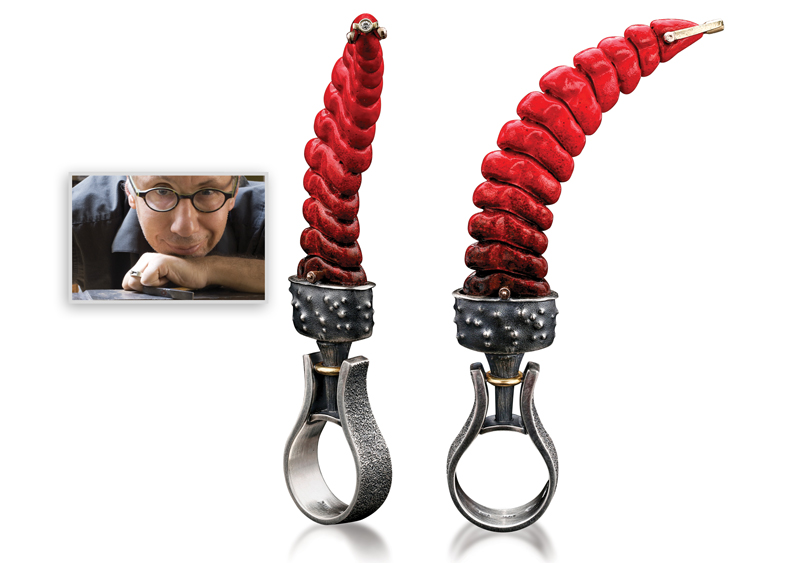
Inspired by Victorians, who often incorporated organics into jewelry, Cooperman saw the rattle as another challenge; after all, he had already created pieces with unexpected materials, including shells, wood, beetles, and porcupine quills. He acknowledges that such jewelry might be hard to wear, but points out that he always ensures that his creations be wearable. Cooperman goes the extra step to adapt his materials to the cause, be it through cutting, bending, or sanding.
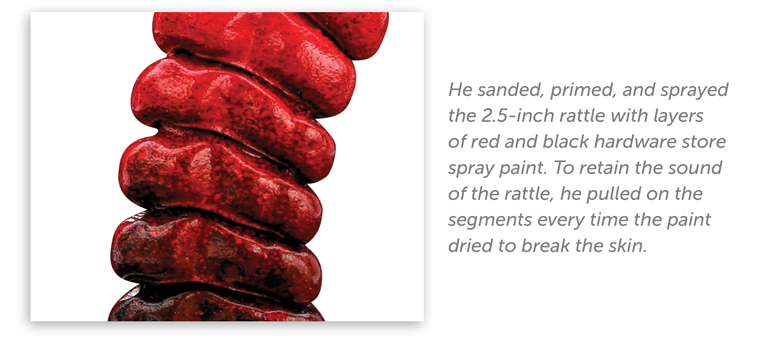
In this instance, he spliced two e-Bay-bought rattles together with super glue; one alone didn’t provide enough height. Since “rattles are a natural material and get beat up when they’re on the snake,” he first repaired any holes with glue, and then sanded, primed, and sprayed the 2.5-inch rattle with layers of red and black hardware store spray paint. To retain the sound of the rattle, he pulled on the segments every time the paint dried to break the skin.
Painting was one of the initial steps because it allowed Cooperman to know whether the design would work. The challenge was to retain the rattle’s rattle and flexibility despite painting and gluing it; after all, “too much of anything [extra glue and paint that would freeze the rattle] and sloppy application” would have meant that the design would need to be scrapped and he’d have to start over with new materials.
For the rest of the ring, he opted to use a range of metals—Argentium, silver, 18k yellow gold, and 14k rose gold—because he thinks a variation in color introduces “a little bling.”
Cooperman made the shank by rolling an ingot of silver and forging it into shape. To give it some texture, he put silver filings onto the shank and used a torch to melt them. While the metal resembles a rind, the sides of the shank are smooth.
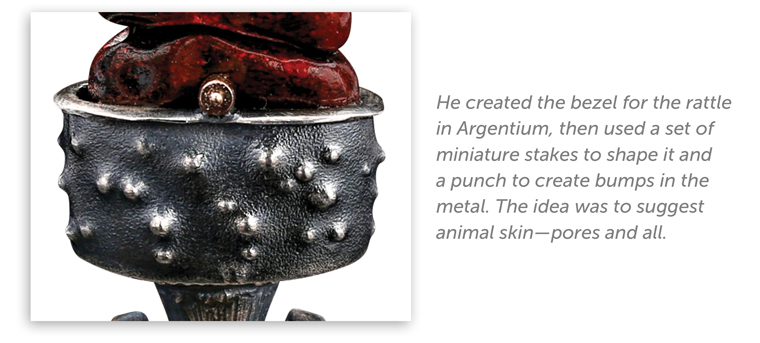
He created the bezel for the rattle in Argentium, then used a set of miniature stakes to shape it and a punch to create bumps in the metal. The idea was to suggest animal skin—pores and all.
To connect the bezel to the ring shank, Cooperman fashioned a stalk from silver tubing that he flared the end of with a punch before soldering it into place. His intention was to make the ring look as if it evolves into the bezel, which evolves into the rattle. Using a hart bur, he covered the stalk in lines to create a surface texture that’s similar to one commonly found in nature. To support the stalk and help join the two sides of the ring shank, Cooperman created an 18k yellow gold ring to encircle the stalk, using dividers to ensure that it was level before soldering it into place. He used liver of sulfur to blacken the metal.
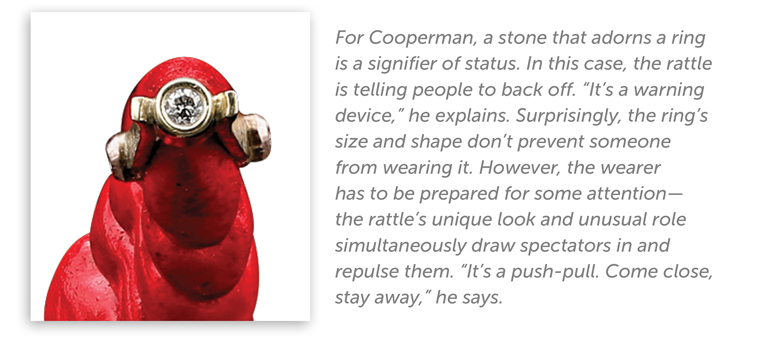
Then it was time to secure the rattle. “I needed a short tube attached to the top rim of the bezel on each side to grip the rattle,” he explains. “Rather than solder each short tube and try to get them to line up, I solder one long tube across the top and then cut out the middle section.” He left just enough room to squeeze in the end of the rattle, which features small grooves he created for the tubes to sit in. He then secured a rose gold ball rivet through the tubes and added a bit of glue as an extra precaution. As the final step, he riveted an 18k yellow gold accent featuring a 3-point diamond onto the top of the rattle.