The Sculptural Jewelry of Othmar Wicke
Seeing Is Believing: Case Study 1
By Shawna Kulpa
The wonderful thing about working with 3-D CAD programs…is that formal restrictions don’t exist, or at least I haven’t found them yet,” says Othmar Wicke of Wien, Austria. One look at his designs—particularly his lifelike and occasionally surrealistic depictions of sea creatures, insects, and other natural life—illustrate his point: Both his imagination and the possibilities of CAD seem limitless.
Wicke starts his designs by first doing pencil sketches, which he then imports into his Rhinoceros 3-D modeling program and refines them. He acknowledges that the software does have a learning curve, and that good planning is needed, along with an understanding of the necessary specifications for production (such as the minimum material thickness needed for a successful cast) but says it’s all still basically drawing in three-dimensional space. “A computer is a tool for me the same as a hammer, tongs, or a file, except it is much more complex.”
And there are tools within CAD that help make the design process even easier. There’s a mirroring tool that allows him to create a mirror image of an item so he only has to design an element once. His CAD program also has a copy and paste feature that allows him to quickly copy a design element for multiple uses.
“Jewelry from a computer does not have to look like ‘computerized jewelry,’” he says. “Everything imaginable can be constructed in CAD. For me, a change from conventional goldsmithing to working with CAD has more in common with infinite possibilities than with challenges.”
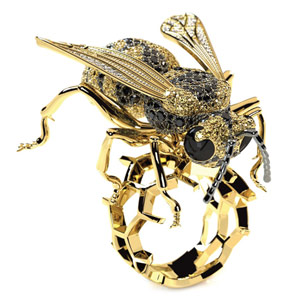
Wasp Ring
“The inspiration for this ring was an insect that is one of the most astonishing animals in nature. Because the finished piece features 637 diamonds (5.6 ctw), I had to construct the ring as four separate pieces—the ring rail, body, wings, and legs—to aid the setting of all of the stones. However, the advantage of CAD is that I only had to do one wing and one leg because I could mirror them. This ring was a perfect duplication of my idea of it, and no modifications were required.”
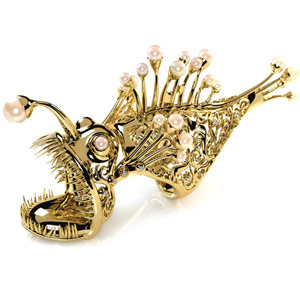
Anglerfish Ring
“The fish basically consists of two major parts: the head and the body. I constructed a basic form for the head and mouth, using [the] ‘mirroring’ option for the eyes and ‘copy and paste’ for the teeth. One tooth was constructed, and then I duplicated it and arranged them on the jaw in different sizes. I created a virtual finger in CAD and then designed the body of the fish to fit around it. I then built a swiveling connection between the head and the body for movement.”
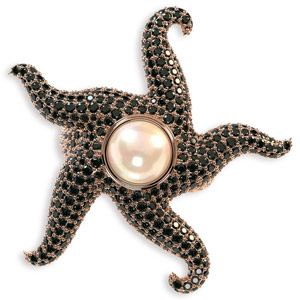
Starfish Ring
“I wanted to depict an expansive, spreading organic form, which is neither floristic nor animalistic but both at the same time. I unintentionally got the shape of a starfish. I constructed the middle part of the ring first, then I worked on each of the five tentacles before putting them together in one single body. I created this ring for demonstration purposes and to be displayed on my homepage—I wanted people to see what is possible in CAD. So often goldsmiths are restricted by economics, either due to materials they can use or the time they can spend creating designs. My intention was to push the boundaries of turning vivid, designer fantasies into real pieces of jewelry.”