

The Story Behind the Sale
Selling the Story
How designers and retailers can turn process, materials, and history into meaningful connections with customers
By Sharon Elaine Thompson
(Originally Published by MJSA May, 2026)
Every jewelry maker has a story, and often it unfolds in layers. It may include how and where the craft was learned, the experiences that followed, the inspirations that shape the work, the materials and methods chosen, and how—and where—the work is presented.
That story is already embedded in the work itself. But when it’s made explicit—when certain elements are intentionally highlighted—it can help customers form a personal connection. When that connection resonates, a piece of jewelry becomes more than an object; it becomes part of the customer’s own story.
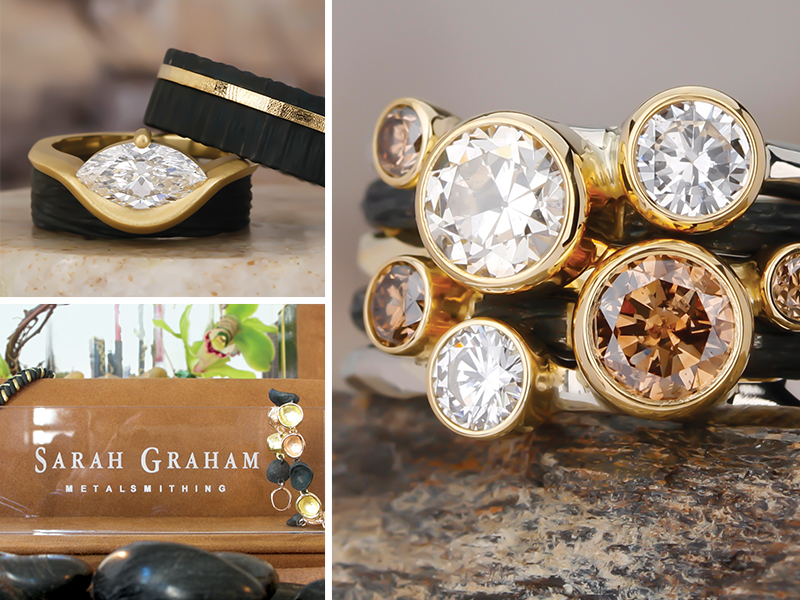
Sarah Graham’s jewelry carries a layered story, but it’s the way that story is shared that ultimately shapes how customers connect with the work.
For Basalt, Colorado, jewelry artist Sarah Graham, the first layer of her story consists of “the materials that I use. That’s what people notice first, this black metal,” she says.
That metal is cobalt chrome, a hypoallergenic, stainless metal originally used in the dental and medical fields. Naturally silver in color, it is oxidized by Graham to a rich, deep matte black, creating a striking contrast with gold and diamonds.
The next layer lies in inspiration. Across more than 30 collections, Graham draws on natural textures, personal relationships, and the surrounding landscape.
The third layer, as with many artists, is personal history: how she came to making jewelry and how long she has been doing it. In retail settings, the salespeople presenting Graham’s work can add to this through their own personal interaction with her.
For San Francisco–based goldsmith Petra Class, story begins with training. Raised in Germany, she studied metalsmithing at a college focused on arts and crafts and then worked for an established goldsmith in West Berlin for a few years before developing her own line of jewelry.
“I really learned metalwork from the ground up,” she says. Her working process still reflects that. “[The jewelry] is all fabricated in-house, the old-fashioned way. We do not use CAD design, and very few pieces need to be worked on by outside craftspeople.”
Apprenticeship, and the handing down of skills, is also part of Class’ story. “I’ve trained many young jewelers in the U.S. that now have successful businesses,” she says. “It’s a very European thing, you know, to have the mentor, the master jeweler, hand down their experience to the next generation. This ensures that the art and craft behind this stay alive, especially in light of many U.S. schools recently cutting their jewelry programs.”
That tradition is also personal. Her son, Lucas Class Knorr, joined the business after his office closed during the pandemic. Having grown up around the studio, he began helping her with the pieces she makes in multiples. He then opened a Manhattan space, which he ran with his wife and a couple of other young jewelers trained by Petra. Now, after moving back to San Francisco, he and Petra are working on pieces together. “He has the same eye for colors and composition as me,” she says. “The jewelry looks like it’s coming from the same workbench, and we are having a lot of fun together.”
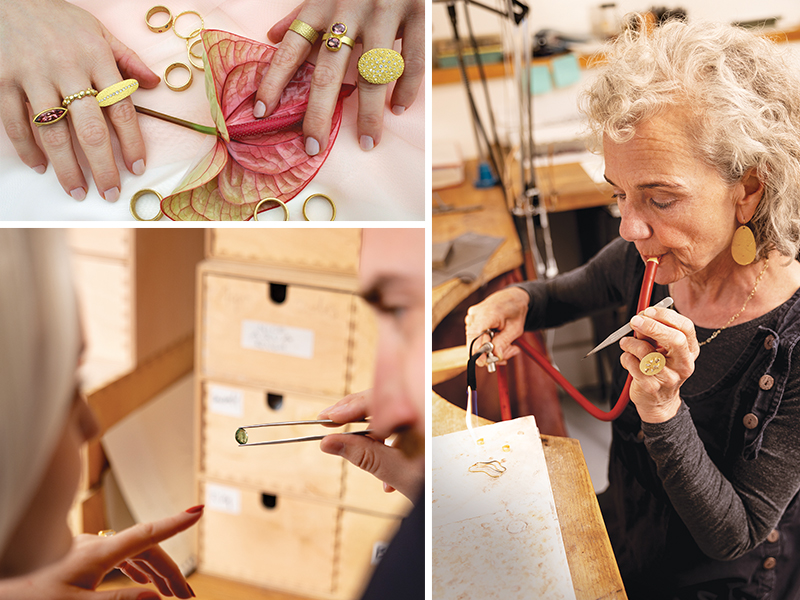
Built on traditional fabrication and sustained through family, Petra Class’ work reflects a strong craftsmanship passed from one generation to the next.
Class’ daughter-in-law, Phoebe Knorr, who studied art administration at Parsons, manages logistics, customer service, and PR. “With Lucas and Phoebe taking over most of the grunt work of running a successful studio jewelry business, it gives me a lot more freedom to develop new work. It’s a family operation, so very traditional,” says Class.
Class doesn’t emphasize her family story as “a promotional story,” she says. “It just happened.” But it is an aspect of her business—and her work—that can help create a connection with clients.
Beyond the Bench
At shows, many jewelers naturally share their stories directly with customers. But when work is sold through galleries or stores, that responsibility shifts to sales staff.
Trunk shows are excellent places to meet and connect with customers, but they are also perfect places to reaffirm relationships, promote new work, and educate sales associates.
“The best tool for training [sales associates] and getting my story across is trunk shows,” says Graham. Telling her story to staff is important, but if they hear it only once, or read it on her website, it’s not the most effective way for her story to “stick,” she says. “What really matters is them hearing me talk to the clients.” As she tells her story over and over to customers, the sales staff begin to absorb it.
Accuracy is just as important as repetition. As she trains staff in her story, Graham emphasizes that they must understand the nature of the oxidized cobalt chrome. “It’s super important that anyone selling my jewelry understands what the metal is and represents it accurately,” she says—especially the fact that no oxidation is permanent and that, with wear, the oxidation will fade off the raised areas. As long as customers are aware that the oxidation will gradually wear, it is seen as a feature rather than a flaw. If they have not been told about it, they may think something has gone wrong with their purchase. It’s much harder for sales staff to explain the changes after the fact and can lead to a disgruntled customer. To reinforce the message, Graham provides stores with informational cards to go with each purchase. “I tell them, if you forgot anything [in the presentation], this is your insurance,” she says.
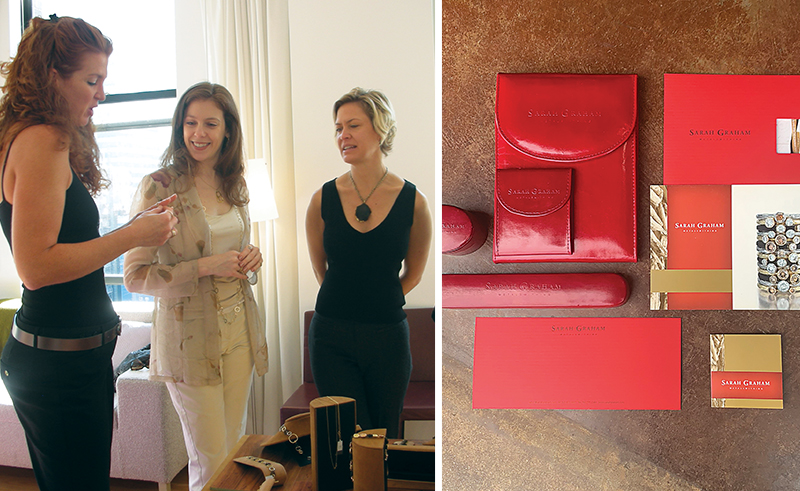
Through trunk shows and printed marketing materials, Sarah Graham provides tools that help sales staff communicate the story behind her work with clarity.
When sales associates truly understand her work, she says, “they’re as excited, and have the same passion—or even more so—than my most ardent fan.” Not everyone makes that depth of connection, so as Graham trains store sales associates, she pays close attention to them. “I’m listening to and watching their body language and their questions and their feedback. I can tell who just doesn’t get it and who does.” She’ll spend a bit more time with those associates because she knows they will make the most sales. That doesn’t mean she gives up on the others. “I’ll keep trying,” she says.
Not all jewelry makers are comfortable talking about their work or their stories.
“Sometimes artists have difficulty talking about their process,” says Jennifer Parker, director of communications at Alchemy Jewelry in Portland, Oregon. Rather than high-energy trunk shows, many of them “prefer intimate pop-ups,” she says. “We love to create a casual atmosphere where they feel comfortable and can chat freely without feeling pressure to perform.”
Not all artists can hold a trunk show, and not all galleries or jewelry stores are set up to hold that kind of event. In that case, the best way to tell the story is via a website, where not only customers but also sales associates can learn about the uniqueness of the work, its history, and the inspiration behind it.
Graham’s site includes an artist bio, information about her studio and how she works, and information about the cobalt chrome and its oxidation. “Each collection has a page with a little story,” she says. “Whenever I’m training, I always tell salespeople, ‘Go online and read the stories, and read them again and read them again and tell them and read them again.’ Because if you can recite them off the top of your head, that is huge. People love those stories.”
Class, by contrast, tells her story visually—through images of hands painstakingly fabricating each piece, hand-drawn illustrations from initial sketch to final piece, and the careful choice of gemstones. The importance of heritage is also clear in family portraits of Class together with her son and daughter-in-law. Ultimately, developing a personal relationship with both customers and gallery or store owners remains the strongest way to convey the narrative behind the jewelry.
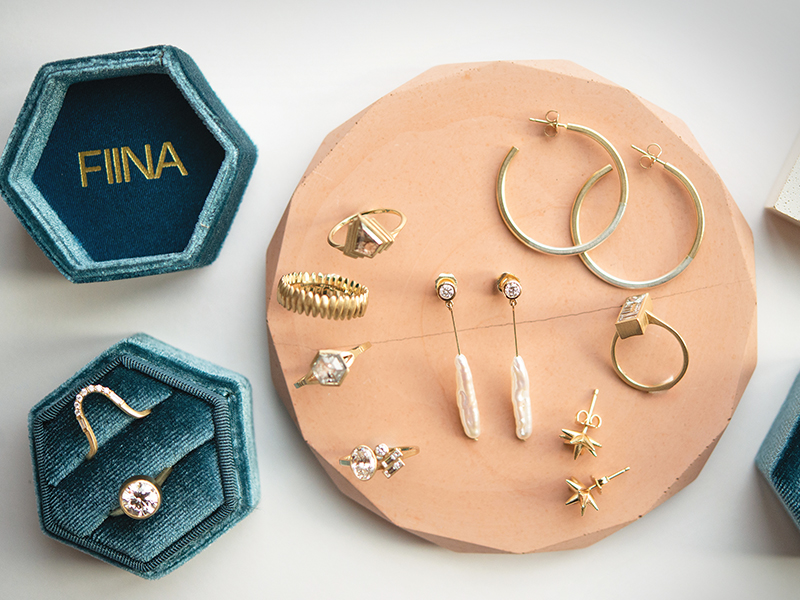
At Betsy and Iya, showcase displays are thoughtfully arranged to reflect each designer’s perspective and create an immediate point of connection for customers.
But sales staff are key, and that starts, says Suzy Lutjen O’Connor, director of retail and buying at Betsy and Iya in Portland, Oregon, with hiring. “We hire staff that is comfortable engaging with strangers in a meaningful way,” she says. “Staff that is excited about the products.” That excitement starts with the store’s story, encapsulated in their trademark tagline: “Beautiful things made by people who care.”
When Lutjen O’Connor starts talking about a new product line, she says, “I address both of those things: what I find beautiful about their work, what I think the talking and selling points are about their designs, and then what is the aspect that ticks the box of people who care?” This may include the charitable organizations that the designers volunteer for or contribute to, sustainability of the materials, or material re-use practices. Because the staff are already onboard with the store’s core philosophy, she says, “they want to tell people about brands.”
She then sends staff links to the designers’ websites or social media. “The staff is wonderfully curious,” she says. “They poke through [the website information], and they’ve read more than I have about the artist by the time I’ve wrapped up for the day.”
In the store, the conversation about designers’ stories can be started by small, printed cards that give customers information about where the designer lives, the materials they choose, and their inspiration. These “really grab customers’ attention,” says Lutjen O’Connor. “Knowing the names, knowing the locations of these designers is really meaningful to the customer experience.”
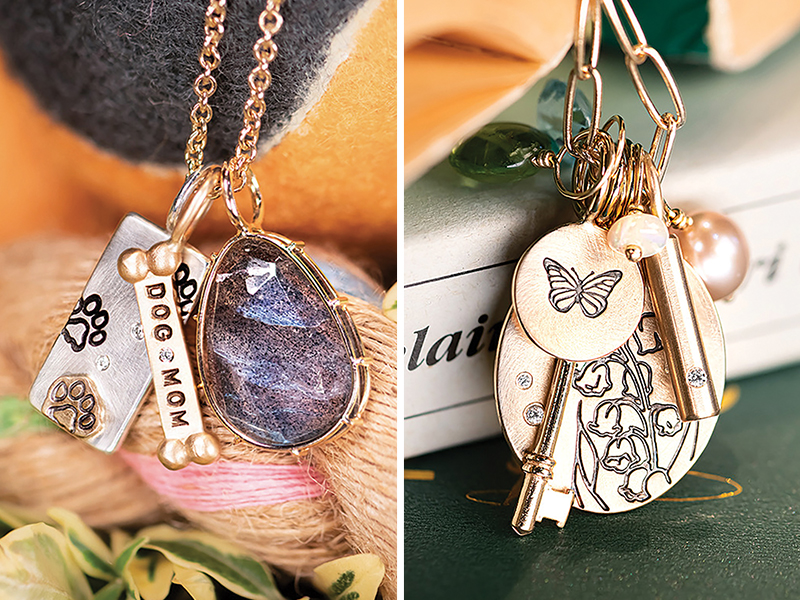
At Alchemy Jewelry, visual presentation is carefully developed to reflect a designer’s voice, using imagery and display to create context around the jewelry, as it does with work by Heather B. Moore.
But she also tries to keep staff thinking about the designers’ lines. Periodically she’ll email the team: “Tell me something in the store that you don’t gravitate toward when you recommend things to customers and tell me what’s beautiful about it. Tell me what you like about the lines. Tell me juicy adjectives that you would use to describe it and connect that to what you know about the designer.” The team also role plays, “where we’re just slowing down and really taking time to dive into a piece. Then that translates to the conversations that [they] have with consumers.”
Across town at Alchemy, Parker researches the designer’s story on their website, looking at photos of the work, reading articles written about the artist, and learning about the designer’s personal and professional history, their artistic philosophies, and the tone of their imagery. Later, she’ll call the artist or their representative to chat. “This is how you come across the stories they want to tell,” she says. “Sometimes they might not even know, but you will likely garner more from personal interaction than by the ‘About Us’ snippet on their website.”
Once she has a feel for the artist, she examines the work itself. “Is it made with a meticulous eye, a delicate hand, or something more primal or emotional?” she asks. She examines it under a microscope “to see first-hand how the designer’s point of view is literally hammered into their pieces.”
Having a sense of the “whole picture” of the artist’s story, Parker creates a visual representation of that story to display with the jewelry, as she has done with Heather B. Moore’s line.
“There are few among us who are not moved by a powerful picture, a striking scene, or a relatable anecdote,” she says. “Art is all-encompassing. It is meant to make you feel something. Adorning oneself is an act of artistic expression, and jewelry should be shown and discussed while indulging this constant subtext.”
It’s also important to keep designers’ work looking fresh. Though work is usually grouped by collection in the cases, using branded marketing when requested, “Sometimes we combine artists that complement or are contemporaries of each other. We clean and service all pieces routinely and make sure all tags are freshly tucked away to let the jewelry stand out and deliver a strong first impression.” Parker avoids stagnation by “moving collections next to other collections, creating stories and moments with layout and display, rotating designers for window time and feature cases. I develop marketing campaigns around these moves and features.”
Like Betsy and Iya, Alchemy has a relatively small staff, and Parker talks to them about the work. She urges them to “find something about a designer that resonates with you and share that with your team and customers. We are all different, and each of our colleagues will be drawn to a different talking point based on the lens through which they see the world.” She encourages them to use their own perspective when talking about the work. “It creates a beautiful diversity of interaction and cultivates sincere, organic moments for team-selling.”
To provide ongoing information about their designers, Betsy and Iya also have an email campaign called “Meet the Maker,” says Lutjen O’Connor. These emails include photos and more in-depth text discussing a designer’s work. They’re created by the marketing team from information gathered from the designers via a form Lutjen O’Connor sends them, in which she asks, “for very directed bits of information about their background and their techniques and what excites them.”
When a story is told through a third party, it takes a partnership between the designer and the retail outlet representing their work to ensure that the customer knows the artist’s story. It takes designers who know what story they want to tell and present it consistently through websites, informational cards, and face-to-face meetings with store staff and retail customers. It takes an enthusiastic buyer to transmit that story to enthusiastic sales associates who have been thoughtfully hired, and who exchange ideas about the different designers’ work among themselves. It takes thoughtful ways for the store to present the designers’ stories so that they remain fresh, surprising, and exciting to entice retail customers.
It takes curiosity about the work and the customers themselves.
“By staying curious, you will inspire yourself, and in turn, inspire your customers,” says Parker. “In a world starved for human connection, we are on the front lines of re-establishing what a meaningful interaction looks like. Therefore, the cornerstone of our storytelling philosophy lies at the intersection of curiosity and connection.”